When Highland Epoxy Flooring prices epoxy flooring in Banning, wind goes into the scope the same way slab moisture does — as a measurable site condition with a cost attached, not as weather somebody complains about on the day. Twenty years in resin flooring has taught us which local variables actually change a specification, and here that is the one.
This is not a general observation about the Inland Empire. The National Weather Service maintains a dedicated public forecast zone, CAZ065, named for the San Gorgonio Pass near this city, carved out of the surrounding zones precisely because the pass behaves differently from the valley on either side of it. This city’s center falls inside that zone; the neighboring city’s center does not.
Airborne grit landing in a wet film during open time is a defect nobody can polish out afterward. So the operational answers — how the door is set, when the approach gets wetted, where material is staged, which hours we work — are written into the plan before a crew leaves the yard rather than improvised once the flags start moving.
A Forecast Zone Named For This Pass
Two Zones, One Forecast Office
The forecast office in San Diego issues CAZ065, San Gorgonio Pass Near Banning, separately from CAZ048, the San Bernardino and Riverside County Valleys zone that covers the Inland Empire. Those are two distinct products written for two distinct wind regimes, and the boundary between them runs between this city and its immediate neighbor to the west.
That distinction is not decorative. When a contractor prices exterior or open-door coating work off a valley forecast, they are reading a document that was never written about this ground. We read the pass zone, and we read it the morning of the pour rather than the week before.
A Routine Day With No Advisory In Effect
The clearest illustration came on an ordinary mid-August day carrying no wind advisory at all. The pass zone forecast issued that morning put wind in every single period: west 10 to 20 mph with gusts to 35 mph becoming 30 mph overnight, and northwest 15 to 25 mph with gusts to 40 mph becoming 35 mph two nights later.
The same office’s same-hour forecast for the Inland Empire zone read differently. It described west winds around 10 mph with gusts to 25 mph in the evening becoming light, and light winds becoming west 10 to 15 mph with gusts to 25 mph in the afternoon. The valley calms down after dark. The pass, on that day, did not.
What an Advisory Day Looks Like
When the weather service does issue a wind advisory for this area, the language it uses is specific. Those advisories typically cite westerly winds between 25 and 35 mph with gusts between 50 and 60 mph, and they warn that blowing dust and sand may greatly reduce visibility, with difficult travel through the pass on the interstate.
We are careful about how we describe those numbers, because they are forecast values read on particular days rather than a long-run station average, and no such average was available to us. What we can say is that they are the conditions the local forecast office considers routine enough to write a standing product for, and we plan the work around them.
Looking for epoxy flooring closer to Lakeview? See Epoxy Flooring in Lakeview.
Wind as a Coating Specification Rather Than a Comfort Problem
The Failure Mode Is Contamination In Open Time
Every resin system has a period between the moment it hits the slab and the moment it stops accepting anything, and in that window the film is effectively flypaper. Fine grit, dust and organic debris that lands on it does not sit on top to be swept away later. It becomes part of the finished surface permanently.
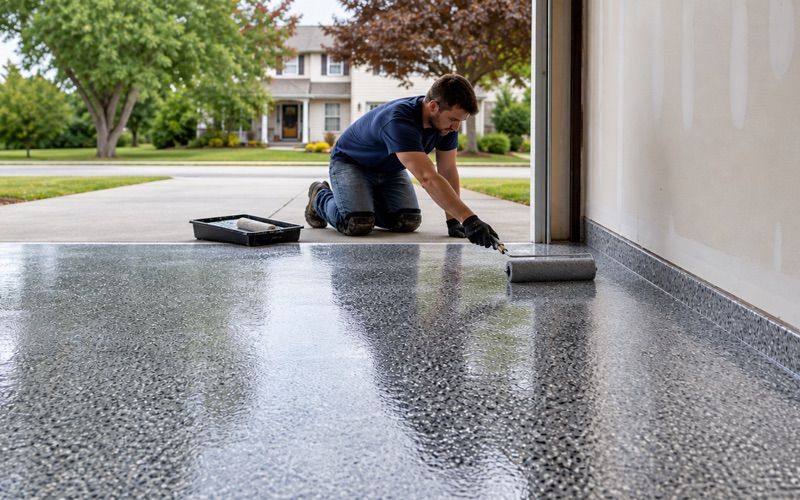
On a broadcast floor the problem compounds, because the flake or quartz broadcast is itself a controlled contamination step. Anything arriving alongside the aggregate lands with it, and no amount of topcoat hides the difference between a clean broadcast and a dirty one once the light comes across the floor at a low angle.
Solvent Flash and Skinning Before the Film Levels
The second effect is less visible and worse. Moving air across a wet film accelerates solvent flash and starts a skin forming at the surface before the coating underneath has finished flowing out. What you get is a film that has stopped leveling with roller texture and lap marks locked into it, and sometimes solvent trapped beneath a closed surface.
That is why we do not simply work faster on a windy day. Faster placement does not fix a film that is skinning; controlling the air across it does. The tools for that are physical, and they cost time on the schedule, which is exactly why they belong in the quoted scope rather than in a crew’s improvisation.
What We Actually Do About It
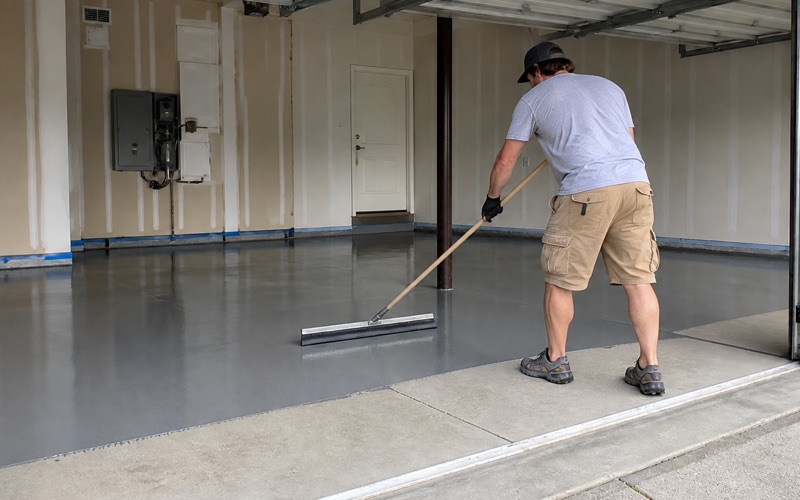
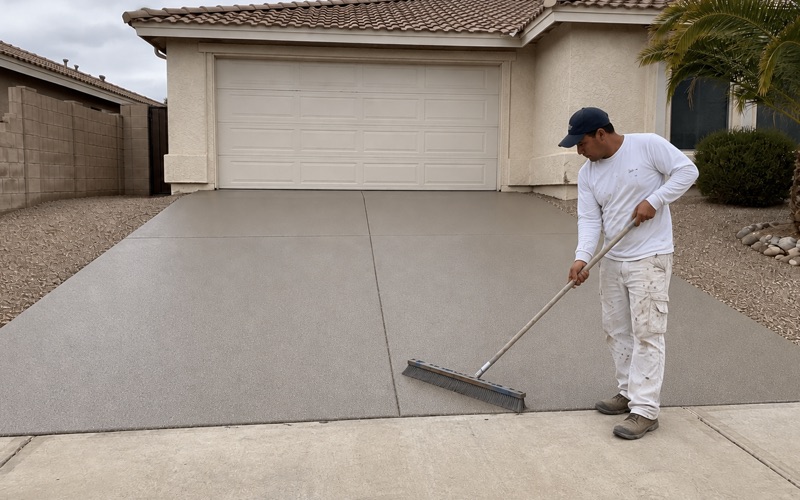
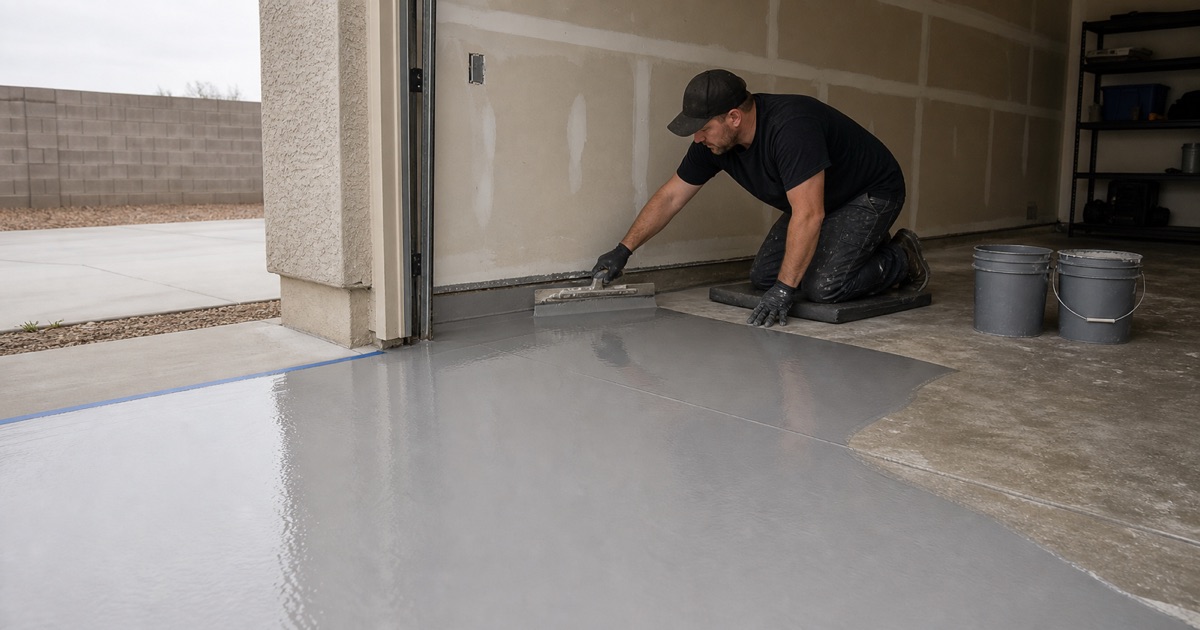
On a garage job the door comes down to a working gap and the gap gets sealed, so the building is ventilated deliberately rather than by whatever the pass is doing. The driveway and approach get swept and wetted before any broadcast step, and material is staged inside the structure rather than sitting open on a tailgate.
Exterior work gets tented or screened where the geometry allows it, and where it does not, the work gets scheduled against the wind maximum rather than straight through it. All of that goes on the proposal as a line the customer can see, because it is a real cost and hiding it inside a square-foot rate helps nobody.
Driveways, Patios and Pool Decks Where the Air Does Not Settle
Exterior Work Here Is Genuinely a Harder Job
The same coating applied to the same slab is not the same job in this city as it is on the valley floor, and we would rather say that than quietly price it identically and hope. An exterior driveway, patio or pool deck here has no building around it to control, which removes most of the tools listed above.
What is left is timing and sequencing. We split exterior placements into smaller sections so the exposed wet area at any moment is small, work the calm end of the daily curve rather than the middle of it, and accept a longer overall schedule in exchange for a surface that does not have the pass embedded in it.
Slip Resistance and What Sits On Top
Exterior surfaces bring a specification that garage floors mostly do not. Slip resistance around a pool deck or a patio is specified as a DCOF value rather than described with adjectives, and it comes from a deliberate aggregate broadcast and topcoat selection rather than from whatever texture the placement happens to leave behind.
Ultraviolet exposure decides the topcoat. An aromatic epoxy left as the wearing surface outdoors ambers and chalks, so the finish coat is a urethane or an aliphatic system chosen for color stability, and the customer is told which layer is doing which job so they know what is being maintained years later.
The Turbines Are the Corroboration
The wind farm running through this pass is not scenery on this page; it is evidence. As of May 2025 it held 667 operational turbines with roughly 628 to 656 MW of rated capacity and a maximum hub height of 300 feet, and it is sited here because the pass is one of the most consistently windy places in the country.
Nobody installs that much equipment on the strength of a pleasant breeze. The same reliability that makes the pass worth generating in is what makes a wet epoxy film here a managed risk, and treating those two facts as connected is simply an honest reading of where this work is being done.
What a Sun Lakes Owner Buys, and What the Rule Allows
A Quarter of the City Behind One Set of Gates
Sun Lakes Country Club is a gated 55-plus community of 3,300 single-family and attached homes developed between 1987 and 2003 by Pulte Homes, Presley, Robson Communities and Cavco, on 50 floor plans running from 850 to 2,627 square feet with two- and three-car garages. Banning Estates adds another 199 age-restricted homes built between 1980 and 2003.
Against 12,355 total housing units in the city, that is not a niche segment; it is close to the modal case. Entry windows, HOA common-area rules and the fact that one satisfied neighbor produces the next three calls all shape how the work gets scheduled here, and we plan around them rather than treating them as friction.
Low Odor, Slip Resistance and No Second Visit
That owner is not usually shopping for a showroom finish. What comes up on those estimates is odor during cure, whether the surface is safe underfoot when wet, whether the garage is usable again on a known date, and whether the job will ever have to be done twice. We specify against those four things.
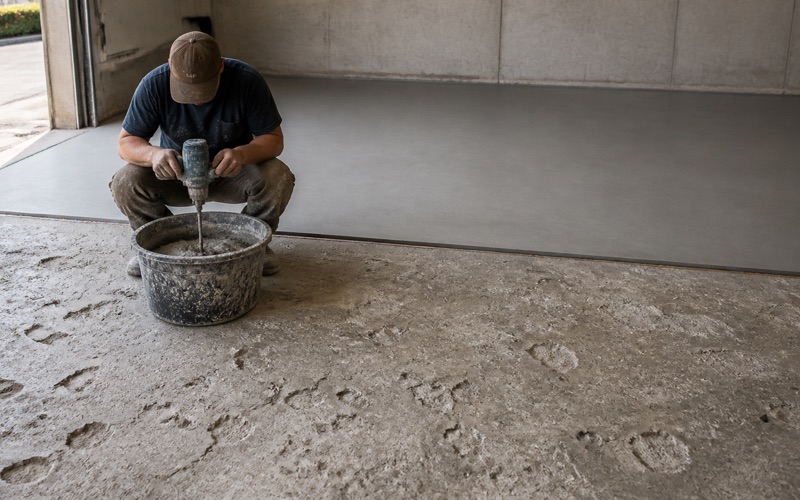
The last one is where moisture testing earns its place. Every garage slab we coat gets tested regardless of its age, because the residential code exempts garages from the under-slab vapor retarder requirement, which means a newer slab proves nothing on its own. The reading goes in the proposal before material is ordered, and the warranty exclusions are written out rather than implied.
Rule 1113 In a City That Is Almost Entirely Residential
South Coast AQMD Rule 1113 caps floor coatings at 50 g/L VOC and industrial maintenance coatings at 100 g/L, the two categories mutually exclusive by the rule’s own definitions, with subsection (c)(6) prohibiting applying or soliciting industrial maintenance coatings for residential use. This city sits in the non-desert portion of Riverside County, inside that district’s jurisdiction.
With 74.2 percent of housing single-family detached and a further 10.9 percent manufactured, nearly every job here is residential by that definition, including a hobby or workshop garage however industrial the wear on its floor. Permits run through Building & Safety at 99 E. Ramsey Street, Monday through Friday, 8:00 AM to 5:00 PM, through the city’s online portal.
- 20+ Years Experience
- Licensed & Insured
- Free Written Estimates