Highland Epoxy Flooring plans epoxy flooring in Calimesa around a reversal of the usual east-foothill story: elsewhere the problem is an old slab, and a meaningful share of the concrete in this city has barely finished curing. Roughly 22.7% of the housing stock is under fifteen years old.
Twenty years of coating garages across the inland foothills means we have met both problems, and the young one is misread constantly. A new slab is not an easy slab, it is a different slab, and the failure it produces looks identical to every other adhesion failure from above while having nothing to do with prep.
The second thing that shapes work here is who owns the house. A large part of the newer product is master-planned and heavily age-restricted, which changes the finish the owner wants, the hours a crew can run, and often who picks up the phone to schedule the job at all.
A Garage Slab Under Fifteen Years Old Is Not an Easy Slab
Twenty-Eight Days Is a Floor, Not a Finish Line
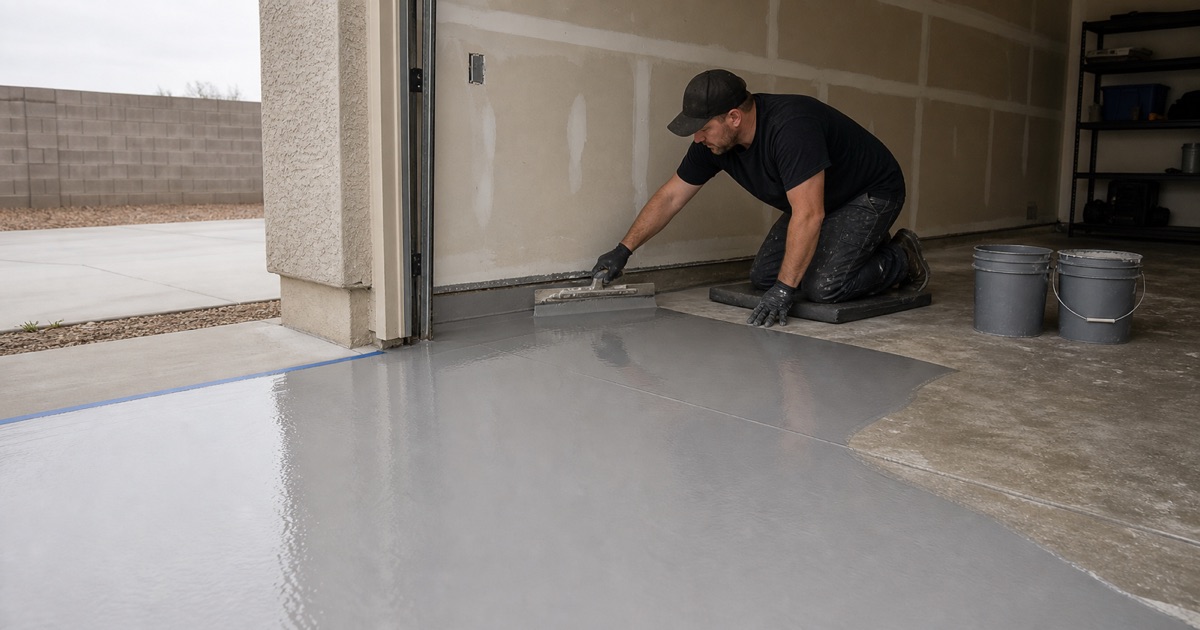
Concrete needs roughly twenty-eight days before it can carry a resinous coating at all, and that figure gets treated as a finish line when it is only a minimum. A slab in its first year is still giving up mix water, and the rate it gives it up at depends on the mix, the season it was placed in and what is underneath it.
On a modern tract slab there is an under-slab vapor retarder doing exactly what it was installed to do. It stops moisture passing down into the soil, which means the water has one direction left to travel, and the surface can read bone dry to a hand or a meter while the interior of the slab has not equalized at all.
In-Situ Relative Humidity on a Five-Year-Old Garage
That is why we run in-situ relative humidity probes to ASTM F2170 on a garage floor here even when the house is five years old and the concrete looks perfect. The probe reads at 40% of slab depth, which is where the answer actually is, rather than at the surface where the owner has been standing.
The threshold values for that reading live in ASTM F710, not in the test method, and ASTM D4263 — the taped plastic sheet — is indicative only, because a positive result fails a slab while a negative result proves absolutely nothing. Age is not evidence in either direction, which is why we test every slab regardless of it.
What the Reading Changes About the Proposal
The number goes into the written proposal before any material is ordered, and it changes the specification rather than just the confidence level. A high reading means a moisture vapor barrier primer under the system, or a delay, or a different chemistry — and it means saying so before a deposit is taken rather than after a floor bubbles.
We also write warranty exclusions out in full instead of publishing a headline term and leaving the conditions unsaid. Moisture-driven failure is the exclusion most coating warranties in this trade quietly carry, and a customer who has been handed a tested number and a stated exclusion knows exactly what they have bought.
Looking for epoxy flooring closer to Muscoy? See Epoxy Flooring Services in Muscoy.
Finish Choices in an Age-Restricted Garage
Slip Resistance and Glare Before Flake Color
A high-gloss floor that reads as premium to a thirty-five-year-old can read as a hazard to a seventy-five-year-old, and in an age-restricted tract that is not a marketing observation, it is the first question. Glare off a bright topcoat under a single garage bulb genuinely changes how a step edge is judged.
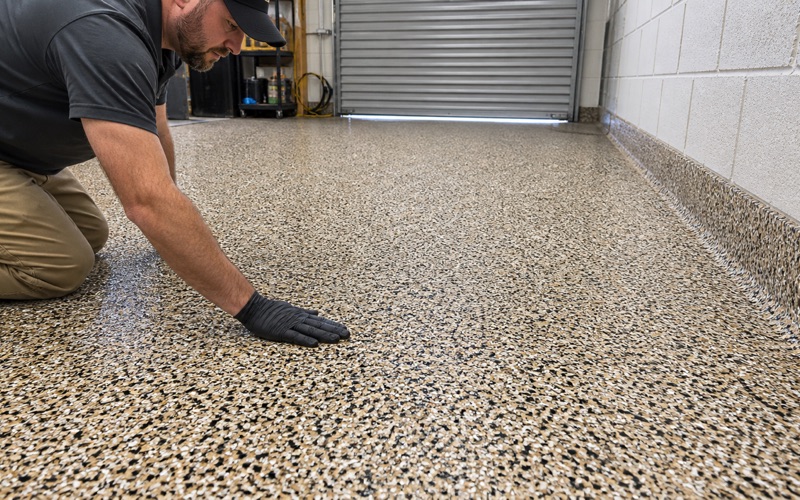
So the conversation starts with the finish’s behavior rather than with a color chart. A broadcast aggregate, a satin rather than a mirror topcoat, and a texture chosen for bare feet and walking aids as well as for tires are all ordinary requests here and all of them get priced as normal scope.
DCOF as a Conversation Rather Than a Footnote
Dynamic coefficient of friction is a real discussion in this city rather than a line in a data sheet. We talk about the wet condition, not the dry one, because a garage floor near a laundry hookup or under a car that has been driven through rain is wet at exactly the moment the surface matters most.
Broadcast rate is the lever that sets it. More aggregate buys traction and costs a little cleanability; less buys a smoother surface and gives some traction back. That trade-off belongs to the owner, stated in plain terms before the topcoat is mixed, rather than settled quietly by whoever is holding the hopper.
An Owner Who Is Home While the Floor Cures
A retired owner at home during the workday is an advantage on this kind of job. Access is straightforward, questions get answered as they arise, and the cure period can be supervised — nobody drives onto a floor at hour twenty because they forgot what they had been told on Tuesday.
It also raises the standard for how the site is left each evening. Containment, dust control and a clean, walkable path back into the house matter more when the customer is living beside the work for three days, and we plan the day around that rather than treating it as an inconvenience.
Getting a Crew and a Grinder Into a Master-Planned Tract
Gates, Guest Access and a Truck With a Trailer
The master-planned tracts approved here before 2007 — Summerwind Trails, Mesa Verde, JP Ranch and Calimesa Springs among them — have come in slowly, and the ones that have arrived carry the access layer that comes with planned development. Where a community is gated, a truck and a trailer need clearance before they need a parking space.
We handle that in advance: guest access arranged, vehicle and trailer dimensions given, and an arrival window agreed rather than assumed. A grinder and a dust-extraction rig that cannot get past an entry gate at 7:00 AM has cost the customer a day, and that is an avoidable failure rather than an unlucky one.
Work Hours, Staging and Who Schedules the Job
Planned communities commonly restrict work hours, and they commonly restrict what can sit in a driveway or on a street. Equipment staging, a dumpster or a material trailer parked overnight are all things to confirm rather than discover, and the answer varies from one association to the next.
The practical consequence is that the scheduling call here is often with a management company rather than with the homeowner. We are comfortable working that way, but it lengthens the front end of a job, and we would rather build that time into the schedule than promise a start date that a third party has not yet agreed to.
Compliance Before the First Grind
Calimesa requires a city business license of any business entering the city to conduct business, and the ordinance names contractors and delivery companies based in other cities specifically. A crew driving in from the hub needs one, which is a checkable item rather than a reassuring phrase.
Product selection is governed by SCAQMD Rule 1113: floor coatings capped at 50 g/L VOC, industrial maintenance coatings at 100 g/L, and subsection (c)(6) prohibiting anyone from applying or soliciting an industrial maintenance coating for residential use. In a city this residential the 50 g/L category is the operating category, and an industrial product cannot be argued into a tract garage on durability.
Park Common Buildings and the Rest of the Stock
Resident-Owned Manufactured Homes and Their Carports
Roughly 1,117 housing units here are manufactured homes, and the ownership pattern behind that number is unusual enough to state: 988 of them are owner-occupied against only 14 rented. That is a resident-owned pattern rather than a rental-park one, and it means the person living in the home is the person making decisions about it.
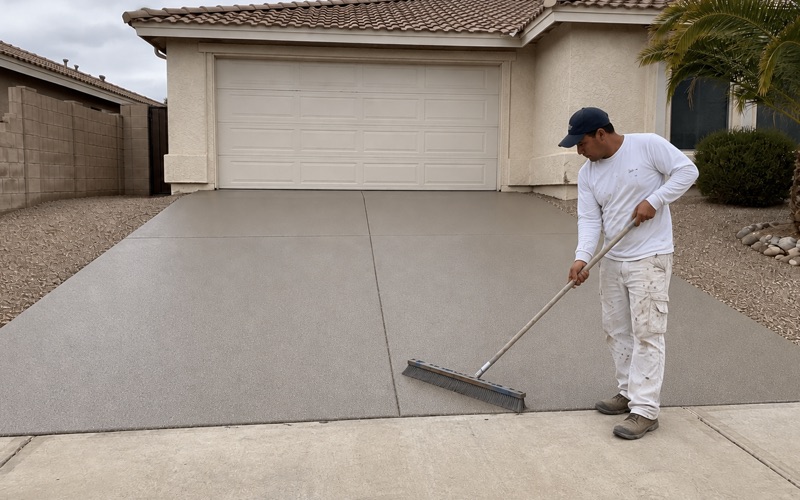
Those homes carry carports rather than enclosed garages, which puts them outside the garage-coating market as it is normally described. A carport slab is still coatable as exterior work — ultraviolet-stable system, broadcast aggregate for traction, drainage confirmed first — but nobody should be quoted a garage floor that does not exist.
Clubhouse, Laundry and Activity-Room Floors
What the parks do have is common buildings, and those floors are squarely in this trade. Plantation on the Lake alone is 557 home sites at Desert Lawn Drive with two pools, two spas, a library, a billiard room and a craft room, and every one of those spaces sits on a slab that gets walked, spilled on and cleaned constantly.
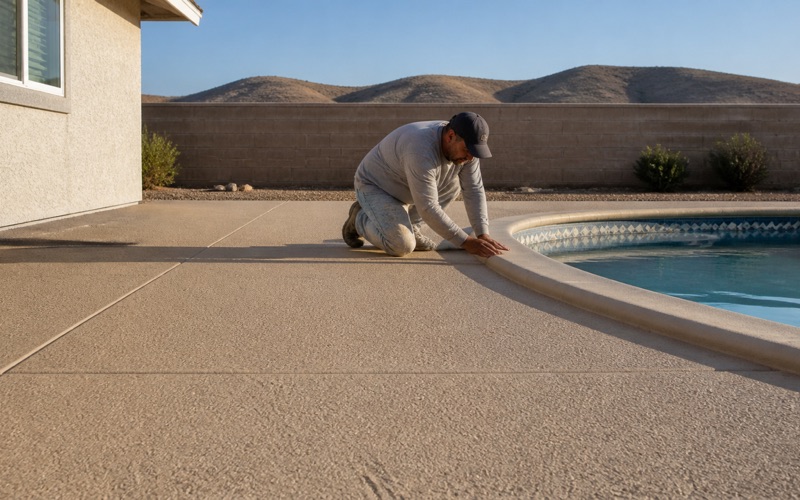
Clubhouse and activity-room floors want a seamless, cleanable build with an integral coved base and a texture chosen for walking rather than for photographs. Pool decks want the opposite priority again: ultraviolet stability, heat behavior underfoot and genuine wet traction, specified for the surface people cross barefoot.
Elevation, Slab Temperature and a Four-Day City Hall
The city averages around 2,392 feet with terrain running from roughly 2,300 to 3,500, so two garages across town can sit at different slab temperatures on the same morning. The diurnal swing matters more than the average: a slab warm at 2:00 PM is cooling by early evening, and concrete outgassing as it cools pushes pinholes and bubbles up through a wet film.
The rule we work to is to place on a rising or steady slab temperature, never a falling one, and to read the slab rather than the air. On permits, the Community Development counter is open 8:00 AM to noon Monday through Thursday with no Friday counter at all, so applications go through the city’s OpenGov portal as the practical route.
- 20+ Years Experience
- Licensed & Insured
- Free Written Estimates