Highland Epoxy Flooring treats epoxy flooring in Canyon Lake as a job that starts at a gate rather than at a driveway, because a grinder trailer does not come in the way a passenger car does. In twenty years of resin flooring we have learned that the access plan is the schedule, and nowhere in this region is that as literally true as it is here.
The community is privately gated with three staffed entrances, and the association’s own access rules keep commercial, oversized and recreational vehicles out of the Main Gate on Railroad Canyon Road entirely. A box truck, a dust extraction rig or a trailered planetary grinder has to route to the East Gate off Goetz Road or the North Gate off Greenwald Avenue instead.
None of that is a formality with a friendly workaround at the booth. Entry is pre-authorized by the homeowner rather than arranged by the contractor, working hours are a written rule with a fine schedule behind them, and the property owner is the one held responsible for how a contractor behaves. So we plan the whole job around those conditions before we quote a date.
Getting a Crew and a Trailer Through the Right Gate
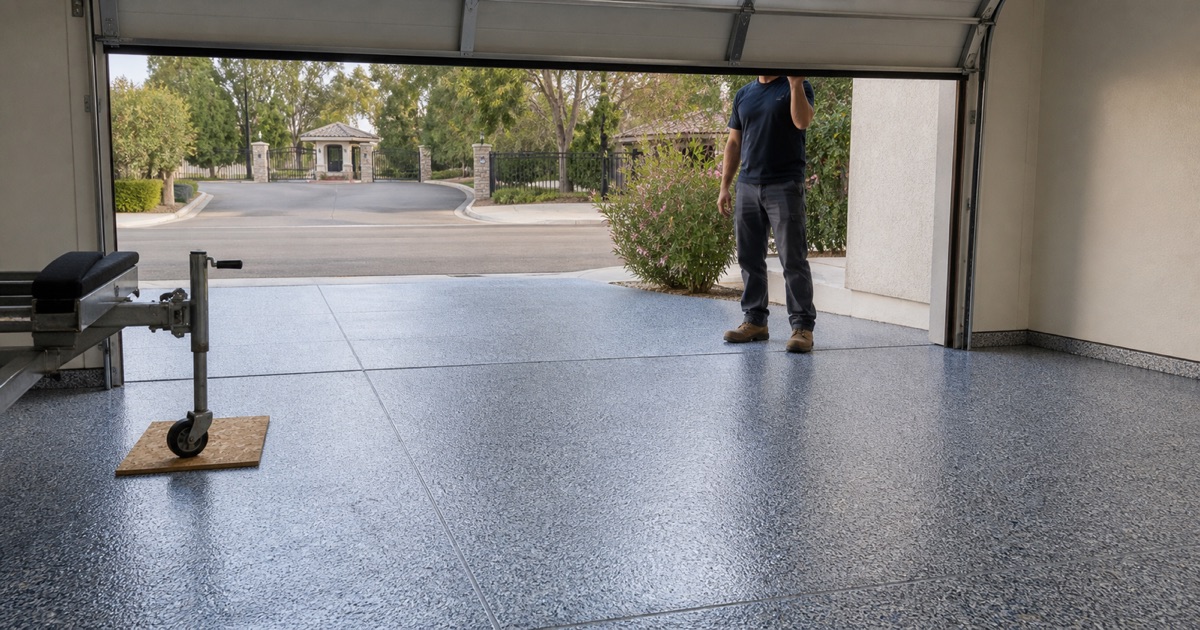
Three Gates, and Only Two of Them Are Ours
The association states its position plainly: access is permitted only to residents and their guests, and all commercial, oversize and recreational vehicles must use the East and North Gates. At the Main Gate, commercial and oversized vehicles are not allowed entry at all, which makes it the wrong instruction to give a driver regardless of how convenient the map looks.
That is a genuine drive-time difference rather than a courtesy note, and it goes on the dispatch sheet as a routing instruction with the gate named. A crew that arrives at the wrong entrance with a loaded trailer does not get waved through after a phone call; it turns around, and the morning of a cure-sensitive job is not a good morning to lose.
The Homeowner Calls Us In, Not the Other Way Around
Contractors are classified as Service Providers under the association’s GoAccess system, and the member is the one who pre-authorizes them through the app, the website or the 24-hour line. The driver then presents a valid driver’s license at the gate. Access under that authorization runs ten days, and it does not extend to any of the community amenities.
Service provider entry is additionally restricted on Memorial Day weekend, the Fourth of July, Labor Day, Halloween, the Parade of Lights and New Year’s Eve. A multi-day cure laid across one of those dates without checking is exactly how a crew ends up unable to reach a floor it has already started, so we check the calendar against those dates first.
The Windshield Pass Is Separate From the Gate Call
Rule PC.7.4b sits alongside the visitor system rather than inside it. It requires contractors to obtain passes through Member Services and to display the worker’s pass conspicuously on the vehicle windshield, with a fine of $100 per occurrence when that is not done, and PC.7.4 makes the property owner responsible for the contractor’s compliance.
The same rule bars crew vehicles from bringing family, friends, pets or any sporting or fishing equipment into the community. We brief crews on that before a first visit, because a fine landing on a customer for something our truck did is not a cost we are willing to pass along to somebody who hired us to improve their house.
Looking for epoxy flooring closer to Redlands? See Epoxy Flooring in Redlands.
Working Hours Are a Rule, Not a Courtesy
The Published Window
Rule PC.7.3g sets working hours seasonally and applies them to contractors, owners and residents alike. From October 1 through April 30 the window is 7:00 a.m. to 6:00 p.m.; from May 1 through September 30 it opens an hour earlier at 6:00 a.m. and still closes at 6:00 p.m.; Saturdays run 7:00 a.m. to 6:00 p.m. year round.
Rule PC.7.3h closes the rest. There is no work at all on Sundays or on association holidays, listed as New Year’s Day, Memorial Day, the Fourth of July, Labor Day, Thanksgiving Day and Christmas Day. The fine schedule attaches $100 to a first offense and $200 plus a stop-work order to a second, which is a real risk to a job in progress.
Laying a Multi-Day Cure Inside That Window
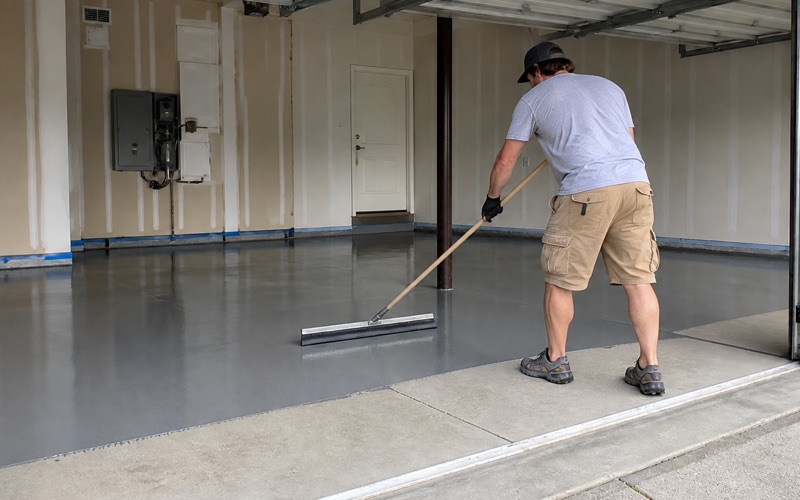
Coating work is not a single shift, and the constraint is not how long we are on the slab but how the cure sequence falls across a calendar with a hard stop in it. A base coat placed late on a Saturday afternoon has its recoat window running through a Sunday when nobody may work, and that has to be designed for rather than discovered.
So we lay the sequence out backwards from the finish coat, count the available legal days, and only then give the customer a date. Where the sequence will not fit cleanly, we say so and either move the start or select a system whose recoat window fits the gap, which is a specification decision rather than a scheduling excuse.
The Six O’Clock Summer Start Is Worth Having
The earlier summer opening is a genuine advantage on this trade rather than only a restriction, because slab temperature drives pot life hard. On one published product it runs roughly sixty minutes at 55 degrees F and drops to about twenty minutes at 95 degrees F, so the coolest legal hour of a summer day is the hour worth having.
One more question belongs in the same conversation. Whether a garage or driveway coating specifically requires an Architectural Control Committee application is not something we will assert either way, since a garage is not habitable space and a driveway is not softscape. We ask Planning & Compliance before commencement, because approval is required before work starts and the fines for skipping it are steep.
An Oil-Stained Driveway Is a Citable Condition Here
PC.4.11 and What It Actually Says
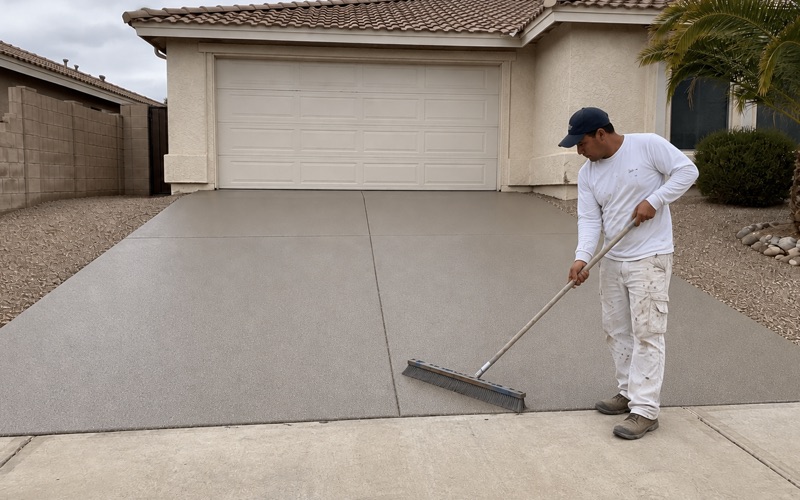
Rule PC.4.11 requires that driveways be maintained in good repair and free from cracks that create a lifting or tripping hazard, and free from grease, oil, stains and other debris. The association’s fine schedule lists that rule at $100 per month, which turns a maintenance standard into a recurring cost rather than a one-time notice.
In most cities a stained driveway is a neighbor’s aesthetic complaint and nothing more. Behind these gates it is a citable condition with a running penalty attached, and that changes the buying trigger entirely. The owner is not comparing a coating against doing nothing; they are comparing it against a monthly charge that does not stop on its own.
What an Oil-Soaked Slab Needs Before Anything Goes On It
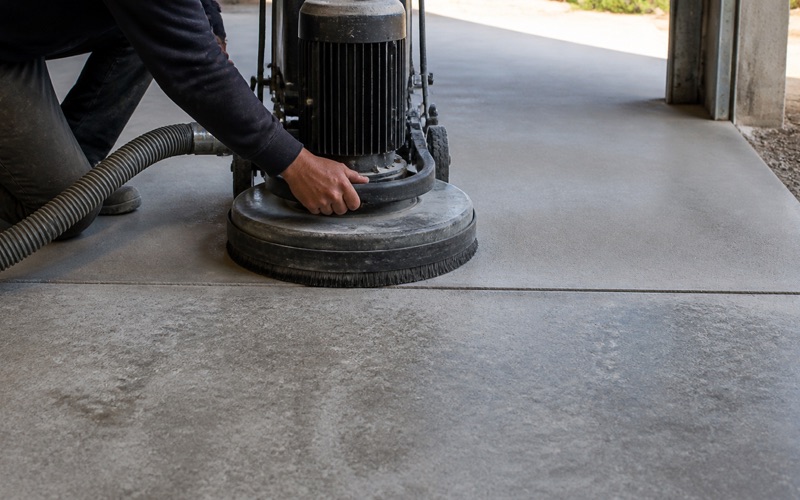
Oil that has been sitting in concrete for years is not a surface condition, and degreasing alone does not solve it. The contamination has migrated into the pore structure, so the only reliable answer is mechanical: grind past it, verify the cut, and in badly saturated areas repeat rather than assume one pass has reached clean concrete.
The profile gets opened with diamond grinding to a specific ICRI concrete surface profile, on a scale running CSP 1 through CSP 10, and that number is stated on the proposal. Diamond segment bond is matched to the hardness of the slab in front of us, on the rule that hard concrete takes a soft bond, rather than running one grit sequence everywhere.
Boat Pads, RV Parking and the Two-Car Requirement
The coatable surfaces here are broader than a garage bay. Rule PC.5.11 requires every dwelling to have an enclosed garage capable of at least two-car storage, with Tract 3961 named as the exception, and PC.5.10 allows only concrete or paver driveways while explicitly contemplating additional parking for an RV, trailer or boat.
Rule GR.5.3f goes further, requiring that all storage or parking of wheeled vehicles sit on concrete slabs or runners designed and approved for that purpose, and GR.5.3b forbids parking on an unpaved portion of a property. Purpose-built boat and RV pads are therefore normal here, and a trailer tongue and a wet hull are a real duty cycle on that concrete.
Dust, Gutters and the Slab Underneath All of It
Job Site Conditions Are Written Into the Rules
Rule PC.7.3b forbids storing materials, tools, supplies and equipment on the street, and requires the job site, streets, gutters and curb area to be kept clean, at $100 per day. Rule PC.7.3d requires that dust be controlled during construction. On a grind-and-coat job those are contract conditions rather than points of differentiation.
We work to shrouded tooling with vacuum extraction as the baseline, contain the work area, and stage material inside the garage rather than along the curb. The association maintains those streets itself, so slurry or grinding dust carried into a gutter is damage to the association’s own asset, and it is the customer who receives the notice.
The Rule Text We Work From, and Why We Confirm It
The rule numbers and fine amounts above come from a published version of the association’s rules and regulations, and revisions have been adopted since that version was issued, including at least one affecting the driveway rules. We do not present any of it as the current consolidated rule book.
What we do instead is confirm the operative requirement with Planning & Compliance before a job is scheduled, and we tell customers that is what we are doing. A contractor quoting rule numbers with total confidence and no verification is a contractor who will eventually quote one that has changed underneath them.
A Consistent Slab, and What Rule 1113 Allows
The housing stock here is unusually uniform. No unit predates 1960, 72.1 percent of all housing was built in the 1970s and 1980s, and 87.1 percent is single-family detached. That consistency means the scope is predictable, and it also means we do not lean on slab age as an argument for anything, because the age argument does not apply here.
Moisture testing still runs on every job, for slab-specific reasons rather than era ones, with the reading written into the proposal before material is ordered. And South Coast AQMD Rule 1113 governs the product: 50 g/L VOC for floor coatings against 100 g/L for industrial maintenance, mutually exclusive categories, with subsection (c)(6) putting the industrial category out of reach on residential work.
- 20+ Years Experience
- Licensed & Insured
- Free Written Estimates