Highland Epoxy Flooring writes almost the same scope of work for epoxy flooring in Cherry Valley job after job. The repetition is not laziness on our part; it is what happens when nearly a whole community’s concrete went down inside one stretch of years and nothing since has replaced it.
About 85.2% of the housing here predates 1980, and the 1970s alone account for 27.5% of it. Twenty years of grinding floors in this community means we can describe the slab, the defect list and the likely history of what has already been painted on it before the truck leaves the yard.
That sounds like a shortcut and it is the opposite of one. A job that repeats is a job that can be scoped precisely rather than approximately, which is why our estimates here carry a fixed prep specification instead of a range and a hedge.
One Garage Job Repeated Across a Whole Community
Slabs From a Single Decade
The 1970s put 739 housing units on the ground here, more than any other decade, with the 1980s adding another 563. Together those twenty years account for close to half of everything built in this community, and only 121 units have gone up since 2010 to dilute the pattern.
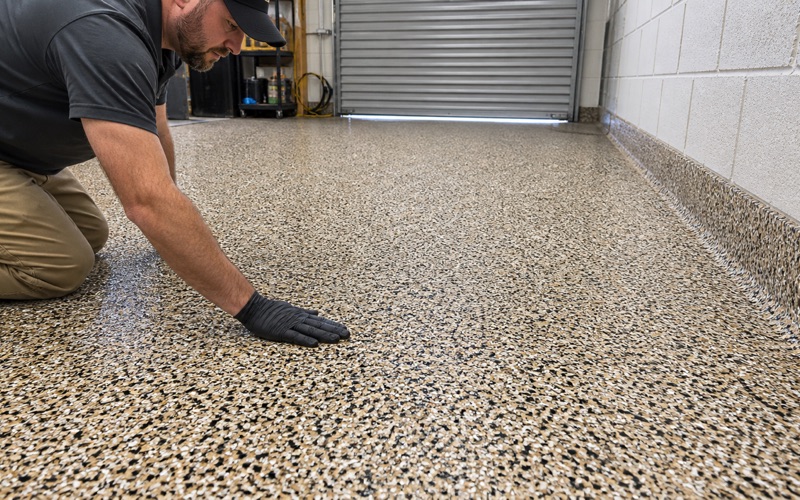
So the modal job is unusually specific: an attached two-car garage slab somewhere between forty-five and sixty-five years old, poured to the tract standard of its day, and used continuously ever since by owners who have mostly stayed put. That is a narrow target, and narrow targets are cheaper to hit properly.
The Same Four Defects, In Roughly the Same Order
What we find on those floors barely varies. Control-joint cracking that has usually stopped moving, settlement and lipping where the slab meets the driveway at the door opening, edge curling along the exposed lip, and oil worked into the concrete in front of where the engine has sat for decades.
Each of those has a settled answer. A crack that has stabilized is repaired and coated over; one that has not is detailed to keep moving rather than bridged and hoped for. The threshold lip is ground down or ramped, the curled edge is cut back, and the oil-saturated area is drawn out and profiled harder than the field around it.
Why the Previous Coating Is Usually the Real Scope
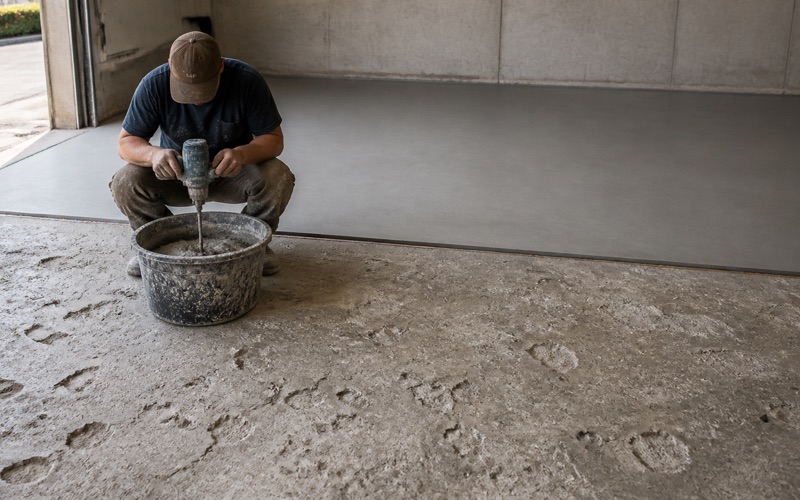
The fifth thing we find, and often the largest single item, is a coating already on the floor. A one-part paint or a store-bought two-part kit rolled onto an unprepared slab, sometimes twice, now failing in the wheel paths while remaining stubbornly attached everywhere else.
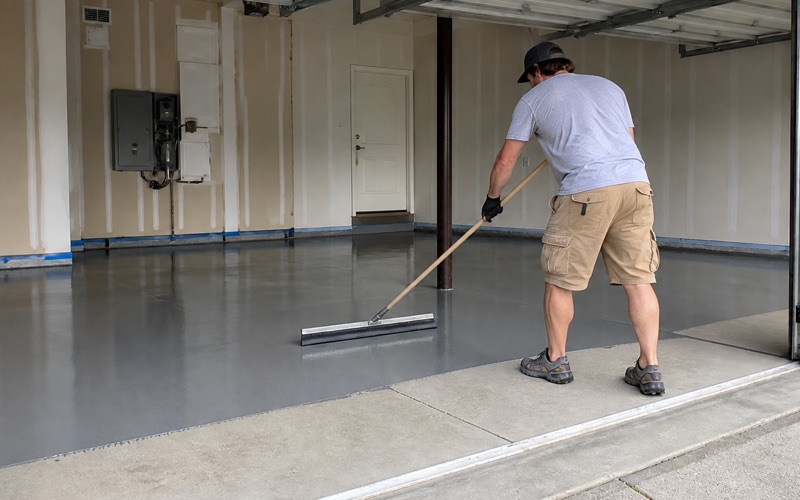
We quote removing it as its own line of work rather than folding it into a square-foot rate, because that is what it costs and hiding it only produces an argument later. On a good many of these jobs the removal is more than half the labor, and the coating that follows is the straightforward part of the day.
Looking for epoxy flooring closer to March ARB? See Epoxy Flooring in March ARB.
Scoping One Case Properly Instead of Ten Roughly
A Grit Sequence That Does Not Get Reinvented
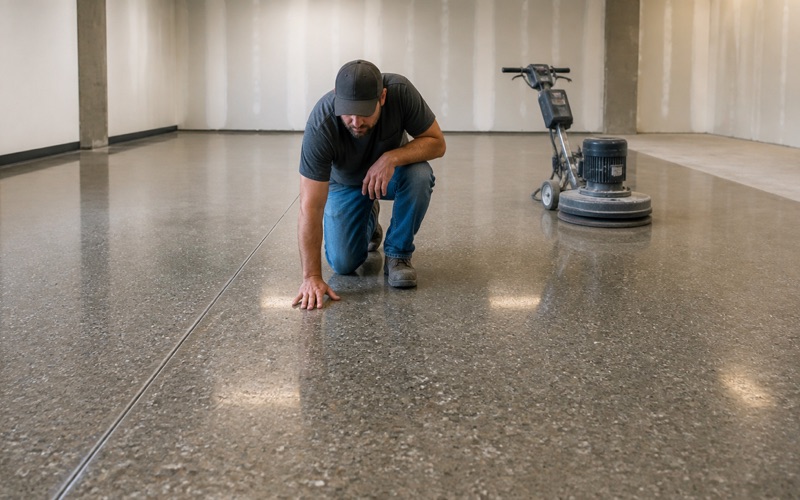
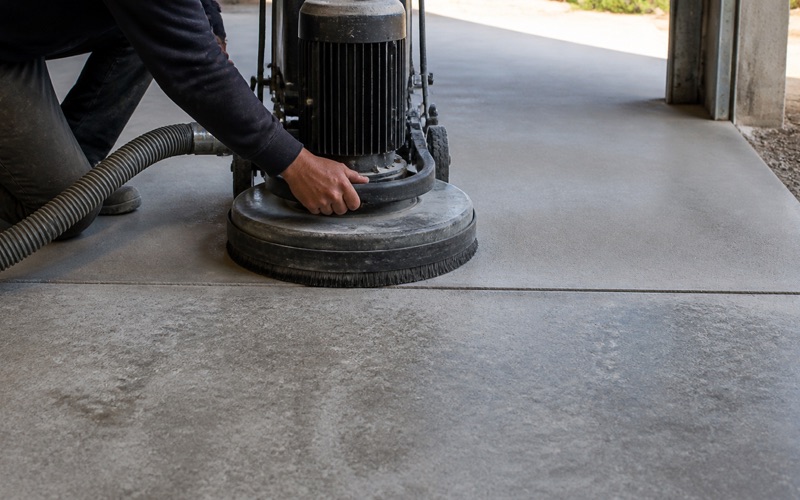
Because the substrate repeats, the prep sequence can be settled rather than improvised. We know roughly where a coarse pass has to start on this stock, how many passes it takes to get through a typical failed film, and what the surface looks like when it is ready — and that knowledge is worth more than any single piece of equipment.
The end point is still named rather than eyeballed. The finished profile is written into the proposal as a target ICRI concrete surface profile, generally CSP 3 for a thin-film system and CSP 4 where a heavier build goes down, opened by diamond grinding and never by acid etching.
PCD Tooling and a Bond Rule Most People Get Backwards
Coating removal runs on PCD tooling rather than on a diamond intended for profiling, which is the difference between taking a film off in one controlled pass and burnishing it into the surface. Using the wrong tool on a forty-five-year-old floor makes the next step harder rather than easier.
The counterintuitive part is bond selection. Hard concrete takes a soft bond and soft concrete takes a hard one, which is backwards to most people’s instinct, and getting it wrong produces either a glazed segment that stops cutting or a segment that wears away in an afternoon. We choose it against the slab we are standing on, not against the last job.
What a Known Day Plan Does to the Estimate
The practical payoff of a repeating case is that crew size, equipment list and the number of days on site are known when the proposal is written. There is very little discovery risk left to price, so the number in front of the customer does not need a contingency built into it to cover a surprise that has not happened here in years.
It also means we can be specific about disruption. When the garage has to be cleared, when the vehicle can come back in, what the return-to-service hour actually is for the product going down — those are commitments rather than estimates when the job has been run this many times.
The Numbers That Change the Size of This Market
Homes With a Carport Instead of a Garage Slab
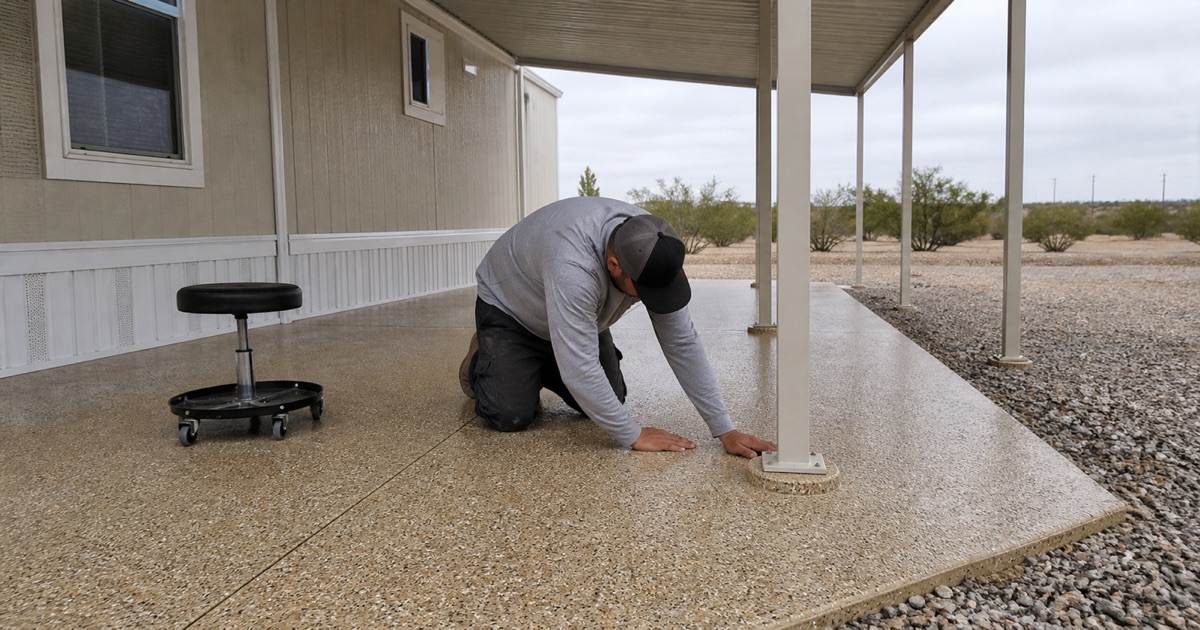
The largest single correction anybody sizing this market has to make is that 805 of the community’s 2,690 housing units are manufactured homes, and those carry carports rather than enclosed garage slabs. That is close to three in ten homes with no garage floor to coat at all.
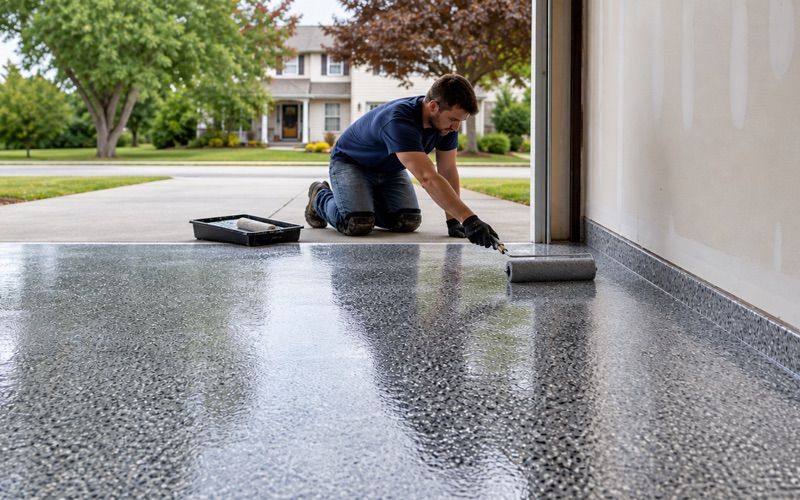
We say so rather than quoting a floor that is not there. A carport slab is still coatable, but it is exterior work with a different specification — ultraviolet stability, a broadcast aggregate for wet traction, and drainage confirmed before anything is written, because a slab that ponds will undermine whatever goes on top of it.
Owner Stock in Exactly Two Forms
Published tenure-by-structure data puts the real addressable pool at 1,523 owner-occupied single-family detached houses. Not the headcount, not the total unit count, and not the 1,866 detached units including rentals — the pool is the owner-occupied detached figure, and it is a small, specific number.
The other striking thing in that table is what is absent. Owner-occupied housing here consists of exactly two categories, detached houses and manufactured homes, with essentially nothing else, and the estimate records zero units in every structure class from three units upward — so there is no common-area or property-managed work in this community to pursue.
The Older Tail Where Moisture Becomes the Question
About 519 units predate 1960, which is a real tail rather than the general case, and it is where slab moisture stops being a formality. We test every garage slab regardless of age anyway, because the California Residential Code exempts garages from the under-slab vapor retarder requirement and age alone therefore settles nothing.
The reading comes from in-situ relative humidity probes to ASTM F2170 and goes into the proposal before material is ordered, with the threshold values taken from ASTM F710 rather than from the test method. Our warranty is written with its exclusions visible, including what happens when moisture drives a failure — the exclusion most warranties in this trade leave unstated.
Working at the Top of the Pass
Slab Temperature at Nearly Three Thousand Feet
At around 2,980 feet this is the highest point on the pass, and that puts an unheated garage slab on the cold side of the problem through the winter. Concrete lags air temperature by hours, so a January morning that feels workable can leave the slab below where a product will cure properly.
Summer runs the other way, hot enough at this elevation to compress pot life sharply and shorten the recoat window with it. The rule we work to is that the product decision follows the slab thermometer and the dew point rather than the calendar, with early starts and small batches through the hot months.
Hospitality and Event Floors Rather Than Industry
The commercial work available here is not industrial. The two named anchors are both historic and event-oriented: Highland Springs Ranch and Inn on Highland Springs Avenue, established in 1884 and Riverside County’s first historical landmark, with an organic farm, restaurant, inn and camp; and the county-operated Edward-Dean Museum and Gardens on sixteen acres.
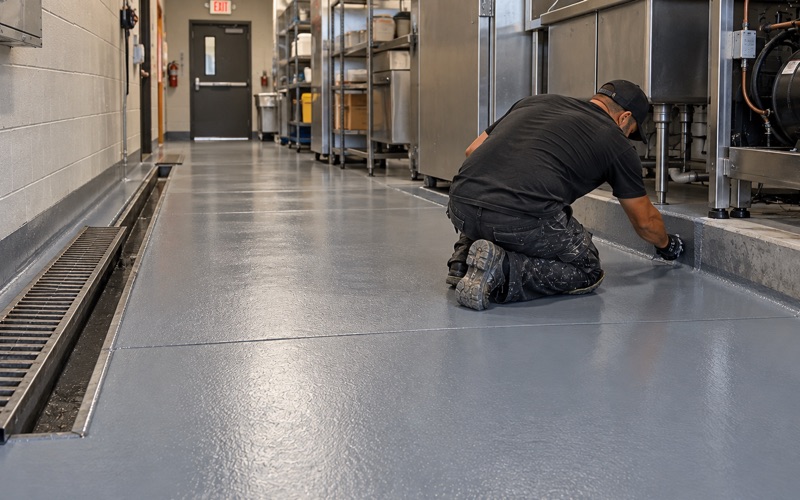
Floors in that world are kitchens, prep and dish areas, event spaces and utility rooms, and they take heat, grease and washdown rather than forklift traffic. The heavy industrial floor work in this corridor sits south of here and outside this community entirely, and we would rather say that than imply otherwise.
County Permits and Which Product Is Legal
There is no city hall here. This is an unincorporated community, so the Riverside County Department of Building and Safety within the Transportation and Land Management Agency is the permit authority, filing through the county’s online portal, with most permits created by appointment at the county’s permit assistance center.
Product category is set by SCAQMD Rule 1113, which caps floor coatings at 50 g/L VOC and industrial maintenance coatings at 100 g/L, with subsection (c)(6) prohibiting anyone from applying or soliciting an industrial maintenance coating for residential use. On a community this residential, the 50 g/L category is the category, and durability is not an argument for leaving it.
- 20+ Years Experience
- Licensed & Insured
- Free Written Estimates