Highland Epoxy Flooring has been putting epoxy flooring in Colton garages, warehouses and plant rooms for more than 20 years, long enough to know that a large share of the concrete in this city is older than most of the products sold to coat it. That single fact drives almost every decision we make on a Colton bid.
Nearly two slabs in five here predate 1970, and a large part of that layer goes back before 1940, to a time when a garage floor was placed by hand on bare grade. Against that sits a single 1980s decade that produced the largest block of housing in the city and a completely different animal.
So the first thing we settle is which half of Colton an address belongs to. The prep, the moisture risk, the access and the price all move together, and a quote written for one half and handed to the other half will be wrong about half the time.
Two Cities’ Worth of Slab Inside One Boundary

The Original Detached Garage in South Colton
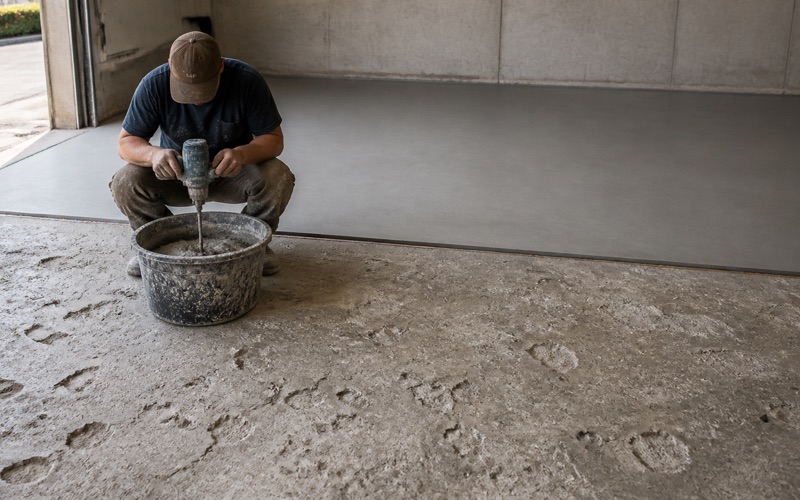
Of 17,856 housing units in this city, 5,296 were built before 1960 and 1,431 of those predate 1940, and that is the pool these floors come out of. A slab poured in the 1930s for a detached garage was placed by hand, on grade, with no vapor retarder under it and usually no reinforcement worth the name. Eighty-odd years later the surface is carbonated, the edges are broken, and there is often more than one generation of patching in it.
Prep on those floors is patient work. Cracks get routed and filled rather than skimmed, spalled areas get rebuilt before anything decorative is discussed, and we set expectations early that a slab this old will read as an old slab even under a good system. Honest expectations set at the estimate stage are cheaper than an argument at handover.
The 1980s Tract Bay in the North of the City
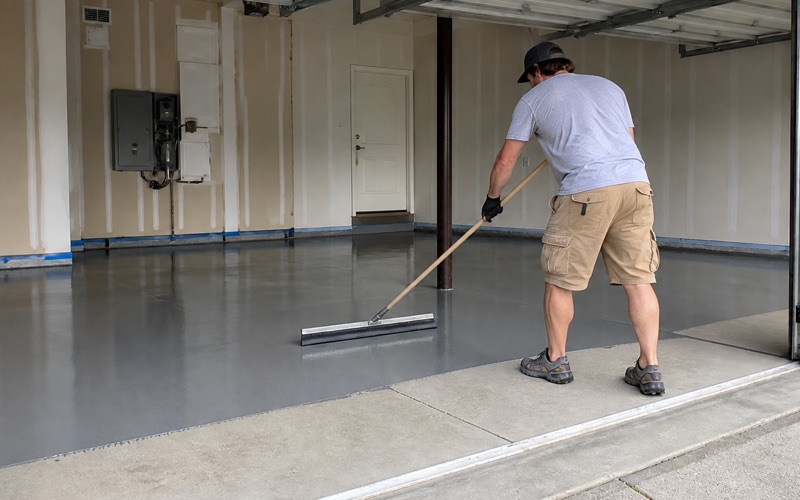
The 4,539 units built between 1980 and 1989 are the other Colton, and their garages are the straightforward end of our work: attached, square, power-troweled, mostly level, with control joints still doing their job. A great many of them have never had anything down at all, which removes the single most expensive variable from the estimate before we start.
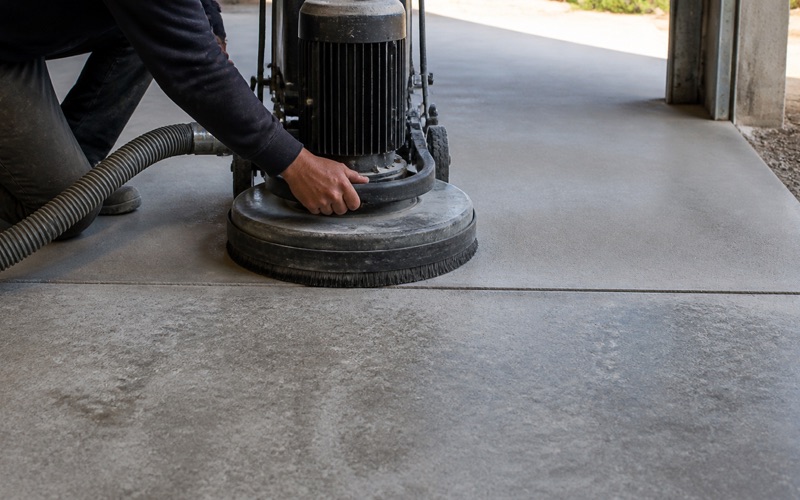
The catch is that a tight machine-troweled surface will not accept a coating without a real mechanical profile cut into it first. We open that profile by diamond grinding to a named ICRI concrete surface profile, never by acid etching, and we match the diamond segment bond to the hardness of the slab rather than running one grit sequence across every job in the city.
Why One Number Cannot Cover Both
The two halves differ in prep hours, in moisture risk, in what has to come off first, and in whether a grinder and dust-extraction rig can even be parked near the door. A price built on the 1980s stock under-quotes South Colton badly, and a price built on South Colton makes us uncompetitive on the newer tracts.
Which is why we walk the slab before quoting rather than pricing off an address and a square footage. It costs a visit and it saves a change order, and it is also where removal of a failed prior coating gets identified and written up as its own line of work. A one-part paint or a big-box kit has to come off mechanically before anything new bonds, and that is hours, not a formality.
Looking for epoxy flooring closer to Grand Terrace? See Grand Terrace Epoxy Flooring.
Moisture Testing Where Two Slabs in Five Predate 1970
What Each Test Actually Measures
Under-slab vapor retarders were not routine construction practice before roughly the 1960s, and 7,003 units, 39.2 percent of this city’s housing stock, predate 1970. On that share of the work a moisture test is scope rather than an upsell, and we would not quote a system without one.
ASTM F1869 calcium chloride measures a moisture vapor emission rate at the surface. ASTM F2170 in-situ relative humidity probes measure a state inside the slab at 40 percent of its depth, which is the reading that tells you what the concrete will still be doing in six months. They answer different questions and we choose between them deliberately. On an older Colton slab we would rather have the in-situ relative humidity number in hand, because it is the one a manufacturer will ask for.
The Plastic Sheet Test Cuts Only One Way
ASTM D4263, the taped plastic sheet, still gets used as a substitute for real testing and it should not be. It is indicative only and it is asymmetric: a positive result fails a slab outright, while a negative result proves nothing whatsoever about what is happening below the surface.
The pass and fail numbers, incidentally, do not live in any of the test methods. They live in ASTM F710, and knowing which document holds the threshold is the difference between reporting a number and interpreting one.
The Reading Goes in the Proposal, Not the Conversation
Whatever the method, the measured value is written into the proposal before any material is ordered. Moisture failure is the single thing most coating warranties exclude, so a number nobody wrote down is a number that will be argued about later.
Every garage slab gets tested regardless of age, because the California Residential Code exempts garages from the under-slab vapor retarder requirement. A 1985 slab in this city proves nothing on its own, and neither does a 2005 one. The test takes a morning and it is the cheapest insurance on the job.
Colton Owns Its Industrial Base
Distribution Aisles, Dock Aprons and Battery Rooms
This city is not sitting beside somebody else’s warehouse belt. The Wal-Mart distribution center, Ashley Furniture at 1601 Ashley Way and the Agua Mansa Industrial Corridor, prepared as a specific plan in July 1986 across 4,285 acres, are inside or immediately against the city.
That work carries the heavy end of the trade: high-cube racking aisles under constant forklift load, dock aprons taking thermal and impact abuse, battery-charging rooms with acid exposure and containment requirements, and safety marking specified by the operator rather than by any federal stripe width, because no such federal specification exists. 1910.176(a) requires aisles to be kept clear and in good repair and says nothing about a width or a color, whatever the industry convention has hardened into.
Refrigerated Rooms in the Agua Mansa Corridor
Lineage Logistics puts genuine cold storage inside the corridor, and a freezer floor is a specialized job rather than a large version of a normal one. The substrate sits well below the temperature an ambient-cure system needs, and thermal cycling works the slab constantly.
Practically that means the work is staged around a controlled thaw and a plant shutdown, with slab temperature monitored the whole way rather than checked once. The schedule is set by the facility’s downtime window, and a contractor who cannot hold that window is not a candidate for the job. We would rather decline a freezer job than start one on a schedule that cannot hold.
An FSIS-Inspected Plant on Citrus Street
Chino Valley Ranchers runs an organic and specialty egg facility at 331 W. Citrus Street and is listed as an FSIS-inspected establishment. That inspection status attaches to the plant, not to anything we install in it, and the difference matters.
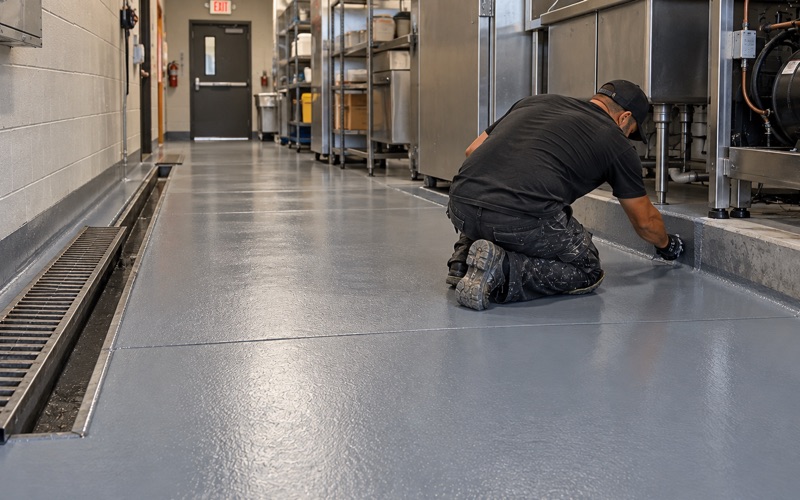
There is no federal approval list for flooring. 9 CFR 416.2(b)(2) is performance-based, requiring floors to be durable, cleanable and maintained in sanitary condition, so a food-plant floor is sold on cleanability, integral coved base, chemical resistance and measured DCOF slip resistance. Anyone selling an approval is selling something that does not exist.
Getting the Work Scheduled in a Rail Town
Crossings the 2013 Flyover Did Not Remove
Two Class I railroads have crossed here since 1882, and Colton Crossing once handled more than 100 trains a day at grade. The flyover completed on August 28, 2013 lifted Union Pacific’s east-west tracks over BNSF’s north-south tracks along roughly 2.2 kilometers.
What it separated was the two railroads from each other, not the railroads from the street network. Freight still moves continuously through the city, so we route a loaded grinder trailer around the surface crossings that remain rather than discovering them with a delivery window closing. Rig staging is planned the same way, before the day rather than on it.
A Four-Day Counter and a City-Owned Utility
The Building and Safety Division sits within Development Services at 659 N. La Cadena Drive, and the city runs a four-day week, with the front counter open Monday through Thursday. Friday is not a permit day here, and anything needing a same-week counter interaction has to land by Thursday afternoon.
Colton also owns its electric, water and wastewater utilities under the Colton Utility Authority, which makes substations, the Agua Mansa Power Plant, pump stations and corporation yards public-agency floor assets procured through the city rather than through a private landlord. That is a different procurement path and a different lead time.
Rule 1113 Bites Harder Where Both Halves Exist
The district’s Rule 1113 allows 50 g/L VOC in a floor coating and 100 g/L in an industrial maintenance coating, and no product is permitted to count as both. Its subsection (c)(6) makes an industrial maintenance coating unlawful to apply, or to offer, on a residential job.
In a city that genuinely has both halves of the market, that line gets tested constantly, and a product that is legal on an industrial floor here is not legal in a Colton garage. We quote the two from two different catalogs for that reason, and the warranty language that goes out states its exclusions plainly instead of leading with a headline number.
- 20+ Years Experience
- Licensed & Insured
- Free Written Estimates