
Highland Epoxy Flooring has been quoting and placing concrete resurfacing in Highland, CA for more than twenty years, and works throughout the surrounding cities including Redlands, Mentone, Loma Linda, Running Springs and San Bernardino. Resurfacing is what we sell when a slab has stopped being a candidate for a coating. The wearing surface itself is gone or going, and a resin film laid over it would reproduce the same failure in a glossier form within a season or two.
The two jobs get sold under one word, so it is worth separating them plainly. A coating is a film measured in mils that borrows all of its strength from the concrete underneath it. An overlay or a resurfacing mortar is a material with its own thickness, its own compressive strength and its own bond line, placed to replace concrete that has scaled, delaminated, spalled or simply been worn below anything a film can sit flat on.
That decision is not one we make from a photograph. We walk the slab, sound it to find the hollow areas a visual read misses, measure how deep the damage runs, and test moisture before any material is named. About a fifth of the housing in this city predates 1960, on slabs poured before under-slab vapor retarders were routine, and what a probe reads changes what can be bonded to that concrete.
When a Slab Has Outrun What a Coating Can Do
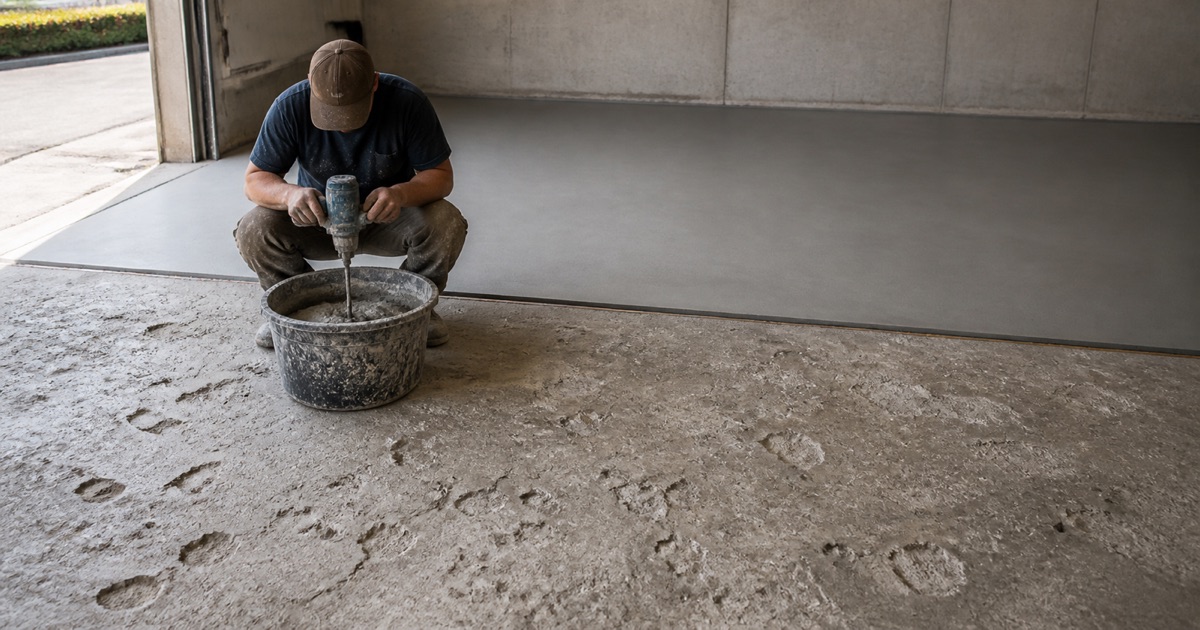
The question is never how bad the floor looks. It is whether there is a sound, cohesive plane of concrete within reach of a grinder for a new surface to bond to, and how much of the slab still has one. A floor with three ugly patches and solid concrete elsewhere is a coating job with repairs in it. A floor whose top eighth of an inch has lost cohesion across most of its area is a resurfacing job.
Scaling and Delamination Across a Whole Bay
Scaling is the top skin of the slab flaking away in sheets or patches, usually where the finish was overworked or closed while bleed water was still rising. Delamination is the same thing one layer down, and it stays invisible until the slab is sounded, because the surface holds over a void. When either covers most of a bay, grinding to sound concrete removes so much material that an overlay is the cheaper and flatter answer.
Spalls That Have Grown Into Fields
A single spall at a control joint or a door threshold is a patch. What we see on older Highland slabs is spalling that has spread along joint edges and around embedded steel until the individual repairs would touch each other. At that point the patch material becomes the wearing surface over much of the floor, and the color and texture difference telegraphs through any thin coating placed on top. Resurfacing puts one continuous material across the whole area instead.
Where Replacement Beats Resurfacing
We say so when it is true. An overlay restores a wearing surface; it does not restore structural capacity, and it does not fix a slab that has broken into moving pieces on unstable subgrade. Working cracks with vertical displacement between the two sides, widespread alkali-silica reaction, or a slab that rocks under load are replacement conditions, and putting a topping over any of them buys a year and wastes the money.
Overlay Systems and What Each One Is For
There is no default overlay. The material gets chosen against three things: how much thickness the slab can accept before doors, thresholds and drain falls stop working, what the floor will be exposed to once it is back in service, and what the moisture reading allows. We quote the system by name and by placed thickness, not as a generic resurfacing line item.
Polymer-Modified Cementitious Overlay
A cement-based topping with a polymer added to the mix for bond strength and flexibility, placed from a skim coat at a sixteenth of an inch up to a quarter inch or more. It is the workhorse for a residential garage, patio or shop slab whose damage is surface-deep, and it accepts texture, integral color and a clear topcoat afterward. It needs a mechanically opened profile underneath it and a dampened, not wet, slab at placement.
Self-Leveling Underlayment
Where the problem is flatness rather than wear, a self-leveling cementitious underlayment poured to a marked thickness pulls a dished or wavy slab back toward plane far more economically than grinding it down. It goes over a primed surface, is spread with a gauge rake, and is finished with a spiked-shoe walk rather than troweled. It is a base for a finish, not the finish itself.
Trowel-Down Epoxy and MMA Mortar
Where a resin surface has to carry the load, a 100% solids epoxy mortar troweled at a quarter inch, broadcast with quartz aggregate and topcoated gives a hard, chemically resistant wearing course that also rebuilds elevation. MMA resin systems do the same work with a much faster cure, which is what buys them a place on a floor that cannot be out of service for several days. Both cost more per square foot than a cementitious topping.
Urethane Cement Where Heat and Water Are the Load
On a floor that takes hot water, steam or wash-down, urethane cement rather than epoxy is the correct family. It moves with the slab through thermal shock instead of debonding from it, and at a quarter inch or more it serves as both repair and finish surface in one operation. This is what we specify behind a kitchen line or a dish area, and it is why we ask what hits the floor before we ask about color.
Repairs That Happen Before the New Surface Goes Down
An overlay is only as sound as what it is bonded to, so the repair scope is quoted in its own right rather than folded into a square-foot price. On a failed floor this is usually the larger half of the labor, and pricing it separately keeps the quote honest.
Spall Repair Quoted by Area
Every spall gets saw-cut to a clean vertical edge rather than feathered, chased down to sound concrete, and filled with a repair mortar compatible with the topping over it. Feathered edges are the classic shortcut and they fail first, because a thin tapered lip has nothing holding it down. We measure the repair area during the assessment and carry it as its own line.
Joints Do Not Vanish Under an Overlay
Control joints and saw-cut joints exist so the slab can crack where you decided rather than where it wants to. Burying one under a topping does not remove the movement; it just guarantees a reflective crack through the new surface in the same line. We honor every joint through the overlay, saw-cutting it back through the new material and filling it with a semi-rigid epoxy joint filler where wheel traffic needs the edges supported.
Moisture Under a New Wearing Course
Vapor moving up through a slab does not care what is on top of it. It will push a cementitious overlay off its bond line and blister a resin one, and it is the failure mode most coating and topping warranties specifically exclude. The reading gets taken before material is ordered and written into the proposal.
Three Tests, Three Different Questions
ASTM F1869 measures a rate at the surface, the calcium chloride moisture vapor emission rate. ASTM F2170 measures a state inside the slab, in-situ relative humidity read at 40% of the depth. ASTM D4263, the taped plastic sheet, is indicative only and asymmetric: a positive result fails a slab, and a negative result proves nothing at all. Both of the threshold numbers people quote live in ASTM F710, not in any of the three test methods.
Why the Age of the Slab Does Not Settle It
ASTM E1745, which defines what a modern under-slab vapor retarder actually is, was first published on 10 March 1997, so anything poured before that is a genuine unknown. Newer is not proof either, because the California Residential Code exempts garages from the under-slab vapor retarder requirement outright. A 2004 tract garage in this city can be as open to vapor as a 1948 one, which is why we test the slab in front of us rather than the year on the permit.
Our Step-by-Step Concrete Resurfacing Process
1. Assessment, Sounding and Moisture Testing
We measure the floor, sound it for delamination, map the spalls and joints, and set in-situ relative humidity probes where the reading will govern the system. Nothing is ordered until those results are in hand and written into the proposal with the material they justify.
2. Removal and Re-Profiling
Old coatings, adhesives and unsound concrete come off mechanically. Depending on what is on the slab and how hard the concrete is, that is diamond grinding, shot blasting, or polycrystalline diamond tooling for a stubborn film, taken down to a named surface profile the chosen overlay requires.
3. Repair, Joint Work and Priming
Spalls are cut, cleaned and filled, active cracks are treated as joints, and the whole floor is primed or scratch-coated with the system the manufacturer specifies. On a slab where moisture governs, a moisture vapor barrier primer goes on at this stage rather than being skipped for schedule.
4. Placing and Finishing the New Surface
The topping is mixed in controlled batches, placed to a gauged thickness and worked before it starts to set. Joints are cut back through, the texture is set, and a topcoat follows once the surface will accept it. Batch size, start time and recoat timing are set by the day’s slab temperature.
- 20+ Years Experience
- Licensed & Insured
- Free Written Estimates