Highland Epoxy Flooring follows the concrete when it comes to commercial epoxy flooring in Fontana, and in October 2023 an enormous amount of new concrete arrived where a two-mile racing oval used to be. Demolition of that oval began that month, and turns one and two together with the parking around them have been redeveloped as large warehouse buildings.
For this trade the value of that ground is not nostalgia. It is several hundred acres of brand-new industrial slab, placed and power-troweled within the last couple of years, sitting in buildings that have never had a pallet jack driven across them.
A floor in that condition is a completely different job from the recoating work that carries most of this city’s older stock, and after twenty years we would rather explain why than let a customer assume a new slab is the easy one. It is tighter, flatter, cleaner and less ready to accept a coating than a forty-year-old floor.
The Two-Mile Oval That Came Out in 2023

What Replaced It, and What That Means for Floors
The site’s relevance now is square footage under roof rather than seats in a grandstand. Ground that used to carry banking and infield now carries slab-on-grade warehouse floors, and the volume of new concrete in one place is larger than anything this trade normally encounters inside a single city.
We describe it exactly that way and no further, because the specific building count, tenancy and acreage on that ground are not ours to state. What can be said accurately is that a very substantial area of new industrial floor exists there, and new industrial floor is a distinct scope with its own sequence.
Green-Field Ground Rather Than an Occupied Building
A green-field pour removes the constraint that dominates most commercial coating work, which is somebody else’s operation. There is no dock schedule to work around, no trailer-stall pattern to negotiate, no aisle that has to reopen by Monday, and no product in racks that dust cannot be allowed near.
What replaces it is a construction program. The floor is one trade among many on a shared site, the coating window is fixed by a general contractor’s schedule rather than by a facilities manager’s tolerance, and being ready to start on the day the slab is released matters more than being flexible about which weekend.
Estimating by the Acre Instead of by the Bay
Work at this scale is priced and planned differently from the ground up. Material is staged by the pallet rather than the pail, mixing is continuous rather than batch-by-batch, and crew size is set by how much wet edge can be kept moving across an open floor with no walls to break it into rooms.
We say that plainly because a contractor who quotes acreage using a garage-floor mental model will be wrong in both directions. The unit rate falls, and the consequences of getting the sequence wrong rise sharply, since a placement error on an open floor cannot be hidden behind a doorway.
Looking for polished concrete closer to Riverside? See Riverside Polished Concrete.
Why a Brand-New Power-Troweled Slab Is Not Ready
A Tight Surface That No Etch Will Open
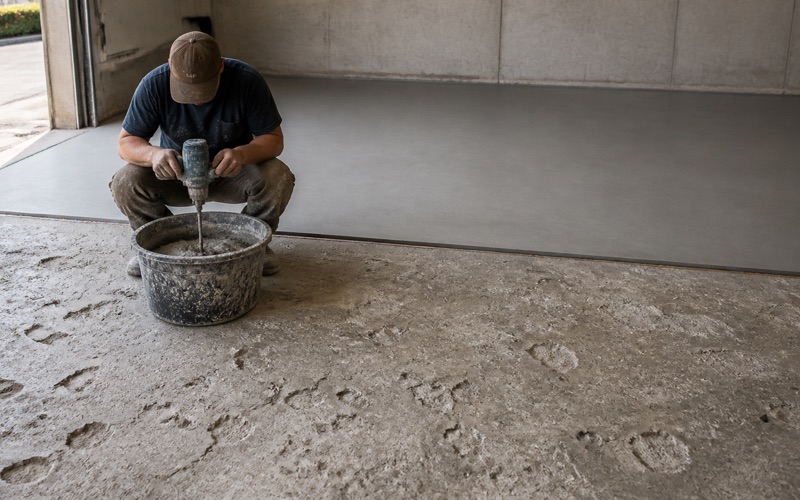
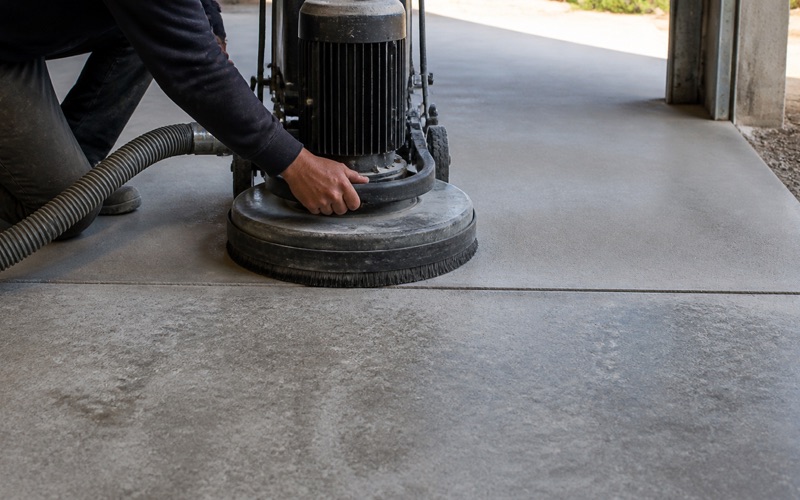
A hard-troweled warehouse floor is closed. The trowel pass drives fines to the surface and burnishes it, producing exactly the dense, low-porosity finish the slab was specified to have, and exactly the surface a coating cannot key into without mechanical intervention.
Acid etching does not solve that. It produces an inconsistent, unverifiable result, leaves residue that has to be neutralized and rinsed, and gives nobody a profile they can specify or check. Every profile we open is opened by diamond grinding or by shot blasting where the area and the schedule justify it.
Naming the Profile as an ICRI Number
A profile that is not named is not a specification. We write a target ICRI concrete surface profile into the proposal — commonly CSP 3 for thin-film work and CSP 4 or higher as the build increases — so the prep can be verified against the published comparators rather than argued about after the coating is down.
The tooling that gets there is chosen against the slab rather than assumed. Diamond segment bond is selected against the hardness of the concrete in front of us on the rule that hard concrete takes a soft bond, and the grit sequence is set on site instead of run out of habit from the last job.
Reading Slab Temperature at the Surface
On a floor this size cure is governed by the slab. Pot life on one published product runs about sixty minutes at 55 degrees F and roughly twenty at 95 degrees F, the recoat minimum collapses from twenty-four hours to six, the surface has to sit at least 5 degrees F above dew point, and an uninsulated slab can approach a 160 degrees F maximum in summer.
So the reading comes off the surface with an instrument, not off a phone weather app. In practice that means early starts through the hot months, smaller mixes than the label suggests, and a willingness to stop placing when the slab moves outside the window rather than pushing one more batch out.
Joints and What Happens Before the First Wheel
Filling and Armoring Before Anything Rolls
Saw-cut joints in a new warehouse floor are the single best opportunity this trade ever gets, because the joint has not been damaged yet. Filling and armoring an undamaged arris is a fraction of the cost of rebuilding a spalled one after two years of hard-wheeled traffic has worked on it.
We fill saw-cut joints with a semi-rigid epoxy joint filler, placed full depth and shaved flush so the filler supports both edges under load. Doing that before the building takes traffic is preventive work with a measurable payback, and it is the item most often value-engineered out by someone who has never had to repair the result.
Curing Compounds, Laitance and What Comes Off First
A new slab usually arrives with something on it. A curing compound, a dissipating membrane, laitance from the finishing operation, or construction traffic residue from every other trade on the site all have to come off before a profile can be opened underneath them.
That is prep work with its own line item, not an afterthought. We check what was applied at placement rather than guessing, because a compound that will not release under grinding changes the tooling and the schedule, and a coating applied over a residual membrane fails cleanly across the whole floor rather than in patches.
Sequencing Against a Construction Schedule
Coating a floor inside an active construction program means being the trade that other trades are waiting on. We plan the work so racking, dock equipment and mechanical installation are not standing on wet material, and so the areas released first are the areas finished first.
Return to service is quoted honestly against that. Where a schedule genuinely cannot absorb a full epoxy cure we specify a polyaspartic or polyurea build instead of promising an epoxy will behave differently than its data sheet says it will, and the actual foot and wheel traffic hours go into the proposal.
The Rest of the City’s Commercial and Residential Floor Work
The Existing High-Cube Corridor
New ground is not the only commercial work in this city. The Slover Avenue corridor between I-15 and I-10 carries dense modern high-cube product, including a 194,595-square-foot building at 16255 Slover Avenue with 36-foot clear height and 29 dock-high doors, and a 671,324-square-foot distribution building approved on the same corridor.
California Steel Industries runs a 430-acre plant with roughly 115 acres under roof on the former Kaiser Steel site, in operation since 1984 — the direct descendant of the mill this city grew around. Floors in operating plants of that kind are repair, joint and recoat scopes rather than green-field pours.
The Kaiser-Era Townsite Slabs
At the other end of the range are the pre-1960 townsite slabs in the south and center of the city, roughly 12.9% of the housing stock. Those floors are sixty-five years old or more and were frequently placed without an under-slab vapor retarder, which makes slab moisture the first question rather than the last one.
We test with in-situ relative humidity probes to ASTM F2170, or calcium chloride to ASTM F1869 where a specifier asks for it, and write the reading into the proposal before material is ordered. The threshold numbers live in ASTM F710, and decades of home-mechanic oil saturation is the other defect we expect to find on that stock.
One Rule, Two Product Lines, in the Same Week
Two VOC ceilings decide which product may legally go down here. SCAQMD Rule 1113 allows 50 g/L for a floor coating and 100 g/L for an industrial maintenance coating, treats those categories as mutually exclusive by definition, and through subsection (c)(6) bars anyone from applying or soliciting an industrial maintenance coating for residential use.
In a city where the same crew may quote several hundred thousand square feet of warehouse floor on Monday and a two-car garage on Saturday, that is a live compliance line rather than a technicality. We keep residential and commercial work on separate product lines for exactly that reason, and permits on either side route through the Build Fontana portal with Building and Safety on Sierra Avenue.
- 20+ Years Experience
- Licensed & Insured
- Free Written Estimates