
Highland Epoxy Flooring installs epoxy garage floor systems across Highland, CA, and we have been coating slabs in this valley for more than twenty years, serving surrounding cities including Redlands, Mentone, Loma Linda, Running Springs and San Bernardino. A garage floor is the one slab in a house that takes point loads from tires, dropped tools and whatever leaks out of a vehicle overnight, and it is also the one slab the builder was never required to protect from below. That combination is why we treat the concrete as the specification and the resin as the answer to it.
Roughly 8,100 owner-occupied detached houses sit inside the city limits, and 75.2% of Highland’s housing is single-family detached. Most of those garages are attached two-car bays poured on 1980s and 1990s tract slabs, which means concrete that has settled, cracked at its control joints and, more often than not, been painted at least once already. What can go on top of that is decided by what we measure, not by whichever product line we happen to stock.
So we quote an epoxy garage floor as a system rather than as a gallon count: a primer chosen against a moisture reading, a build coat carrying a stated mil thickness, whatever broadcast the floor is getting, and a topcoat that absorbs the abrasion. Every one of those layers has a data sheet, and every data sheet has conditions attached to it.
What an Epoxy Garage Floor Is, Layer by Layer
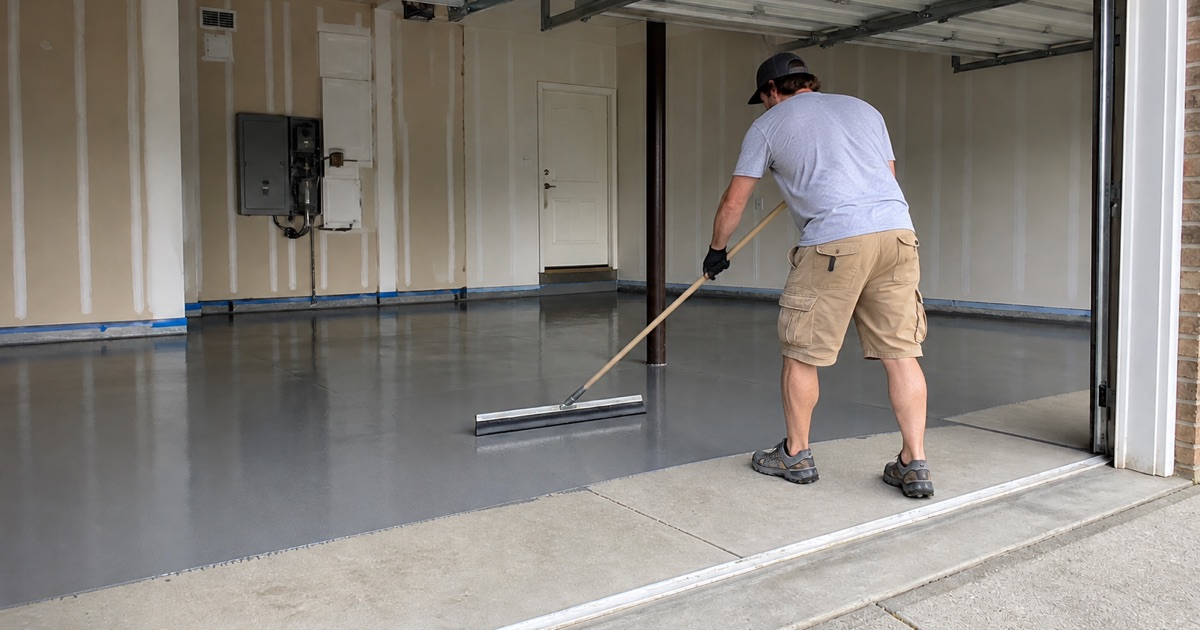
The word epoxy describes a chemistry, not a floor. What we install is a stack, and each layer in it does one job that the layer above it cannot do for itself.
The Primer Is Chosen From the Moisture Number
A primer’s first job is adhesion, and on a slab carrying vapor it is also a barrier. A water-based epoxy primer wets into porous concrete and gives the build coat something to key into, while a moisture vapor barrier primer is a different and considerably more expensive product, specified when the in-situ relative humidity comes back high enough that an ordinary system would be pushed off from underneath. We do not pick between those two by feel, and we do not price one and then install the other.
The Build Coat, and Where Mil Build Comes From
Mil build is the number most often quoted and most often misunderstood. It is not a property of the resin at all; it is a product of spread rate and of the tool, which is why a gauge rake set to a known notch and a wet film thickness gauge in the crew’s hands are what make a stated build real rather than aspirational. A 100% solids epoxy laid at a controlled spread rate leaves very nearly everything that came out of the pail on the floor.
The Topcoat That Absorbs the Wear
Epoxy is hard, and it is not the best available answer to ultraviolet light or to surface abrasion, which is why the layer you actually walk on is usually a urethane topcoat or a polyaspartic. That coat carries the gloss level, the slip resistance and the chemical resistance, and it is the layer that can be renewed years later without disturbing the base underneath it. Treating the topcoat as an optional upsell rather than as part of the system is a short-term saving with a predictable ending.
Reading the Slab Before Anyone Talks About Color
Moisture failure is the dominant way a garage coating comes off a slab in this region, and it is also the failure most coating warranties name in their exclusions. That is the argument for testing before a pail is ordered: a probe costs little against a floor that has to be ground off and paid for twice.
In-Situ Relative Humidity Against a Surface Rate
ASTM F2170 drills to 40% of the slab depth and measures a state, the relative humidity inside the concrete where the vapor actually lives. ASTM F1869, the calcium chloride method, measures a rate at the surface over a set period. Those are two different questions, and neither threshold number is written into the test methods themselves. Both live in ASTM F710, which is the citation most often got wrong.
The Plastic Sheet Test Cuts One Way Only
ASTM D4263 is the taped-down plastic sheet, and it is indicative only. It is also asymmetric, which is the part that gets skipped: condensation under the sheet fails a slab outright, but a dry sheet the next morning proves nothing whatsoever. We use it as a free early look on a walkthrough, never as the basis for a system decision.
The Garage Is the Room With No Retarder Required
The California Residential Code exempts garage slabs from the under-slab vapor retarder requirement that applies to living space, and ASTM E1745, the standard defining a modern under-slab retarder, was not first published until 10 March 1997. Age is therefore a weak proxy in both directions. A 2000s slab out in the East Highlands tracts can be as open to vapor as one poured in the 1940s off Base Line, so every garage we coat is tested on its own reading.
Where a Store-Bought Kit and a Bonded System Part Company
More people search for a garage floor kit than search for what a garage floor costs, so this is not a fringe comparison. It is the main one. The kits are not a scam; they are simply sold without the three things that decide whether a coating stays down on an inland slab.
Solids Content, and What a Gallon Leaves Behind
Solids content is the share of a product that remains once the carrier has left. A one-part paint at low solids can cover a two-car garage out of a couple of pails and leave behind a film measured in fractions of a mil. A 100% solids epoxy at the same square footage leaves a coating you can feel with a fingernail at the edge of the slab, which is why coverage figures printed on two different boxes are not comparable numbers.
Etching Against a Named Profile
An acid rinse opens the surface chemically and leaves the depth of that opening to the slab’s own character. Diamond grinding opens it mechanically to a profile we can name, typically CSP 3 or CSP 4 for a thin-film garage system, and the ICRI scale those numbers come from runs 1 through 10 rather than 1 through 9, since the 2013 revision added the tenth. Naming the profile in the proposal turns preparation into a deliverable instead of a promise.
Heat, Pot Life and the Length of a Working Day
Slab temperature is a scheduling input rather than a comfort question. Every figure below comes off published product literature rather than off a rule of thumb.
Pot Life Is a Curve, Not a Number
On one published product, pot life runs 60 minutes at 55 degrees F, 40 minutes at 72 degrees F and 20 minutes at 95 degrees F. The resin has no interest in what time the appointment was booked for. That collapse is why we mix small batches on a hot slab, why crews start early, and why a floor that goes down in one continuous pour in spring may need a different sequence in August.
The Recoat Window Moves With It
The same temperature curve pulls the recoat minimum from 24 hours down to as little as 6, and there is a maximum on the far side of that window as well. Miss it and the following coat sits on a fully cured surface rather than bonding chemically into it. Sequencing a broadcast, a grout coat and a topcoat around that moving window is most of what scheduling in this trade actually consists of.
Dew Point and the Surface Ceiling
There is a floor and a ceiling on the same working day. Surface temperature has to sit at least 5 degrees F above the dew point or moisture condenses into a curing film, and an uninsulated inland slab can genuinely approach the 160 degrees F maximum surface temperature a data sheet allows. We take both readings on the slab in front of us rather than reading a forecast and hoping.
Highland Garages, and the Rules That Come With the Address
The split between residential and commercial coatings is a legal boundary in the South Coast basin rather than a marketing one, and Highland sits inside that basin under South Coast AQMD.
50 g/L, and a Category You Cannot Have
SCAQMD Rule 1113 caps floor coatings at 50 g/L of VOC and industrial maintenance coatings at 100 g/L, and definition (24) makes those two categories mutually exclusive. Subsection (c)(6) goes further still: it prohibits applying, or soliciting the application of, an industrial maintenance coating for residential use. The higher-VOC product is therefore not a premium tier a homeowner can pay extra to unlock.
The Workshop on a Residentially Zoned Parcel
Highland has detached shops, hobby bays and outbuildings sitting on residential parcels in its older tracts and up on the foothill lots, and the wear inside some of them is genuinely industrial. Under Rule 1113 the parcel decides the category, not the wear. We say that plainly at the quote instead of working around it, and then specify a compliant floor coating built to carry the load anyway.
Sloping Lots and Where the Rig Sits
Grade shows up on the older and eastern tracts here, where split-level driveways and sloping lots decide where a grinder, a dust extractor and a generator can stand and how far hose and cord have to run. The same grade decides how a slab drains toward the door, which affects where a threshold detail or a coved edge earns its place. We walk all of that before quoting rather than discovering it on the morning of the grind.
- 20+ Years Experience
- Licensed & Insured
- Free Written Estimates