Highland Epoxy Flooring specifies concrete floor coating in Hesperia under Mojave Desert AQMD Rule 1113, and the number on that rule is exactly where contractors go wrong. Hesperia sits north of the Cajon Pass in the desert portion of San Bernardino County, inside the Mojave Desert Air Quality Management District.
The South Coast district, which covers the valley cities on the other side of the pass, also numbers its architectural coatings rule 1113. Two districts, two rule books, one rule number. A contractor who quotes the wrong one is not making a technicality error; they are quoting a legal limit that does not apply to the building.
We have spent more than 20 years selecting coating categories against the rules that actually govern a job, and this is the single most consequential jurisdictional fact in the High Desert. It is worth walking through carefully, because the two rules do not simply differ by a margin. They split.
Rule 1113 in Two Districts, and Only One Governs Here
Floor Coatings: 50 g/L on Both Sides of the Pass
Under MDAQMD Rule 1113 as amended October 26, 2020, floor coatings carry a VOC limit of 50 g/L, a figure that took effect January 1, 2022 and brought the desert district down from the earlier 100 g/L figure to the same number the South Coast district sets. On floor coatings specifically, the two districts have converged.
That is worth stating plainly because it is the opposite of what people assume. There is no looser desert allowance on a floor coating, and anyone selling one on that basis is describing a rule that stopped being current several years ago. A product legal as a floor coating in the basin is legal as a floor coating here, and one that is not, is not.
Industrial Maintenance: 250 g/L Against 100 g/L
Where the two rules genuinely part company is the industrial maintenance category. MDAQMD caps industrial maintenance coatings at 250 g/L with no scheduled reduction, against 100 g/L in the South Coast basin. That is a factor of two and a half, and it is a real difference in what can lawfully be applied.
So an industrial maintenance product that cannot legally go down on a warehouse floor south of the pass may be entirely lawful on one here. That is genuinely useful on heavy commercial work, and it is also the kind of thing a specifier should confirm against the current rule text rather than take from a page like this one on faith.
The Two Categories Are Not Interchangeable
Floor coating and industrial maintenance coating are defined categories, not marketing descriptions, and a product sits in one of them. The 250 g/L latitude belongs to the industrial maintenance category and does not travel across into a floor coating, so it cannot be used to widen the 50 g/L floor-coating selection by relabeling.
The rule reaches applicators as well as sellers. MDAQMD Rule 1113 applies to anyone who supplies, sells, offers for sale, manufactures, blends or repackages an architectural coating for use in the district, and equally to anyone who applies or solicits the application of one within it.
Looking for epoxy flooring closer to Lytle Creek? See Lytle Creek Epoxy Flooring.
The Structural Difference: There Is No (c)(6) Here
What South Coast Prohibits and This District Does Not
South Coast Rule 1113 subsection (c)(6) prohibits any person from applying, or soliciting the application of, an industrial maintenance coating for residential use. It is an applicator prohibition, aimed squarely at the person holding the squeegee, and in the basin it draws the residential and commercial line as a matter of law.
MDAQMD Rule 1113 contains no equivalent subsection at all. Its Section (C) requirements run through VOC content limits, the most restrictive limit provision, specialty coating categories, sell-through, painting practices, thinning and colorants, and none of those prohibits residential application of an industrial maintenance coating.
What Section (D)(1)(e) Actually Requires
The residential restriction in the desert rule appears in one place only, at Section (D)(1)(e), and it is a container-labeling requirement. The label of an industrial maintenance coating must display “For industrial use only”, “For professional use only”, or “Not for Residential use” or “Not intended for Residential use”.
The rule also defines what residential means. Rule 1113 (B)(56) covers areas where people reside or lodge, including single and multiple family dwellings, condominiums, mobile homes, apartment complexes, motels and hotels, which is a broad definition and one worth reading before assuming a building falls outside it.
Why the Missing Subsection Is Not a Green Light
The honest reading is that this is a difference in how the two rules are structured, not permission. The constraint still arrives, but printed on the pail rather than written at the applicator. The label still reads not for residential use, and the manufacturer’s data sheet and warranty terms still govern what happens if that instruction is ignored.
There is also a specification argument that has nothing to do with any district. A coating formulated for immersion service and heavy abrasion is frequently the wrong product for a house on its own merits, whatever a rule permits. We quote residential and commercial work from separate product lines for exactly that reason, and we will say no to a request rather than put the wrong system in a garage.
A Thirty-Seven Degree Day-to-Night Swing
An August Night Near 62 Degrees F Buys Back Working Time
Hesperia sits at 3,347 feet with a cold desert climate, and the July and August monthly averages run a high near 99 degrees F against a low near 62 degrees F. That 37-degree spread is a working asset rather than a piece of trivia.
Pot life on a published two-part system runs roughly 60 minutes at 55 degrees F, 40 at 72 degrees F and 20 at 95 degrees F. In a valley city an August night barely leaves the 70s, so an early start buys little. Here it genuinely returns working time to the crew, which is why summer installs start at first light.
The Afternoon Slab Is Still the Hazard
The same swing runs the other way by mid-afternoon. An uninsulated slab in this climate can climb toward the 160 degrees F surface maximum a data sheet will name, and at that point the material is unworkable no matter how carefully it was mixed.
The recoat window narrows with it, collapsing from a 24-hour minimum toward six hours, which sounds convenient and is actually a tighter target to hit. Miss it and the whole floor has to be abraded again before the next coat will bond. Winter inverts the problem rather than removing it, because overnight lows near freezing leave the slab lagging well behind the air and it takes hours of daylight to climb back.
Blowing Dust in an Open Bay
This city sits inside the Mojave Desert Planning Area, a federal PM10 attainment-plan area with its own fugitive dust rules under MDAQMD Rule 403 and Rule 403.2. Whatever the regulatory reach over an interior floor job, the physical problem is not in dispute.
An open garage bay or roll-up door on a windy afternoon delivers grit straight into a wet film, and grit in a wet film is permanent. The answers are sequencing and containment, closing the bay down to a working gap, screening the opening and wetting or sweeping the approach before broadcasting flake, rather than hoping the wind holds off.
Scoping a Floor on Hesperia’s Young Slab Stock
Nearly a Third of the Housing Was Built This Century
Of the city’s 30,425 housing units, 9,472, about 31%, were built in 2000 or later, while only 1,744 units, roughly 5.7%, predate 1960. The regional stereotype of a coating job as the removal of somebody’s failed 1970s kit describes a smaller share of the work here than it does south of the pass.
A large fraction of what we quote is therefore a first coating on a sound, uncoated slab. That should show up as a shorter prep line rather than as a removal allowance the job never uses, and where a prior product does exist we quote its mechanical removal as its own item so nobody meets it as a change order.
Build Era Does Not Settle the Moisture Question
A newer slab is not a dry slab, and this is where the young stock misleads people. The California Residential Code exempts garages from the under-slab vapor retarder requirement, so a garage slab poured here in 2005 may have nothing beneath it at all, and the year on the permit proves nothing.
Every slab therefore gets measured. We use ASTM F2170 in-situ relative humidity probes or ASTM F1869 calcium chloride, write the reading into the proposal before material is ordered, and take the acceptance thresholds from ASTM F710 rather than from the test methods. ASTM D4263 plastic sheet is indicative only and asymmetric, since a positive result fails a slab while a negative one settles nothing.
Commercial Slabs, Prep Method and the Permit Counter
The commercial half of this market is large, new industrial floor area beside the freeway, with the Hesperia Commerce Center entitled for millions of square feet on a 232-acre site and the city reporting a substantial pipeline citywide. Those are flat, hard, power-troweled slabs where the scope is moisture mitigation, joint filling, high-build systems, dock aprons and marking rather than a decorative finish.
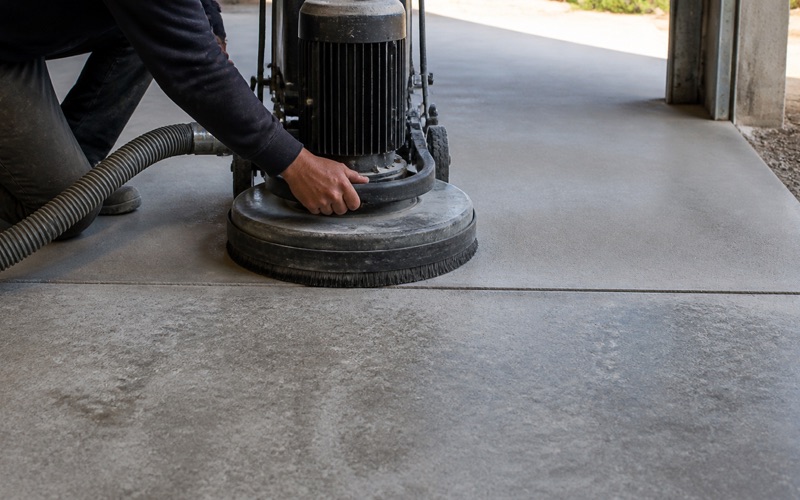
On any of it, profile is opened by diamond grinding to a named ICRI concrete surface profile and never by acid etching. Segment bond is chosen against the hardness of the slab in front of us, on the rule that hard concrete takes a soft bond, rather than by running one grit sequence across every job. Scheduling is also easier here than in the four-day city halls elsewhere in the county. The City of Hesperia Building and Safety Division on Seventh Avenue runs a five-day counter, Monday through Thursday from 7:30 AM to 5:30 PM and Friday from 7:30 AM to 4:30 PM, opening at 9:00 AM on the second and fourth Wednesday.
- 20+ Years Experience
- Licensed & Insured
- Free Written Estimates