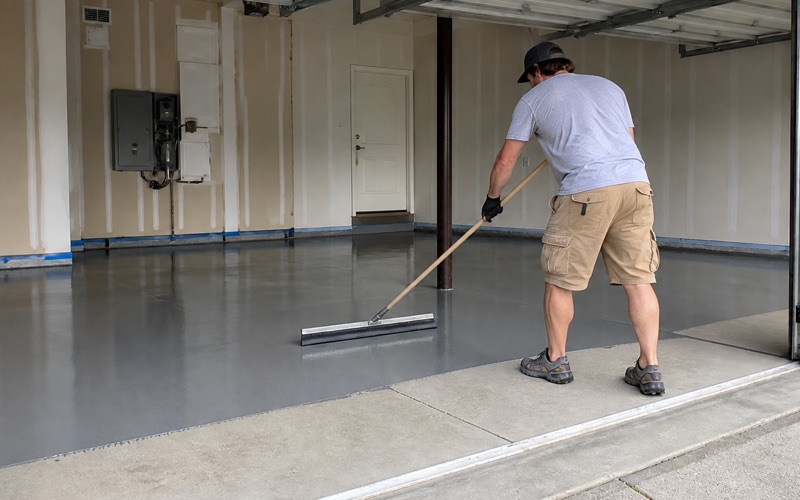
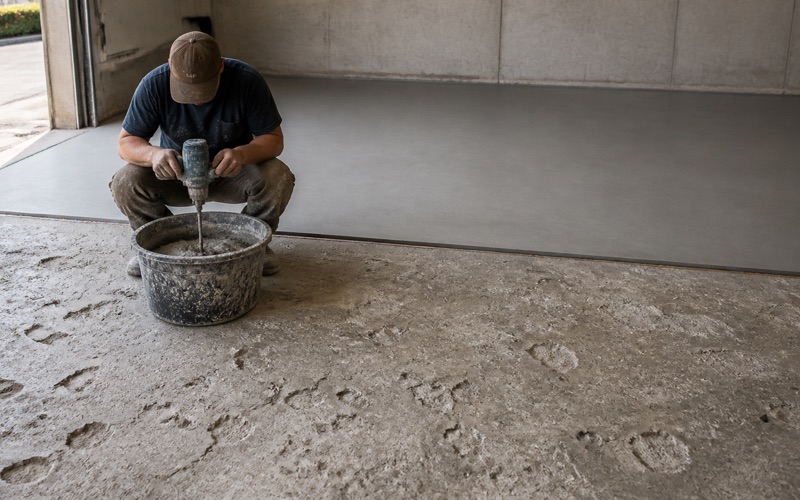
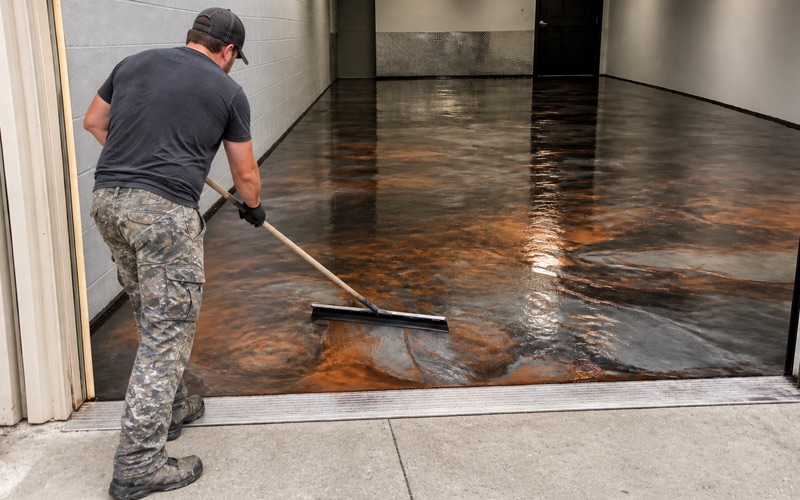
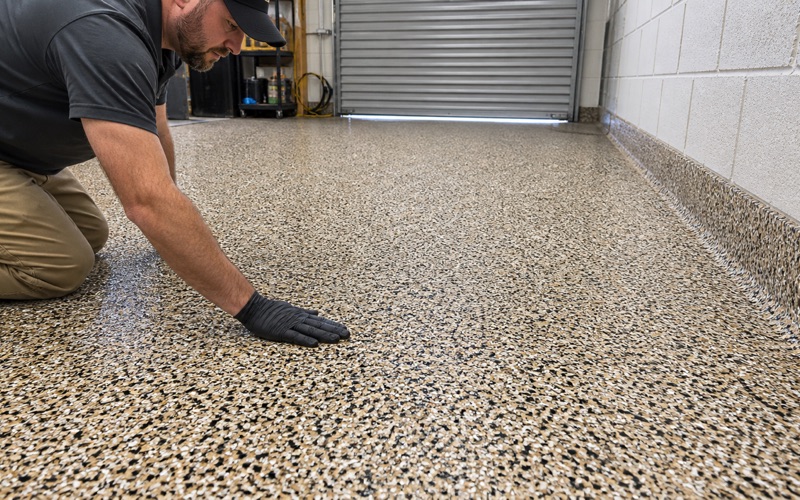
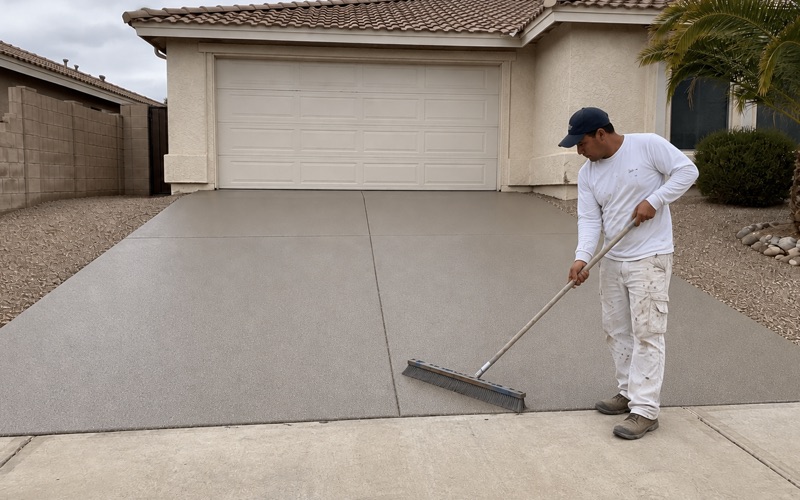
Highland Epoxy Flooring meets epoxy flooring in Highgrove on younger concrete than anywhere else in our service area. Roughly 1,560 of the community’s 2,593 housing units, about 60%, were built in 2000 or later, and close to 30% of the whole stock went up in the 2010s alone.
That single fact reorganizes the job. Across most of the inland region a garage floor quote is really a quote to remove somebody’s failed one-part paint first. Here the typical slab has never been coated at all, and the work is a clean prep-and-coat on sound concrete.
It does not, however, make moisture go away. It moves the question from whether a vapor retarder was ever installed to whether the slab has finished drying, and after more than 20 years in this trade we have found that the second question is the one people skip.
The Modal Highgrove Job Is a Clean Prep-and-Coat
Sixty Percent of the Housing Was Poured This Century
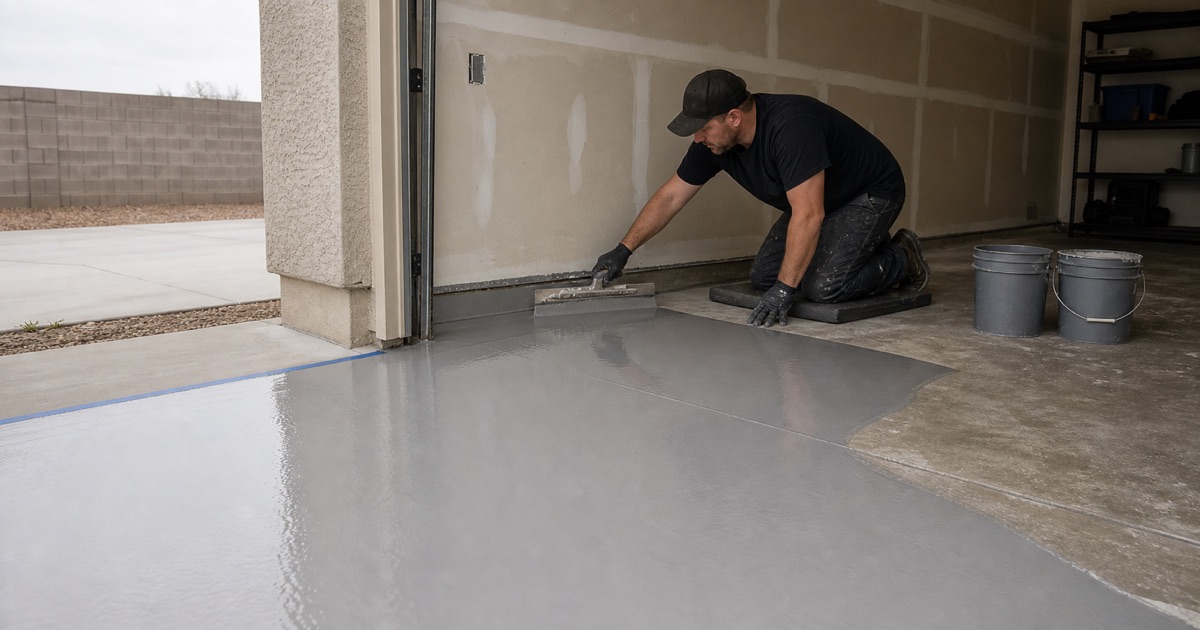
The typical property here is an attached two- or three-car garage on a tract slab placed within the last twenty-five years, on a community that is roughly three-quarters single-family detached. Nothing has been ground off it, nothing has delaminated, and there is no unknown prior product to identify before quoting.
That is genuinely good news for an owner, and it should show up in the price rather than being quietly absorbed. When there is no failed coating to remove, we say so and we do not carry a removal allowance that the job will never use.
A Sound Slab Changes What Prep Costs, Not Whether It Happens
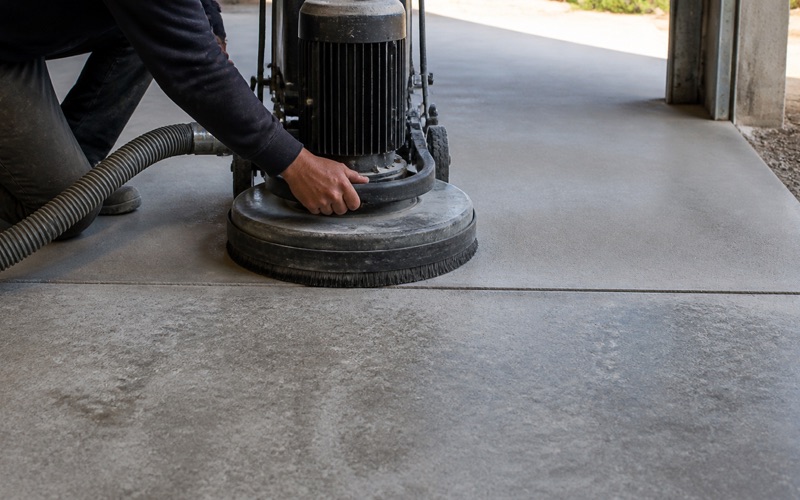
We still open a mechanical profile by diamond grinding to a named ICRI concrete surface profile, and we still do not acid etch. A clean slab shortens the grinding, it does not remove it, because a coating bonds to an opened surface and not to a swept one.
What changes is the tooling. A newer, harder, power-troweled slab resists a standard grit sequence, so segment bond is picked against the concrete in front of us on the rule that hard concrete takes a soft bond. Running one sequence everywhere polishes a slab like this instead of opening it.
Curing Compounds and Densifiers on Recent Pours
Recent construction often leaves something on the surface that was never meant to be coated over, whether a curing compound, a densifier or a sealer applied at handover. None of that is visible from the doorway and all of it interferes with adhesion.
So the first pass is diagnostic as much as it is productive. We grind a test area, look at what comes off the surface and at what the concrete underneath actually looks like, then adjust the sequence and the tooling from there before committing to the rest of the floor. It costs an hour on a one-day job and it prevents the kind of patchy adhesion failure that only shows itself three months later.
Looking for epoxy flooring closer to Crestline? See Epoxy Flooring in Crestline.
Cure Age, Not a Missing Retarder
What an In-Situ Relative Humidity Probe Is Actually Measuring
Concrete keeps releasing water for a long time after it is placed, and a slab poured a few years ago can still be carrying enough internal moisture to lift a film. ASTM F2170 drills into the slab and reads relative humidity at 40% of its depth, which is a measurement of the condition of the concrete itself rather than of its surface on the day of the test.
That is why it is the right instrument on housing this young. We run the probes, allow the required equilibration time, and write the reading into the proposal before any material is ordered, because moisture failure is the exclusion that most coating warranties are written around.
Why a Calcium Chloride Test Answers Something Else
ASTM F1869 measures a moisture vapor emission rate at the surface over a set period. It is a legitimate test and we use it, but it describes what is leaving the top of the slab rather than what is stored inside it, and on a young slab those two things can diverge.
The acceptance numbers for both methods live in ASTM F710, not in the test methods themselves, which is a distinction worth making because it decides which threshold a product is actually being judged against. A contractor quoting a limit without naming the standard it comes from is quoting a number from memory.
The Test That Cannot Settle the Question
ASTM D4263, the plastic sheet taped to the slab overnight, is indicative only. It is asymmetric in a way that gets misread constantly: a positive result condemns a slab, and a negative result proves nothing whatsoever.
We will still run it, because it takes minutes and a positive result saves everyone a great deal of time. What we will not do is present a dry sheet as clearance to coat a floor. We would rather lose a job to somebody willing to do that than write a warranty over a slab nobody ever actually measured, and we state warranty exclusions in writing, including what happens if moisture drives the failure.
Crossing the County Line
Riverside County Building and Safety Within TLMA
Highgrove is unincorporated Riverside County, so the building authority is the Riverside County Department of Building and Safety inside the Transportation and Land Management Agency, at 4080 Lemon Street in Riverside. Permits are filed online, with in-person transactions handled at the Permit Assistance Center, and this area is served by TLMA’s District 1 permit process advisors.
That is a different department, a different plan-check queue and a different set of forms from the ones a few minutes north. A crew that worked one county on Monday has crossed a boundary by Tuesday, and pretending otherwise is how a schedule slips.
The Air District Does Not Change at the County Line
What does not change is the air district. Highgrove sits in western Riverside County inside the South Coast Air Basin, so SCAQMD Rule 1113 governs coating VOC content here exactly as it does on the other side of the line.
That means floor coatings capped at 50 g/L VOC and industrial maintenance coatings at 100 g/L, with subsection (c)(6) prohibiting any person from applying or soliciting the application of an industrial maintenance coating for residential use. We quote residential and commercial work from separate product lines because the rule draws that as a legal boundary rather than a preference.
Getting a Grinder and Dust Extraction Rig to the Job
Access here has one constraint most local pages miss. Center Street is the only internal street carrying through east-west access across the community, and it crosses both the BNSF and Union Pacific mainlines at grade with no grade separations.
The county’s own area plan describes traffic waiting for freight on both lines, with long delays at scheduled stops where trains off-load raw materials or pick up finished product. A loaded trailer stuck on that route has no alternative, so we build the arrival window around it rather than treating it as bad luck.
The Size and Shape of the Local Market
Roughly 1,540 Owner-Occupied Detached Houses
Ownership here runs near 74%, and the published cross-tabulation puts owner-occupied single-family detached units at about 1,540, with only a small rental layer among detached houses. That is a small market but an unusually clean one, since almost everyone in it can authorize work on their own property.
It is also a market where round numbers are the honest ones. The margin of error on the total housing count is in the hundreds of units, so we characterize this community rather than quoting it to the decimal, and we would rather be approximately right than precisely misleading.
The Older Core West of the Freeway
A minority of the stock is genuinely old: roughly an eighth predates 1960 and not quite a fifth predates 1970, concentrated in the established core near Center Street and Iowa Avenue where commercial, civic and residential uses sit together on small, irregular parcels.
On those properties the moisture conversation reverts to the older pattern and the prep is heavier, often including removal of a prior product. We scope those separately rather than applying a tract-garage price to a detached garage that is three times the age of its neighbors.
Where the Commercial Work Actually Is
This is not a warehouse community, and it would be dishonest to write it as one. The governing area plan designates modest acreages of light industrial and business park and no heavy industrial at all, with the heavy product sitting north across the county line. There is also effectively no multifamily here, so there is no parking-deck or common-area segment to speak of.
What does exist is a pipeline. An active application proposes rezoning several parcels for a speculative industrial building, and that kind of work is a different sale entirely, made to a general contractor against an architect’s specification on a construction schedule rather than to an owner with a stained floor. Inland heat still governs cure on all of it, so summer pours start early and run in small batches while we read slab temperature rather than air.
- 20+ Years Experience
- Licensed & Insured
- Free Written Estimates