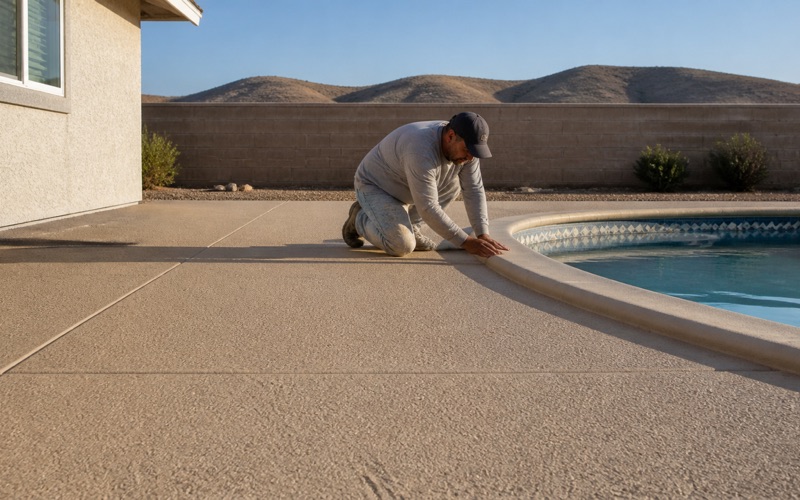
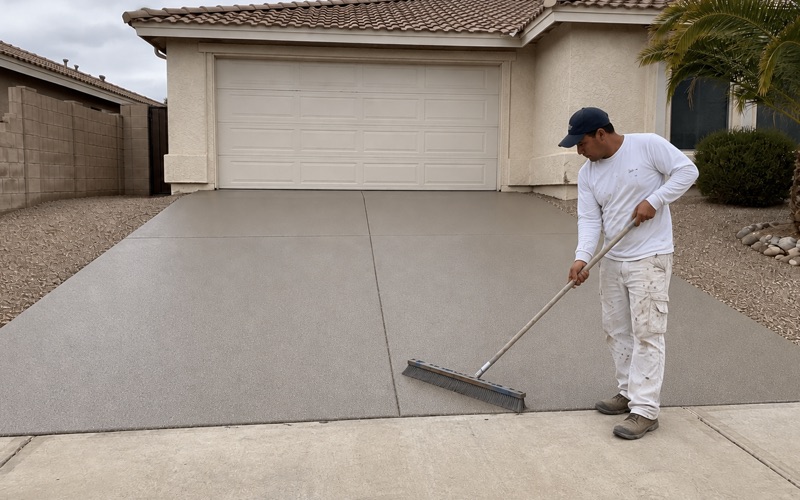
Highland Epoxy Flooring runs two completely different preparation routines for polyaspartic floor coating in Jurupa Valley, because this city holds 1950s garage slabs and freshly power-troweled distribution floors inside the same boundary. In 20 years of doing this we have rarely seen two markets that far apart share one city limit.
This is a young city stitched together out of seven older communities, Rubidoux, Glen Avon, Mira Loma, Pedley, Sunnyslope, Indian Hills and Sky Country, and the housing stock still reads as seven places rather than one. Most of what is standing went up before 1980, with a real pre-1960 layer underneath that, while the industrial product on the Mira Loma side is some of the newest in the region.
So we do not price an address off a citywide figure. A drive between two jobs on the same afternoon can move from a small-lot 1950s street to a 2010s tract to large-lot rural residential, and the slab underneath changes with it every time.
One City, Two Preparation Routines
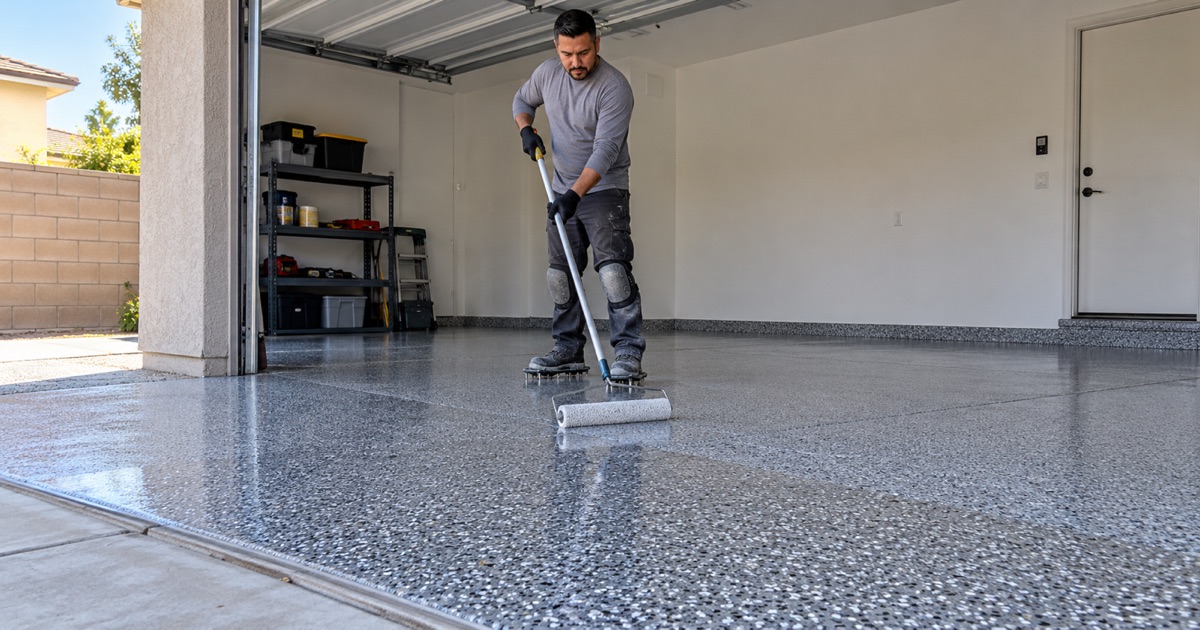
A Pre-1960 Slab in Rubidoux or Crestmore
Roughly 6,297 units here were built before 1960, and 987 of those predate 1940. Those slabs were commonly placed without a vapor retarder beneath them, and six or seven decades of settlement, patching and hot tire pickup have usually left a surface with several different histories in it.
Work on that side of the city is patient rather than aggressive. Cracks are routed out and filled with a semi-rigid joint filler where the joint is still moving, delaminated patches come off, and the grinding pass is as much diagnosis as production. What the first pass exposes usually decides how the rest of the day is spent, which is why we would rather grind a test area at the estimate than guess at one.
A Power-Troweled Distribution Floor in Mira Loma
The industrial floors are the opposite problem. A recent warehouse placement is machine-troweled to a burnished, closed surface that is far too tight for any coating to key into, and nothing about it needs repair — it needs opening up. Bidding it like an old slab wastes a day; bidding an old slab like it produces a coating that lifts inside a year.
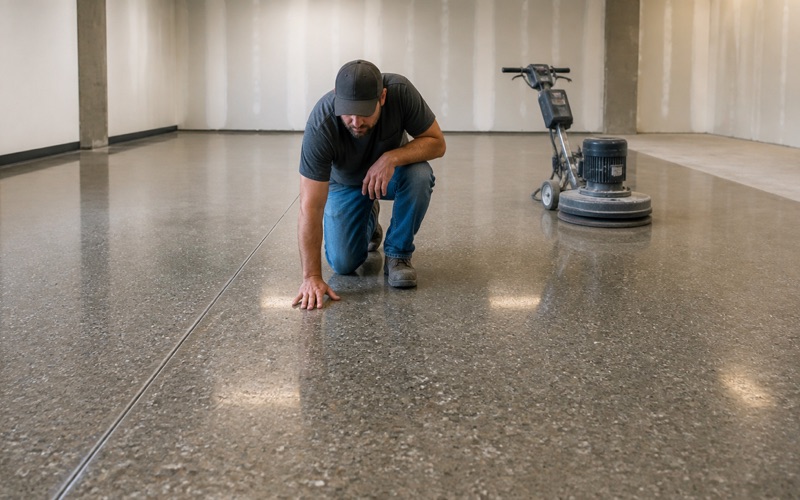
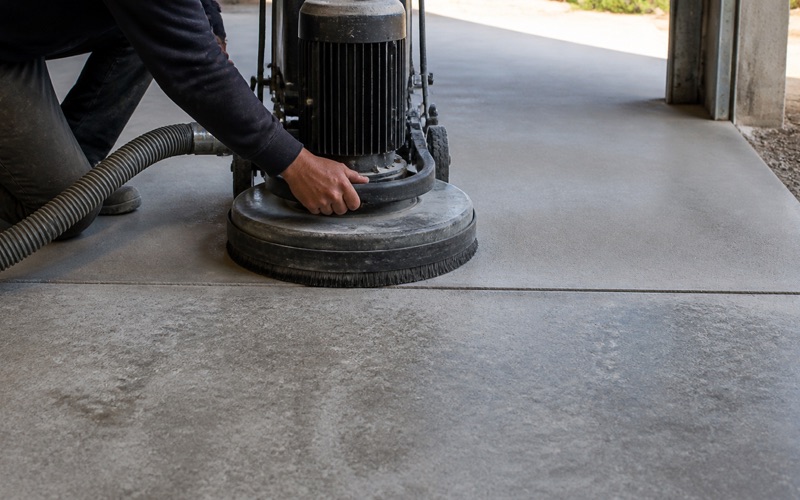
That calls for aggressive diamond grinding to a named ICRI concrete surface profile, usually deeper than a residential job would ever require, with dust extraction sized for the square footage. A polyaspartic build over a properly opened profile is where this system genuinely earns its money.
Why a Citywide Average Prices Nothing Correctly
Estimating a specific address off a citywide average is how a bid goes wrong here. The city only incorporated on July 1, 2011, so the citywide number it produces, 51.2 percent of 29,248 units predating 1980, is seven housing stocks averaged together rather than a description of any one of them. Prep hours, moisture risk, mobilization and the amount of failed coating to remove all move independently between these communities, and averaging them produces a number that is wrong in both directions at once.
So a walk of the slab comes before a price. Removal of a failed prior coating is written as its own line of work when we find one, rather than folded into a square-foot rate that assumes it lifts easily. Two addresses a mile apart in this city routinely differ by more than the coating itself costs.
Looking for epoxy flooring closer to Banning? See Banning Epoxy Flooring.
Why Polyaspartic, and Where It Is the Wrong Call
Return to Service Measured in Hours
The reason a polyaspartic system gets specified at all is speed. Its recoat window is short and its return-to-service time is measured in hours rather than days, which is what makes a weekend shutdown realistic on a floor that has to carry forklifts on Monday.
It is also UV stable, so it does not amber the way a straight epoxy topcoat will under skylights or in a bay with an open door all day. On a residential garage that shows up as color that still matches itself in five years. On a commercial floor it means a color-coded aisle layout still reads as designed after several summers under skylights.
Pot Life on a Hot Inland Slab
The trade-off is working time. Pot life on one published product runs roughly 60 minutes at a 55 degrees F slab and about 20 minutes at 95 degrees F, and inland summer afternoons here sit at the unhelpful end of that curve.
On a large open floor that changes crew size and batch discipline rather than just the start time. We read surface temperature and dew point on the day, keep batches small, and set the wet film thickness with a gauge rather than by eye, because a fast chemistry punishes guessing. Scheduling is driven by slab temperature and dew point rather than by the calendar, which on an inland summer job usually means starting early and finishing before the afternoon.
Freezer and Wash-Down Bays Are Urethane Cement Territory
Lineage operates a temperature-controlled Mira Loma regional distribution facility, and we will say plainly what most of this trade sells around: a freezer or cooler bay that moves thermally and gets washed down is urethane cement work, not a job for a polyaspartic or resin coating.
Thermal cycling and hot wash-down will find the bond line of the wrong system, and quoting one into that environment is a known failure mode rather than a risk. If that is the room, we would rather name the right chemistry and lose the easy sale. An honest no on one room tends to be worth more than a yes we have to come back and argue about.
Preparation Decisions That Do Not Transfer
Diamond Segment Bond Against Slab Hardness
The tooling decision is made against the concrete in front of us on the rule that hard concrete takes a soft bond. A soft 1950s pour and a hard modern warehouse slab will load the same segment in opposite ways, and running one grit sequence across every job is how a crew ends up polishing when it meant to profile.
We cut a test area, read how the tooling behaves, and set the sequence from that. Acid etching is not part of the process on either side of the city, because it does not produce a consistent, measurable profile.
Routing, Patching and Joint Treatment on Old Concrete
Old slabs need their cracks and control joints dealt with honestly. A saw-cut joint that is still working gets a semi-rigid epoxy joint filler rather than a skim of patch compound, and a crack that has moved gets routed to a real section before anything fills it.
None of that applies to a new distribution floor, where the joints are sound and the question is whether the joint filler already in them is compatible with what we are about to put down. Two completely different conversations, sometimes on the same day. Compatibility gets confirmed against product data rather than assumed from what the joint looks like.
Moisture Testing on the Older Side of the City
On the pre-1960 stock a moisture test is a standard line item rather than an upsell. ASTM F2170 in-situ relative humidity probes read a state inside the slab at 40 percent of its depth and ASTM F1869 calcium chloride reads a vapor emission rate at the surface, and the reading is written into the proposal before material is ordered.
The thresholds live in ASTM F710 rather than in either test method, and an ASTM D4263 plastic sheet is indicative only, since a positive fails a slab and a negative proves nothing. Where the number comes back high, a moisture vapor barrier primer becomes part of the scope instead of a surprise later.
Working Inside Somebody Else’s Schedule
Racking, Equipment and Tenant-Improvement Sequencing
Warehouse coating windows in this city are routinely defined by other trades. Racking installation, conveyor and equipment sets and the rest of a tenant-improvement sequence all compete for the same empty floor, and the coating is usually the one that has to wait or has to be quick.
We confirm the racking and equipment install sequence before committing to a cure date. A polyaspartic system’s speed is only an advantage if the floor is genuinely clear on the day it is supposed to be. Where a shutdown is short, we would rather stage the work in bays than promise the whole floor at once.
Staging a Rig on Streets Built for Big Rigs
Etiwanda Avenue and the Mira Loma industrial streets carry constant heavy truck traffic to and from the freeways, and Costco’s mid-1980s warehouse there was the first of those buildings, triggering the conversion of the area from dairies and pasture.
Practically that means street parking for a crew vehicle is not a safe assumption anywhere near a dock apron. Grinder, dust extraction and material staging get planned around truck flow with the facility before the day, not negotiated at the gate on the morning.
Rule 1113 and the Residential Line
Rule 1113 in this district limits a floor coating to 50 g/L VOC and an industrial maintenance coating to 100 g/L, holds the two headings apart by definition, and through subsection (c)(6) forbids putting an industrial maintenance coating on a residential job or offering to.
In a city this evenly split between warehouse work and older residential work, that line gets tested constantly, so the two halves are estimated off different product ranges. Permits, where a job needs one, run through the City of Jurupa Valley Building and Safety Department and its online permitting system. Warranty terms go out with their exclusions stated in writing, including what happens if moisture drives a failure, rather than as a headline number with the conditions left unsaid.
- 20+ Years Experience
- Licensed & Insured
- Free Written Estimates