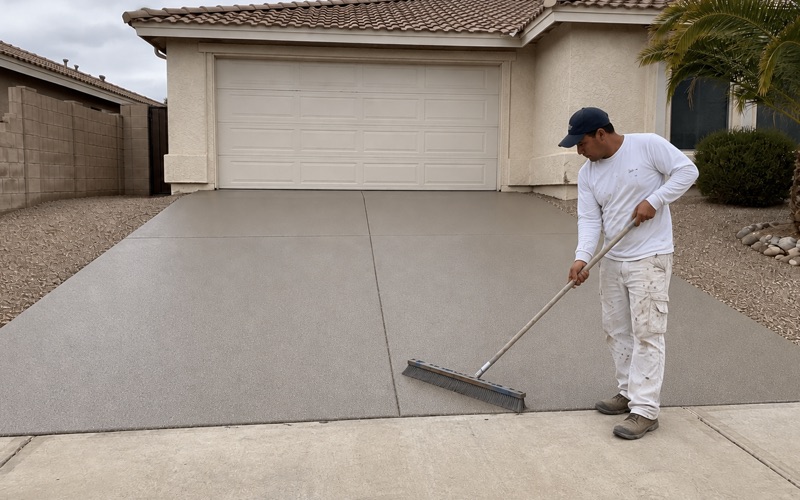
Highland Epoxy Flooring will haul a grinder up the canyon for epoxy flooring in Lytle Creek, and we will also tell you plainly that this is a small community where every job is scheduled on its own rather than slotted into a route. Twenty years of inland work has made us comfortable saying that out loud.
Access is the defining operational fact and it is the honest reason our pricing and minimums here differ from valley work. A loaded trailer climbs a winding canyon road off the Interstate 15 corridor into terrain that rises well above the valley floor, and that is a real trip rather than a fifteen-minute hop.
The second fact is that the substrate question starts further back than usual. Before any product is discussed, we establish whether there is a slab on the parcel worth coating at all, because on older canyon properties that is genuinely not a given.
Getting the Equipment to the Slab
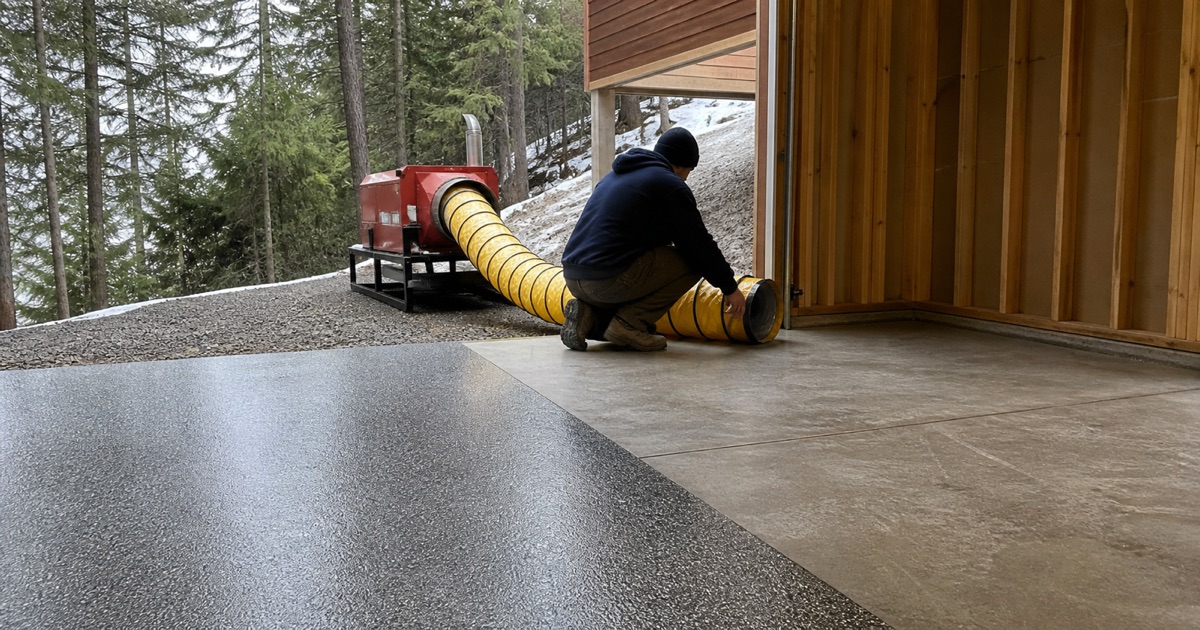
The Climb Off the Interstate With a Loaded Trailer
A planetary grinder, a dust-extraction rig, a generator and material all have to make the same trip. On a winding grade with a trailer behind the truck that is a planning exercise, not an afterthought, and it is the single biggest reason a Lytle Creek quote reads differently from one written a few miles downhill.
So we build the drive into the day rather than pretending it disappears. That means fewer, longer visits and a schedule that is agreed rather than assumed, which most people up here find perfectly reasonable once it is said openly. Batching two nearby jobs into one trip is usually better for everyone than two separate half-days.
Steep, Unpaved and Decomposed-Granite Driveways
Once up the canyon the last stretch is usually the hard part. Driveways are frequently steep, unpaved or surfaced in decomposed granite, and structures are often set well back from the road behind a grade a heavy machine cannot simply be walked up.
We confirm that last hundred feet before a date is committed: turnaround for the trailer, the grade, and whether the grinder can physically reach the slab. Discovering it on the morning costs the whole day, and the day was expensive to get here in the first place. Where power at the building is uncertain, that gets confirmed on the same visit.
No Back-Up Rig Anywhere Nearby
In the valley a failed machine means a phone call and an hour. Up here it means the job stops, so we arrive with spare tooling, spare consumables and a plan for the failure rather than an assumption that nothing will go wrong.
That redundancy is part of what a canyon job costs, and it is more honest to say so than to price like a suburban driveway and then explain later why the crew went home early. It is the same reasoning behind stating warranty terms with their exclusions in writing rather than as a headline number.
Looking for epoxy flooring closer to Nuevo? See Epoxy Flooring in Nuevo.
First Question: Is There a Slab to Coat?
Piers, Posts and Raised Crawlspaces
Older canyon cabins were commonly built on piers, posts or a raised crawlspace with wood floors rather than slab-on-grade. That is a default assumption we verify on site rather than a measured share of anything, and it changes the entire conversation when it turns out to be true.
Where the house has no slab, the only coatable concrete on the parcel is a detached garage, a shop or an outbuilding, if one exists at all. Establishing that on a first visit saves everybody a wasted estimate. It also tells the owner something useful about their own property that they may not have been told before.
Where There Is a Slab, It Is Usually an Old One
Around two thirds of the housing here predates 1980, and more than a quarter of it dates to the 1940s. Slabs of that vintage were placed without a vapor retarder underneath, and a canyon parcel adds drainage and a water table that a valley lot does not have.
So ASTM F2170 in-situ relative humidity or ASTM F1869 calcium chloride testing is mandatory scope here rather than an optional extra, with the pass and fail thresholds living in ASTM F710 rather than in either method. An ASTM D4263 plastic sheet is indicative only, since a positive fails a slab and a negative proves nothing, and the reading goes into the proposal before material is ordered.
What the Numbers Here Honestly Support
This is a community of a few hundred housing units, nearly all of them detached houses, with fewer than a dozen renter households and no commercial or industrial anchors at all. The published estimate sits around 330 units with a margin of error near plus or minus 80, so every figure should be read as directional.
We say that rather than implying a busy local service area, because a resident would know immediately that it was not true. Jobs here are individual, planned in advance, and worth doing properly when they come. A small market is not a reason to do smaller work; it is a reason to plan it properly.
A Schedule Fire and Weather Can Erase
Wildfire Is a Condition, Not an Event
This area has a documented history of large, stand-replacing wildland fires with significant impacts to the community, and the USDA Forest Service, Pacific Southwest Region and CAL FIRE have run a Lytle Creek Hazardous Fuels Reduction Project to remove hazardous fuels adjacent to the community and its infrastructure.
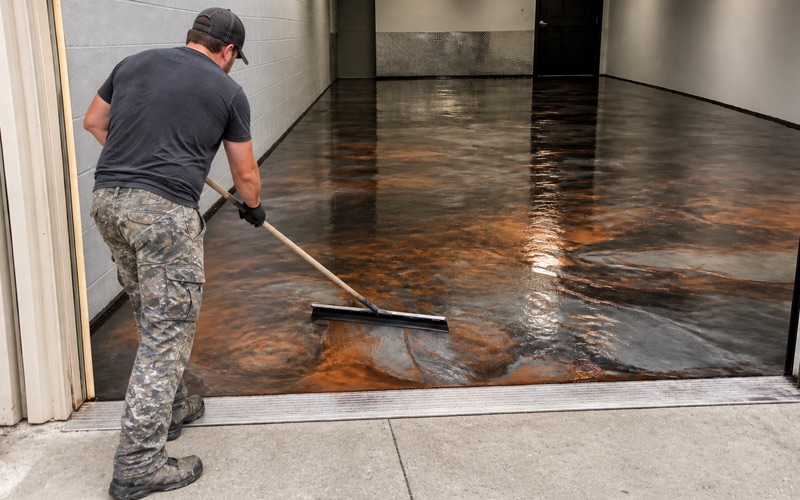
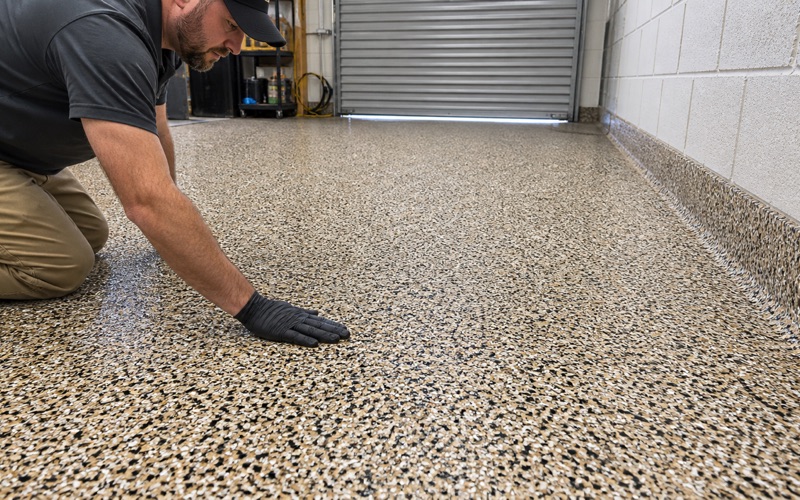
Practically that means a scheduled job can be cancelled by a road closure with no warning at all. It also shifts what a customer actually wants, which is often an ignition-resistant, easily cleaned shop or garage floor rather than a decorative flake finish. A surface that hoses down and does not hold ash and grit in its texture is a practical request up here, not an aesthetic one.
Burn Scars, Storms and Winter Closures
Post-fire burn scars in this drainage make debris flow and road closure a live risk on top of ordinary storm closures, and that risk concentrates between late fall and early spring. Bare ground above a canyon moves water and debris in a way vegetated ground does not.
Anything we book in that window carries an explicit weather contingency written into the agreement. A date that can move by agreement is worth more than a date that quietly cannot be kept. We would rather have that conversation at the estimate than on the phone at seven in the morning.
Building the Contingency Into the Date
We would rather hold two possible windows than promise one and apologize. Material is ordered against a confirmed date, and where the forecast or a closure moves it, the order moves with it rather than sitting in a truck. Two-part material with a stated shelf and working life does not benefit from riding around waiting for a road to open.
That is also why we ask about access alternatives and about who will be on the property at the estimate stage. Knowing in advance who can open a gate is the difference between a delay and a cancellation, and on a canyon property that gate is often a long way from the house.
Specifying a Floor for a Canyon Slab
Preparation Is Mechanical, Always
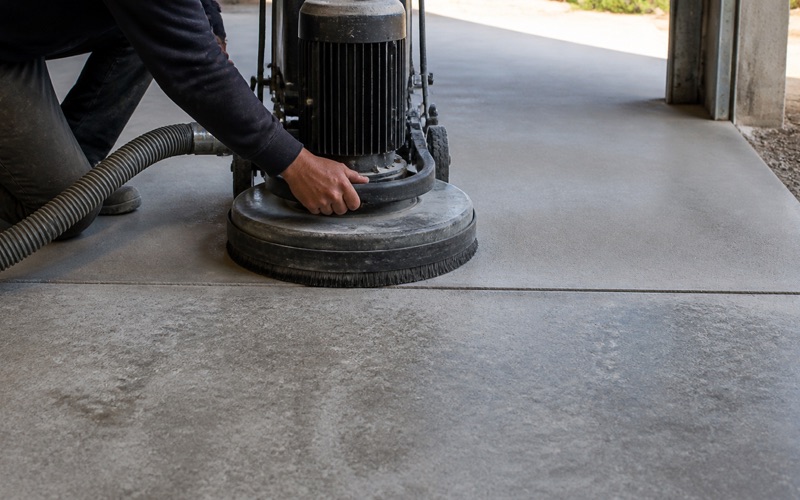
Every slab gets its profile opened by diamond grinding to a named ICRI concrete surface profile. Acid etching is not part of our process anywhere, and on old canyon concrete of uneven hardness it would be particularly useless. A named profile is something a manufacturer will stand behind; an etched surface is not.
The diamond segment bond is chosen against the slab in front of us on the rule that hard concrete takes a soft bond, and where a previous owner rolled on a one-part paint or a store-bought kit, removal is quoted as its own line of work rather than hidden inside a rate. On a slab this old that removal can be most of the first day.
Cool Slabs Stretch Cure and Recoat Windows
Elevation cuts the other way from the valley floor here. Cool mornings and shoulder-season slab temperatures push pot life toward the long end of a product’s published curve, which sounds like an advantage and is only half of one.
Full cure and the recoat window stretch with it, so a floor that would be walkable by evening down in the valley may not be up here under the same conditions. We check a product’s stated application conditions and the dew point margin before a winter job, and we monitor surface temperature rather than air temperature. The slab is what the coating touches, and it lags the air by hours in either direction.
Permits, Defensible Space and the VOC Rule We Work To
There is no HOA layer and no city architectural review in this community. The gate is San Bernardino County Land Use Services, which issues building permits for the unincorporated area through the county’s online permitting portal, and County Fire’s defensible space requirements are usually what an owner is actually thinking about.
On product selection we work to South Coast AQMD Rule 1113: 50 g/L VOC for floor coatings, 100 g/L for industrial maintenance coatings, with subsection (c)(6) barring industrial maintenance coatings for residential use. Because this is an unincorporated place rather than an incorporated city, we check the district assignment per address rather than treating it as settled.
- 20+ Years Experience
- Licensed & Insured
- Free Written Estimates