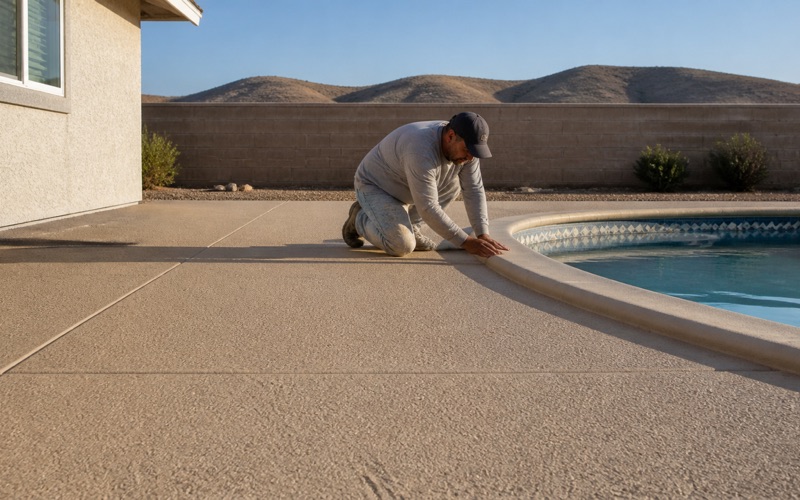
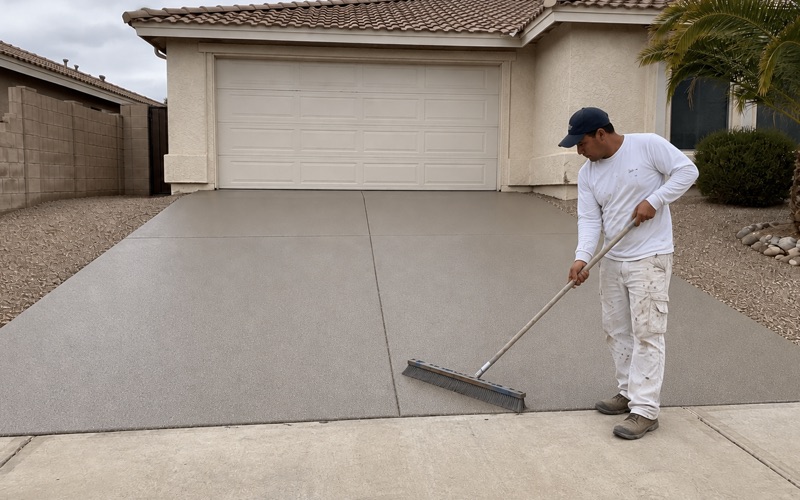
Highland Epoxy Flooring does more commercial than residential epoxy flooring in Mentone, which is not the ratio anyone expects in a community this small. The reason is the business mix here. Seventeen named automotive businesses operate inside this unincorporated community, nearly all of them on or a block off Mentone Boulevard.
Clear Coat Auto Body and Collision, M&M Custom Auto Body, Cole Competition Engines, Bulletproof Suspension Inc., Cota’s Tire Services, Mentone Auto and Muffler and RV Paint Department are all operating on concrete that takes solvent, gear oil and hot rubber daily. Concentrated like that, the local floor market is a chemical-resistance conversation rather than a color selection.
Twenty years and more into this trade, we quote a service bay the way we quote a garage slab: a moisture reading written into the proposal before any material is ordered, a mechanical profile opened by diamond grinding to a named ICRI concrete surface profile, and a coating category chosen against the VOC limits that legally apply to that specific building.
Coating a Body Shop or Collision Bay on Mentone Boulevard
What a Collision Floor Actually Has to Resist
Filler dust, lacquer thinner, reducers, brake fluid and gear oil can all land on the same square yard of slab in one afternoon. A floor sold on the strength of its flake blend will chalk and soften under that load inside a season, so we build the specification from the exposure list the shop itself generates rather than from a sample board.
The system we usually land on is a 100% solids epoxy body coat carrying the film thickness, finished with a urethane topcoat that carries the chemical and abrasion duty. The topcoat is the sacrificial layer, it is the one we expect to be renewed on a maintenance cycle, and we put that expectation in writing instead of implying the floor is permanent.
Mil Build Is Measured, Not Assumed
“Two coats” describes a sequence, not a thickness. We take wet film thickness gauge readings as material goes down and work back against the product’s published solids content, because a chemical-resistant product rolled out thin is still a thin film, and thin films are what fail first at the door line and under the lift.
The number an owner-operator actually cares about is how many days the bay is out of service, and that is set by mil build and cure schedule together. A heavier build buys durability and costs return-to-service time, so both figures go in the proposal and the shop chooses the tradeoff against its own booking calendar.
Hot Tire Pickup and Why a Prior Film Lifts
Hot tire pickup is not folklore. A tire comes off the highway hot, parks on a thin one-part film, cools, and takes a disc of that film with it when the vehicle pulls out. It is the most common reason we get called to a slab in this community that has already been coated once by somebody else.
The answer is not another coat of the same wrong product over the wreckage. It is mechanical removal of the failed film, a fresh profile ground into sound concrete, and a high-solids system bonded to an opened surface rather than perched on a sealed one. That removal is quoted as its own line of work so no one meets it as a surprise mid-job.
Looking for epoxy flooring closer to Loma Linda? See Loma Linda Epoxy Flooring.
Engine, Muffler, Tire and Paint Shop Floors
Point Loads From Jacks, Stands and Dropped Tooling
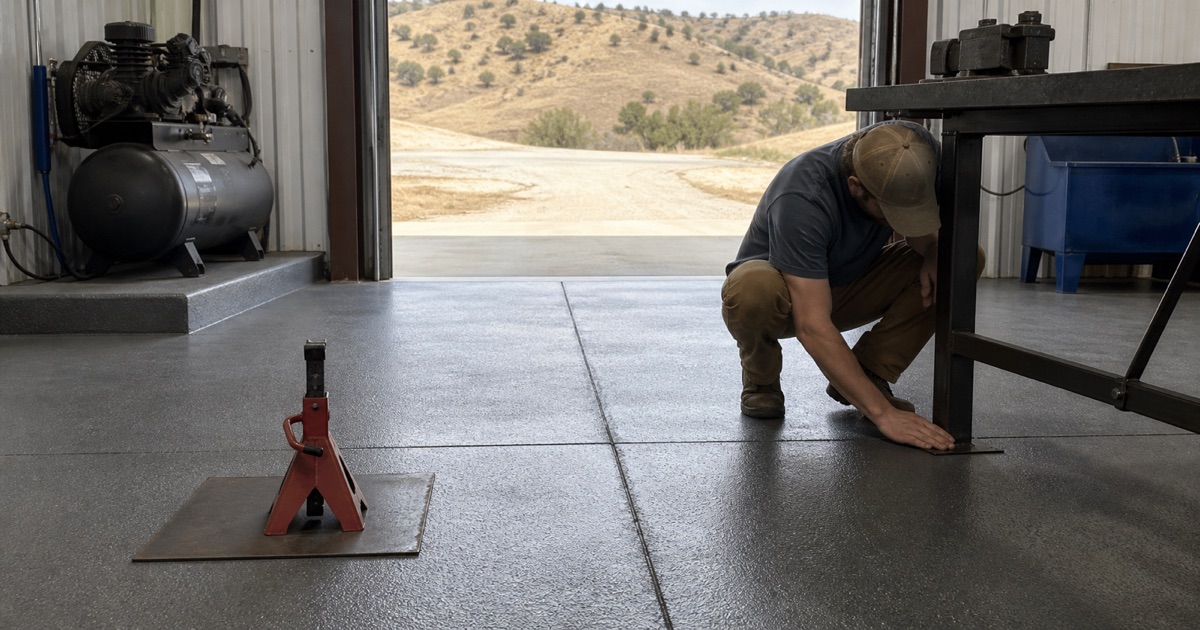
An engine builder’s floor sees concentrated point loads from engine stands and jack pads, plus impact from dropped tooling, in a way a showroom floor never does. Compressive strength of the coating matters less than the soundness of the concrete carrying it, which is why we sound the slab and price repair of any hollow or spalled areas before quoting a system over them.
Suspension fabrication and muffler work add heat and sparks near the floor. Where cutting and welding happen in a fixed spot we will often recommend leaving that zone uncoated or accepting it as a wear area to be patched, rather than selling a decorative finish into a place that will be scarred within a month.
Control Joints and Joint Filler Under Rolling Gear
A saw-cut control joint left open under a floor jack or a rolling tool chest spalls at the edges, and once the arris breaks down the coating around it goes with it. On shop floors we fill sound joints with a semi-rigid epoxy joint filler that supports the joint edge while still allowing the slab to behave as it was designed to.
We do not simply coat over every joint and pretend it has gone away, because it has not. A joint that is honored, filled and finished flush reads as one continuous floor to a rolling caster and still relieves stress where the slab needs it, and that distinction is worth explaining to an owner before the work starts.
RV Paint, Storage and Powder Coating Neighbors
RV and boat storage slabs and a paint department floor are a different problem again: long dwell times under parked weight, drips that sit for weeks, and overspray that has to be cleanable rather than merely resistant. Those jobs push toward a chemically tighter topcoat and a slip-resistant finish measured as DCOF rather than judged by feel.
Worth saying plainly: not every business on this boulevard is a prospect. A powder coating shop and a concrete contractor both operate out of Mentone, and in a market this small they are peers and referral sources at least as often as they are customers. We would rather be honest about that than pretend every address is a lead.
Pot Life Collapse on a 1,650-Foot Slab in August
Slab Temperature Is the Reading That Governs
Mentone sits at roughly 1,650 feet on the south bank of the Santa Ana River, low enough that the cure problem here tilts hot rather than cold. On one published product, pot life runs about 60 minutes at 55 degrees F, 40 minutes at 72 degrees F and 20 minutes at 95 degrees F, and an uninsulated slab in an inland summer can approach a 160 degrees F surface maximum.
Those numbers are keyed to the surface, not to the shade temperature on a phone. We take a slab temperature reading at the start of every summer install and schedule from it, which is why work in July and August starts early and why we will move a date rather than mix into a slab that is already past the window.
Small Batches and a Recoat Window That Collapses
When pot life drops to twenty minutes, batch size and crew size have to change with it. Mixing a full kit and hoping to spread it is how a bay ends up with ridges, roller stipple and a hard edge halfway across the floor, so summer jobs get smaller batches, more hands and a planned wet edge.
Heat cuts the other end of the schedule too. The same product’s recoat minimum falls from 24 hours to 6, which sounds like good news and is actually a narrower window, because a missed recoat means abrading the whole floor again before the next coat can bond. Sequencing has to be planned around the day rather than assumed.
The Five Degrees Above Dew Point Floor
The quieter constraint is dew point. Common data sheets require the surface to sit at least 5 degrees F above dew point, and a cool slab in a closed bay after a wet morning can fail that test while the air feels perfectly fine to stand in.
Condensation at that scale is invisible and it destroys adhesion completely. Checking the two readings takes a couple of minutes and it is the cheapest insurance on the entire job, so it happens on every install rather than on the ones that look questionable.
Garage Floors on the 1887 Citrus Townsite
The Real Residential Number Is 1,923 Houses
Mentone was laid out as a citrus townsite in the late 1880s, and the flat grid that came out of it is easy to work on. The honest addressable pool, though, is not the census population of fewer than 10,000 people, and it is not the 3,690 housing units either. It is the 1,923 owner-occupied single-family detached houses, because a garage floor decision has to be made by somebody who owns the property.
Another 382 detached houses here are rented, which is a large single-family rental layer for a place this size, and roughly 487 mobile homes carry carports rather than garage slabs. We would rather scope from the real number than quote against a population figure that nobody can actually sell to.
Moisture Is Scope on a Pre-1950 Slab
A little under a quarter of the housing stock predates 1960 and several hundred units predate 1950, and under-slab vapor retarders were not routine that early. On that stock the moisture question is scope rather than an add-on, and we test with ASTM F2170 in-situ relative humidity probes or ASTM F1869 calcium chloride before a product is chosen.
We also test newer garages. The California Residential Code exempts garages from the under-slab vapor retarder requirement, so a recent pour proves nothing on its own. ASTM D4263 plastic sheet is treated as indicative only because it is asymmetric, a positive result fails a slab while a negative one proves nothing, and the acceptance thresholds live in ASTM F710 rather than in the test methods.
Diamond Grinding, Bond Hardness and Where the Permit Counter Is
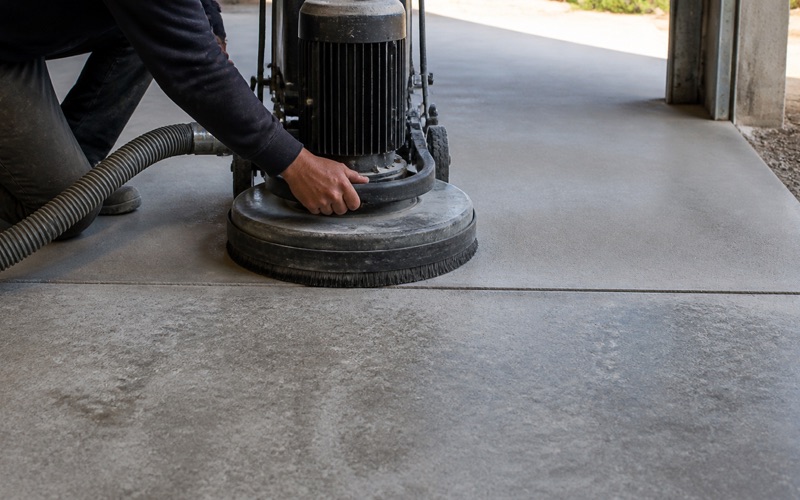
Profile is opened mechanically, with diamond grinding to a named ICRI concrete surface profile, never by acid etching. Segment bond is chosen against the hardness of the slab in front of us on the rule that hard concrete takes a soft bond, which is why we do not run one grit sequence across every job in a neighborhood.
One scheduling note that matters here: Mentone is an unincorporated census-designated place, so the building authority is San Bernardino County Land Use Services, Building and Safety Division at the County Government Center on North Arrowhead Avenue. Anything that does touch a permit runs through that counter, and turnaround expectations should be set accordingly.
- 20+ Years Experience
- Licensed & Insured
- Free Written Estimates