
Highland Epoxy Flooring installs metallic epoxy floors in Highland, CA, and after two decades of pouring decorative systems in this valley we sell them with their limitations attached, serving surrounding cities including Redlands, Mentone, Loma Linda, Running Springs and San Bernardino. A metallic floor is the one product on this site bought almost entirely for how it looks. That makes the specification conversation different from every other page here.
What produces the effect is a reflective pigment suspended in a clear 100% solids epoxy and then moved while it is still flowing. The pigment settles and separates as the resin levels, and the depth people recognize comes from that separation rather than from any printed or stamped pattern. It is a controlled accident, and the control is the part you are hiring.
Everything underneath it is ordinary and unglamorous, and it is what decides whether the floor lasts. The slab is tested and mechanically profiled, a pigmented base coat goes down as the color the metallic sits on, and a protective topcoat goes over the finished pour. Skip any of those and you have a photogenic floor with a short life.
How a Metallic Floor Is Actually Made
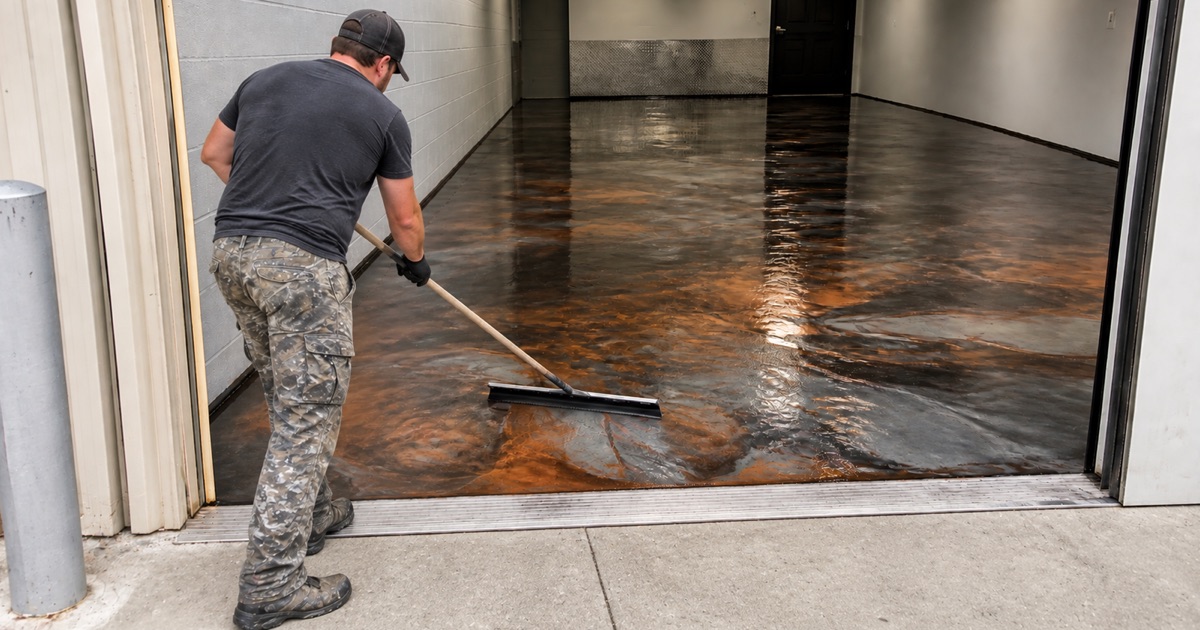
The sequence matters more here than on any other decorative system. A mistake in one layer stays visible through every layer above it.
The Base Coat Decides the Depth
The pigmented base coat is not just an adhesion layer, it is the color the metallic reads against. A black or charcoal base gives the finished floor its darkest veins and the deepest apparent dimension, while a light base produces a softer, brighter floor with less contrast. Choosing that base is a design decision made before any metallic is mixed, and changing your mind afterward means starting the whole build again.
Pigment Is Moved, Not Poured
Once the metallic layer is spread it gets worked: a roller or squeegee to distribute it, then air, a solvent misting, or a trowel edge to open cells and drive the veining. How aggressively that is done, and how long the crew has before the resin stops responding, is where technique lives. A large room needs a plan for which direction the crew retreats in, since a bootprint in the wrong place is in the floor for good.
The Topcoat Is Not Optional
The metallic layer is a clear epoxy, and clear aromatic epoxy is not the right final surface: it ambers under ultraviolet light and it scratches more readily than the finishes made for wear. A urethane or polyaspartic topcoat carries the abrasion, the gloss level and the chemical resistance, and it is the layer that can be renewed later without touching the artwork underneath it.
What a Metallic Floor Cannot Be Asked to Do
These are the three things people are most often surprised by. All three are easier to hear before the deposit than after the pour.
It Cannot Be Reproduced Exactly
Every pour is unique, including two bays of the same garage done on the same day. We can control the palette, the contrast and roughly how busy the floor reads, and we cannot promise a specific arrangement of veins. Clients who want certainty about the pattern are happier with a flake floor, where appearance is a specification rather than an outcome.
It Cannot Be Spot-Repaired Invisibly
A damaged area can be repaired and it will not disappear, because the surrounding pattern cannot be continued into the patch. On a busy dark blend the repair blends acceptably; on a calm pale floor it reads. That is a real argument for putting a metallic floor where impact and dropped tools are unlikely, and something more forgiving where they are routine.
It Is Smooth Until Someone Makes It Otherwise
The finish that shows the pattern best is also the finish with the least texture, so slip resistance is added rather than inherent. A fine aggregate or polymer additive broadcast into the topcoat gives a measurable DCOF value at a modest cost in mirror. In a garage where wet vehicles come in off a sloping driveway, that trade is usually worth making.
Where a Metallic Floor Belongs in Highland
About three quarters of this city’s housing is single-family detached. Most of the demand here arrives as a finished garage rather than as a commercial specification.
Garages and Converted Bays
The strongest residential fit is a bay that has stopped being purely a garage: a workshop kept clean, a gym, a collection space, or a converted room off the house. Those floors see light traffic, little chemical exposure and a lot of looking at. A working bay with a project car and a welder on it is a different brief.
Showrooms and Retail Along Base Line
Base Line is Highland’s retail and restaurant spine and the corridor the city identifies as its town center, and metallic floors do their commercial work in exactly those spaces: sales floors, entries, salons, studios and showrooms where the floor is part of the presentation. Back-of-house behind those same tenancies almost always wants a different system.
Where We Point People Elsewhere
We talk clients out of metallic in wash-down areas, commercial kitchens, mechanical rooms and anywhere with real thermal or chemical load, and outdoors, where a smooth reflective surface is the wrong answer to sun and water. Saying that costs a sale occasionally and far less than replacing a floor that was never going to survive the room.
- 20+ Years Experience
- Licensed & Insured
- Free Written Estimates