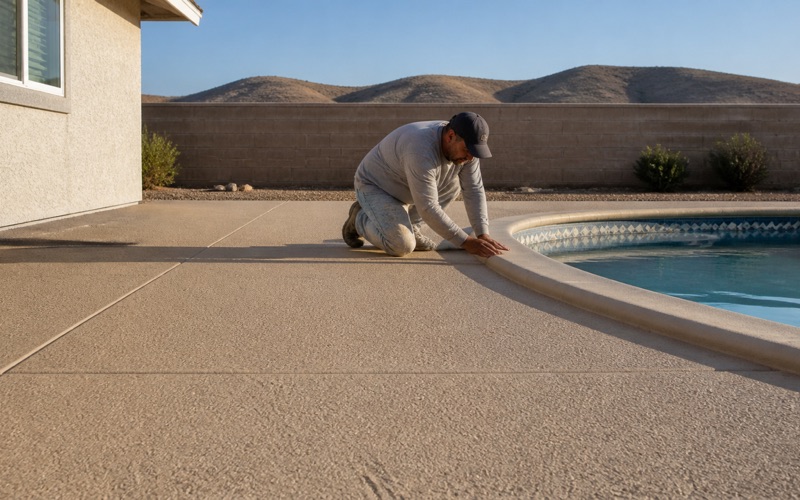
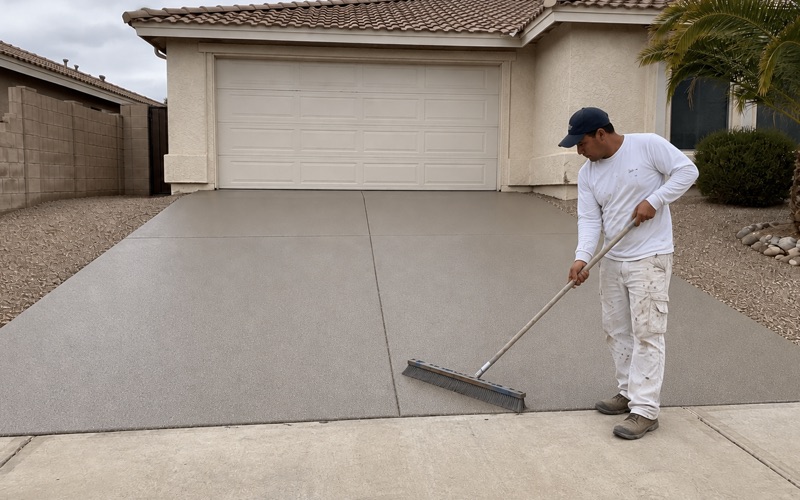
Highland Epoxy Flooring has done enough concrete resurfacing in Moreno Valley to describe most of the city’s slabs before seeing them, and after twenty years that is less a boast than an accident of how this place got built. Four homes in five here went down after 1980.
That concentration is unusual and it is genuinely useful to a customer. A crew working residential in this city is working essentially one generation of concrete, so the prep specification can be settled rather than re-argued on every driveway, and the surprises are about how a floor has been used rather than how it was originally made.
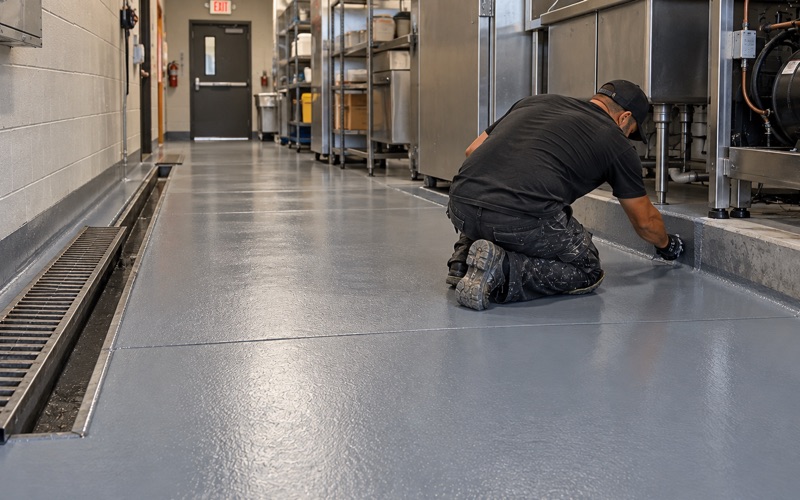
The other half of the work is industrial and it is large. Distribution operations, production plants and one very substantial entitled logistics project sit across the south and east of town, and the coating that is legal to put on those floors is not the coating that is legal inside a garage.
One Decade of Concrete Under Almost the Whole City
Twenty-Three Thousand Slabs Poured Inside Ten Years
The number that defines this market is 22,982 housing units built in the 1980s alone, 40.1% of every home in the city, with 46,675 units — 81.3% of the stock — built in 1980 or later. Only 4.2% of housing predates 1960, and that small tail sits in the older Moreno, Sunnymead and Edgemont settlement areas.
Very few cities of this size are that uniform. Somewhere like Riverside sends a crew across eight decades of concrete in a single week; here the same crew can work a month without meeting a slab poured before the Reagan administration, and the estimate reflects that rather than hedging against unknowns that are not present.
A Defect List Driven by Use, Not by Era
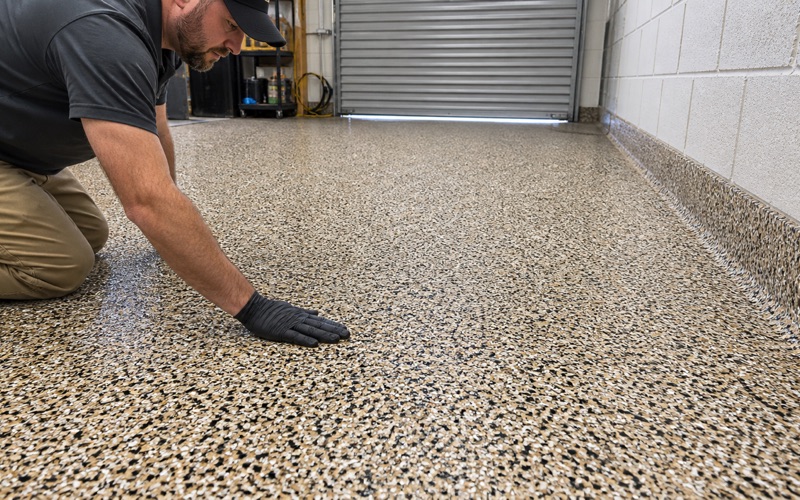
What ages a 1980s tract garage slab is what has happened on top of it. We expect control-joint and shrinkage cracking, settlement and lipping at the garage door threshold, edge curling along the exposed perimeter, and three or four decades of motor oil and tire-plasticizer staining ground into the surface.
Every one of those is a use profile rather than an era profile, and they behave predictably. A crack that has stopped moving is repaired and coated over; one that has not is detailed to keep moving. Oil is drawn out and the affected area profiled harder than the field, because a coating over saturated concrete fails at exactly the spot the customer will notice first.
What a Repeatable Prep Specification Buys
Because the substrate repeats, the grit sequence, the tooling and the day plan can be fixed in advance rather than improvised. We name the diamond segment bond against the hardness of the slab we are standing on — hard concrete takes a soft bond, which surprises most people — and run PCD tooling where a previous coating has to come off before anything else can happen.
The customer benefit is not technical, it is logistical. Crew size, equipment list and the number of days on site are known when the proposal is written, so a Saturday quote does not turn into a Tuesday phone call explaining why the price moved after the first pass.
Looking for epoxy flooring closer to Bloomington? See Epoxy Flooring Services in Bloomington.
Testing a 1980s Slab Rather Than Assuming It
Elevated Moisture as the Condition to Find
Because most of this housing went in after 1980, under-slab vapor retarders were routine construction practice on the overwhelming majority of these floors. That makes elevated moisture vapor emission the condition to find here rather than the condition to assume, which is the opposite of how the same trade has to think in an older city.
Finding it still means testing for it. Moisture failure is the dominant failure mode in resinous flooring and it is the failure most coating warranties explicitly exclude, so we test every slab, write the reading into the proposal before material is ordered, and state our warranty exclusions in writing rather than publishing a headline number and leaving the conditions unsaid.
Which Test, and Where the Thresholds Actually Live
We read slab moisture with in-situ relative humidity probes to ASTM F2170, and calcium chloride testing to ASTM F1869 where a specifier calls for it. The pass and fail numbers for both live in ASTM F710, not in the test methods themselves, which is a distinction that gets muddled constantly in proposals written by people who have never run either test.
ASTM D4263, the taped plastic sheet, is indicative only and we treat it that way: a positive result fails a slab outright, while a negative result proves nothing whatsoever. There is also a code point worth knowing, which is that the California Residential Code exempts garages from the under-slab vapor retarder requirement, so a garage slab never gets a pass on age alone.
Grinding a Failed Kit Off Forty-Year-Old Concrete
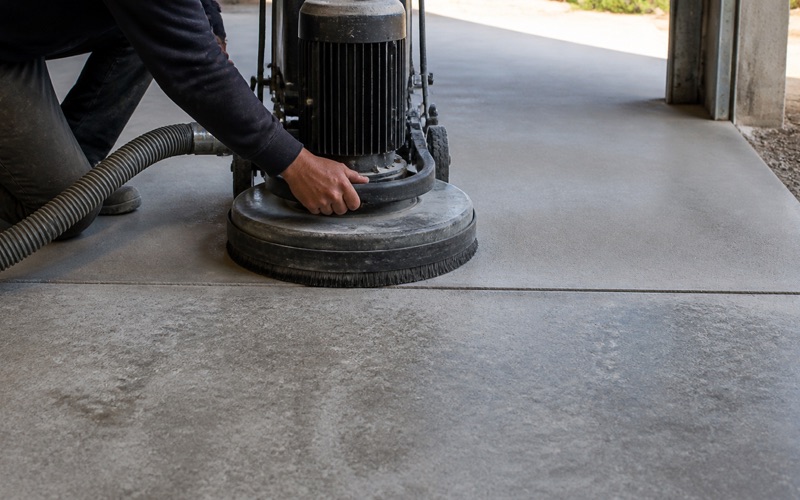
A very large share of these garages already carries a one-part paint or a store-bought two-part kit applied by a previous owner. It is peeling at the wheel paths, it is bonded unevenly, and it has to come off mechanically before any resurfacing system can be specified over the slab underneath it.
We quote that removal as its own line of work rather than folding it into a square-foot rate. The profile that follows is opened by diamond grinding to a named ICRI concrete surface profile, typically CSP 3 or CSP 4 depending on the film thickness going down, and never by acid etching, which leaves residue and a profile nobody can specify or verify.
Production Floors Behind the Distribution Names
The Manufacturers That Get Overlooked
Everyone recognizes the distribution names in this city. Fewer people notice that WABASH, Masonite Door Fabrication, Serta Simmons Bedding, Solaris Paper, ResMed and Eurotek Windows and Doors all run production operations here, and a production floor is a different specification from a pick aisle in almost every respect.
Plant floors take concentrated point loads under machine feet, chemical exposure that a distribution aisle never sees, and forklift traffic through the same twelve feet of concrete every shift. Those floors get built up rather than sealed: a heavier resinous system, aggregate where impact demands it, and joint detailing designed for wheels rather than for appearance.
Repairing Joints on a Floor That Has Been Driven On
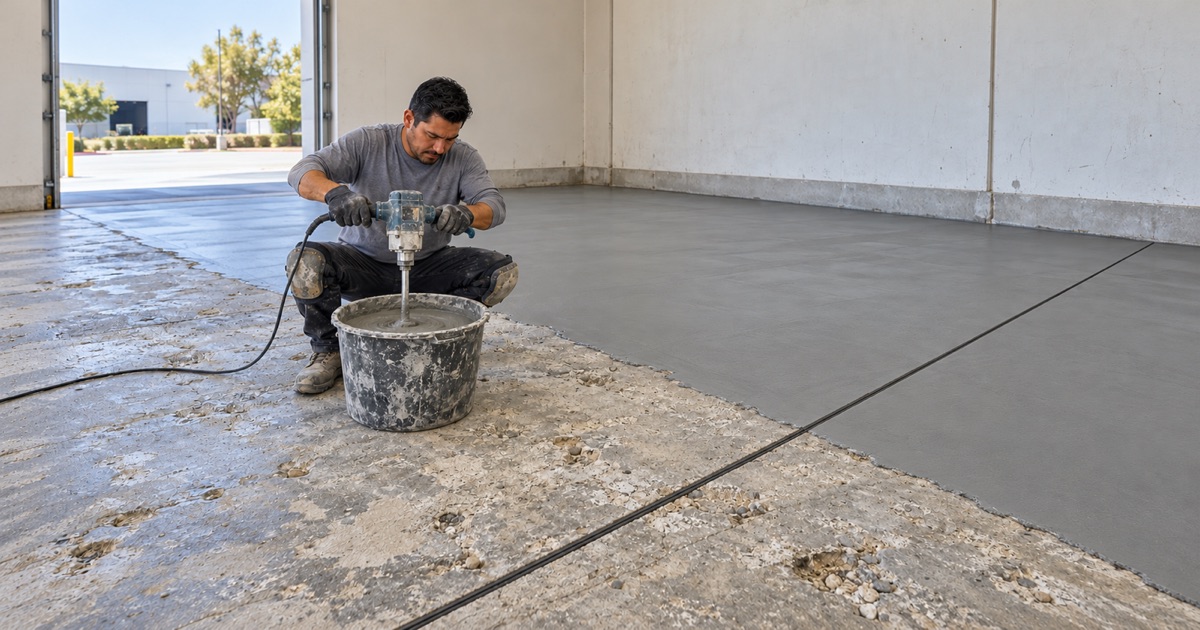
Existing warehouse and plant floors fail at their joints long before they fail in the field. Hard polyurethane wheels chip the joint arris, the spall widens, and eventually the forklift is dropping into the gap and shaking the load. That is a repair scope, not a coating scope, and it should be priced honestly as one.
We rebuild the arris, fill the saw-cut joint with a semi-rigid epoxy joint filler shaved flush so the edges are supported, and only then talk about what goes over the field. Doing it in the other order produces a floor that looks finished for a season and then telegraphs every joint back through the new surface.
Working Around an Operation That Does Not Stop
Distribution and production tenants here run close to continuously, which makes sequencing the hardest part of a commercial quote. We scope by bay or by aisle against the schedule the facility already has, and we ask what the dock and trailer-stall pattern looks like before promising any cure or return-to-service window.
Where markings are part of the scope we set them out to the operator’s own traffic plan, and we tell them straight that no federal regulation specifies an aisle stripe width or an aisle stripe color. That claim circulates widely in this industry, it is not true, and a facility manager making budget decisions deserves to hear the accurate version.
Scale, Entitlement and Which Product Is Legal
Forty Million Entitled Square Feet South of the 60
The World Logistics Center is a 2,610-acre project entitled for more than forty million square feet of logistics space across roughly twenty-seven buildings, south of the 60 Freeway between Redlands Boulevard and Gilman Springs Road. The city council approved it in 2015 and it is planned over roughly a fifteen-year build-out.
That is entitled acreage rather than delivered floor, and we describe it that way because the distinction matters to anyone budgeting against it. New-construction floor work at that scale is a fundamentally different sale from recoating an occupied building, priced by the acre and sequenced against a general contractor’s pour schedule rather than against a tenant’s operations.
Rule 1113 Across a Two-Sided Market
SCAQMD Rule 1113 caps floor coatings at 50 g/L VOC and industrial maintenance coatings at 100 g/L, the two categories are mutually exclusive by definition, and subsection (c)(6) prohibits any person from applying or soliciting the application of an industrial maintenance coating for residential use.
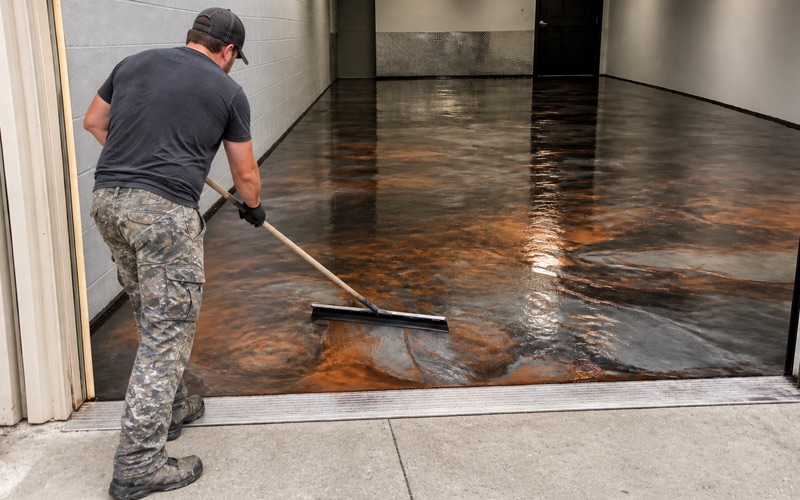
In a city with roughly 44,000 detached houses on one side and a very large industrial base on the other, that boundary gets crossed several times a week. We quote residential and commercial work from separate product lines for exactly that reason, and a durability argument is not a lawful route to bringing an industrial maintenance product into a garage.
Slab Temperature, Pot Life and the Permit Portal
Cure here is governed by the slab, not the calendar. On one published product pot life runs about sixty minutes at 55 degrees F, roughly forty at 72 degrees F and about twenty at 95 degrees F, with the recoat minimum collapsing from twenty-four hours to six, a floor of 5 degrees F above dew point, and a surface an uninsulated slab can push toward 160 degrees F in summer.
So we read surface temperature at the slab rather than air temperature off a phone, start early in summer and mix in small batches. On the permitting side the city runs SimpliCITY, an online plan review, permit and inspection portal available around the clock, so a permit interaction here does not require anybody to drive to City Hall.
- 20+ Years Experience
- Licensed & Insured
- Free Written Estimates