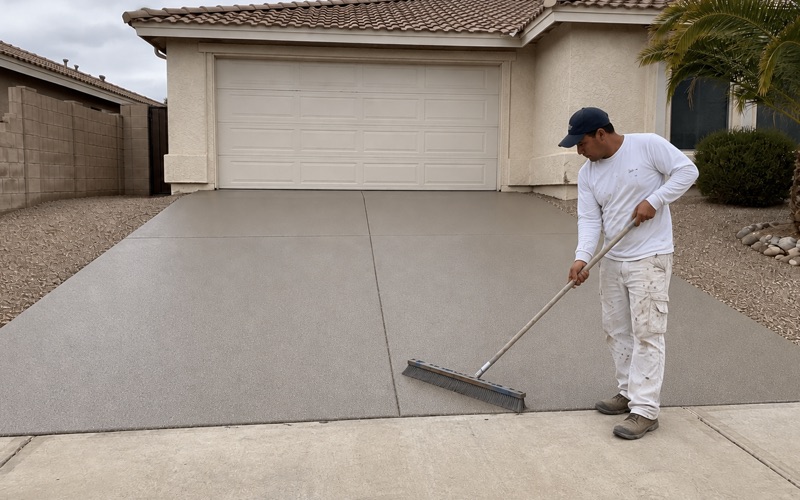
Highland Epoxy Flooring has spent twenty years putting epoxy flooring in Muscoy garages, shops and outbuildings, and on close to half of them the person signing the proposal does not live in the house. That single fact reorders everything about how a quote should be written here, and most coating companies working this area have never noticed it.
The housing tables cross tenure against structure type here in unusual detail, and what they show is a split near enough to even that neither buyer can be treated as the default. Roughly forty-eight percent of the occupied detached stock is somebody’s rental property, sitting on physically identical slabs in identical driveways alongside the half that is owner-occupied.
An owner-occupier and an investor are buying two different things from the same crew. One is choosing a floor to look at every day. The other is choosing an asset that has to survive tenants, turnovers and a maintenance budget, and wants to know how many days the unit is out of service. We quote both, but we do not quote them the same way.
Half the Detached Houses Here Are Rentals
Two Buyers, One Slab
When the resident owns the house, the conversation drifts naturally toward appearance: flake blends, chip size, whether a metallic pigment reads well under a single fixture. Those are real questions and we answer them, but they are not the questions that decide the job when the signature is coming from somewhere else.
A rental owner asks a shorter set. How many days is the garage unusable, what does it cost per unit, how does it hold up under a tenant who parks a work truck on it, and what happens if the coating fails in year two. Those answers are the whole sale on half the addressable stock in this community: the tables count 1,047 owner-occupied single-family detached houses against 1,002 renter-occupied ones, which is as close to an even split as this trade ever sees.
What Turnaround Actually Means Between Tenancies
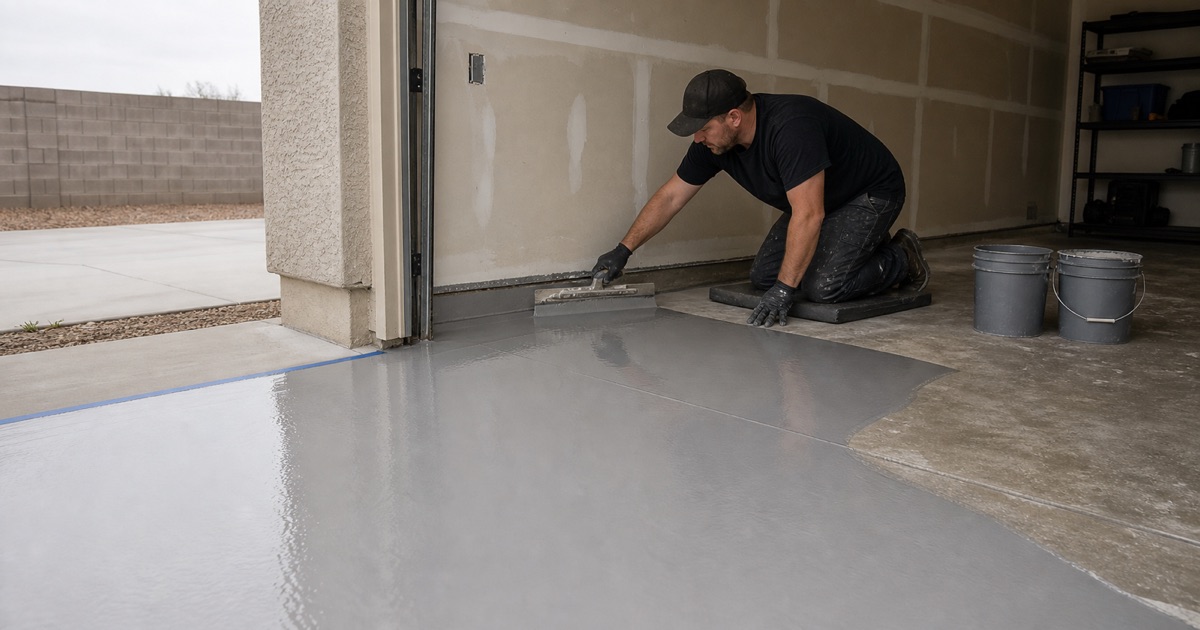
The window between one tenant leaving and the next arriving is the only window that exists on a rental, and it is usually short. That makes cure schedule a commercial term rather than a technical detail, so we state return-to-service by traffic type, separating foot traffic from vehicle traffic instead of quoting a single number that hides the difference.
It also changes what we recommend. A system that comes back to vehicle traffic faster is worth real money to an owner counting vacant days, and a system that survives a careless tenant is worth more than one that photographs better. We put both of those tradeoffs on the table rather than steering toward the pricier finish.
Scheduling When the Decision-Maker Is Not On Site
Remote authorization is normal here, which means the proposal has to carry enough detail to be approved without a walkthrough. The moisture reading, the named surface profile, the mil build, the removal scope and the exclusions all go in writing before anything is ordered, because nobody approves a number they have to trust blindly.
It also means access is a scheduled item rather than an assumption. We confirm who unlocks the building, whether power is live, and whether a tenant is still occupying it, before a crew and a trailer are dispatched. A wasted mobilization is expensive for us and it is a broken promise to the owner.
Looking for epoxy flooring closer to Highgrove? See Highgrove Epoxy Flooring.
Slabs Poured Before Under-Slab Vapor Retarders Were Routine
The Age Profile Is Not Marginal Here
Of 2,536 housing units in this community, 54.8 percent predate 1960 and 64.8 percent predate 1970. The 1940s and 1950s alone account for 50.4 percent of everything standing: 616 units built between 1940 and 1949 and 662 between 1950 and 1959. The median structure was built in 1959.
Under-slab vapor retarders were not standard practice on residential concrete of that era, so on the majority of jobs here the slab almost certainly went in without one. That is not a reason to refuse the work. It is a reason to measure before quoting a system, because a coating placed over an untested slab of that vintage is a warranty claim waiting to be filed.
Two Tests That Measure Two Different Things
ASTM F1869, the calcium chloride test, measures a moisture vapor emission rate at the surface over a set period. ASTM F2170 measures relative humidity inside the slab itself, with in-situ probes set at forty percent of the slab depth, which is a state rather than a rate. They are not interchangeable and they do not answer the same question.
The pass and fail numbers for both live in ASTM F710, not inside the test methods, which is why quoting a threshold without naming the standard it comes from is meaningless. We write the actual reading into the proposal before material is ordered, because moisture-driven failure is precisely what most coating warranties in this trade exclude.
The Test That Only Works In One Direction
ASTM D4263, the taped plastic sheet, still gets used as a field check and it is worth understanding what it can and cannot do. It is indicative only, and it is asymmetric: if condensation appears the slab has failed, but if the sheet comes up dry that proves nothing whatsoever about what the slab will do under a sealed film.
So we treat a negative plastic-sheet result as no information at all rather than as a green light. On a slab of this age the instrument reading is the only thing we are willing to base a warranty on, and it is cheap compared with grinding a failed coating off eighteen months later.
Eighty Years of Oil Comes Off Before Any Resin Goes Down
Mechanical Profile, Never Acid
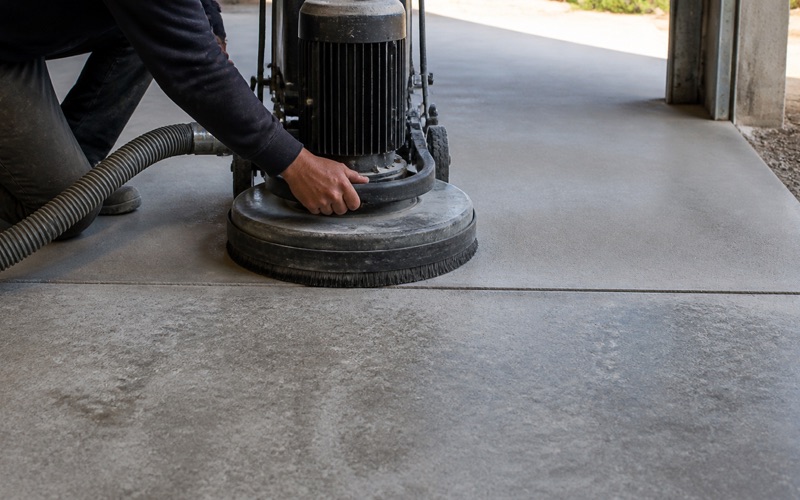
We open the profile by diamond grinding to a named ICRI concrete surface profile, and the profile number goes on the proposal so it can be checked against what the coating manufacturer asks for. That scale runs from CSP 1 through CSP 10, and a thin sealer and a high-build broadcast system genuinely do not want the same one.
Acid etching does not do this job. It roughens laitance without producing a consistent mechanical key, it leaves salts behind that have to be neutralized and rinsed, and on an old contaminated slab it simply drives the contamination deeper. We do not use it on any residential floor and we will explain why on site.
Bond Hardness Against Slab Hardness
The tooling decision is where the actual skill sits. Diamond segment bond gets chosen against the hardness of the concrete in front of us rather than by running one sequence on every job, and the rule is counterintuitive enough that it is worth stating: hard concrete takes a soft bond, so the matrix wears away and keeps exposing fresh diamond.
Get that backwards on a hard old slab and the segments polish, the machine stops cutting, and the crew spends a day producing a shine instead of a profile. Get it backwards the other way on soft concrete and the tooling tears the surface. Neither is recoverable once the coating is down over it.
Removal Is Its Own Line, and So Is Dust
A failed prior coating is quoted as separate work rather than folded silently into the word preparation. Old garage paint, a previous kit or a mastic residue only leaves mechanically, and the quantity of it sitting there drives the grit sequence, the tooling on the machine and how many days the building has to be ours.
Dust containment gets stated as scope here rather than treated as overhead. This community sits inside a designated state Community Air Protection Program area carrying a high cumulative air pollution exposure burden, so grinding dust has a higher local profile than it would in an ordinary suburb, and shrouded tooling with real vacuum extraction is the baseline we work to.
What Rule 1113 Allows Us to Bring Onto the Property
Two Limits, Mutually Exclusive
The VOC ceiling that South Coast AQMD Rule 1113 puts on a floor coating is 50 g/L; an industrial maintenance coating is allowed 100 g/L, and the rule’s definitions keep the two categories mutually exclusive rather than treating them as a sliding scale. The county’s own community profile places this area inside the South Coast Air Basin, so those limits are the operative ones on every address here.
Subsection (c)(6) goes further than limiting what may be applied. It prohibits applying or soliciting the application of industrial maintenance coatings for residential use, which means offering the higher-VOC category on a home is itself the violation, whether or not a pail is ever opened on the property.
A Detached Shop Is Still Residential Property
The case that comes up constantly on these parcels is a freestanding workshop or storage building set back from the house. The wear on that floor can be entirely industrial in character, and it makes no difference at all to the rule: on a residentially zoned parcel it is residential property, and the 50 g/L category is what we are allowed to place.
That is a legal boundary rather than a judgment call about durability, and it is one of the reasons we quote residential and commercial work from separate product lines. What we can do inside the residential category is specify a heavier build and a tougher topcoat, which is usually the real answer to the wear anyway.
The Kit Conversation, and Who Issues the Permit
Median household income here runs near $40,033, so the hardware-store kit is a live alternative on most estimates and we would rather address it directly than pretend it does not exist. The gap between a kit and a specified system is not the resin in the pail; it is grinding, moisture testing and solids content, and on an eighty-year-old slab that gap is the entire outcome.
Because this is unincorporated territory, the permitting authority is the San Bernardino County Land Use Services Department, Building and Safety Division, at 268 W. Hospitality Lane, Suite 300 in San Bernardino, reachable at (909) 884-4056, with applications running through the county’s EZ Online Permitting system. We name that authority and let it answer its own questions.
- 20+ Years Experience
- Licensed & Insured
- Free Written Estimates