Highland Epoxy Flooring treats epoxy flooring in Oak Glen as commercial work first: cider pressing rooms, packing sheds, bakery and preserve kitchens, farm stores and event space, with a residential garage as the occasional side job rather than the main event. Twenty years of doing this has taught us to size a market by what is on its floors.
That is not a positioning choice, it is arithmetic. This community carries more than 300,000 visitors a year against a few hundred residents, and the buildings absorbing that traffic are largely old agricultural structures standing on slabs that were never specified for food production in the first place.
So the conversation starts with what actually hits the floor, and only then moves to product. Juice, sugar, hot water, caustic wash-down chemicals and loaded wheeled bins each attack a coating differently, and the slab underneath has to be sound enough to bond to before any of that matters.
Five Floor Specifications on One Property
Pressing Rooms and U-Press Floors
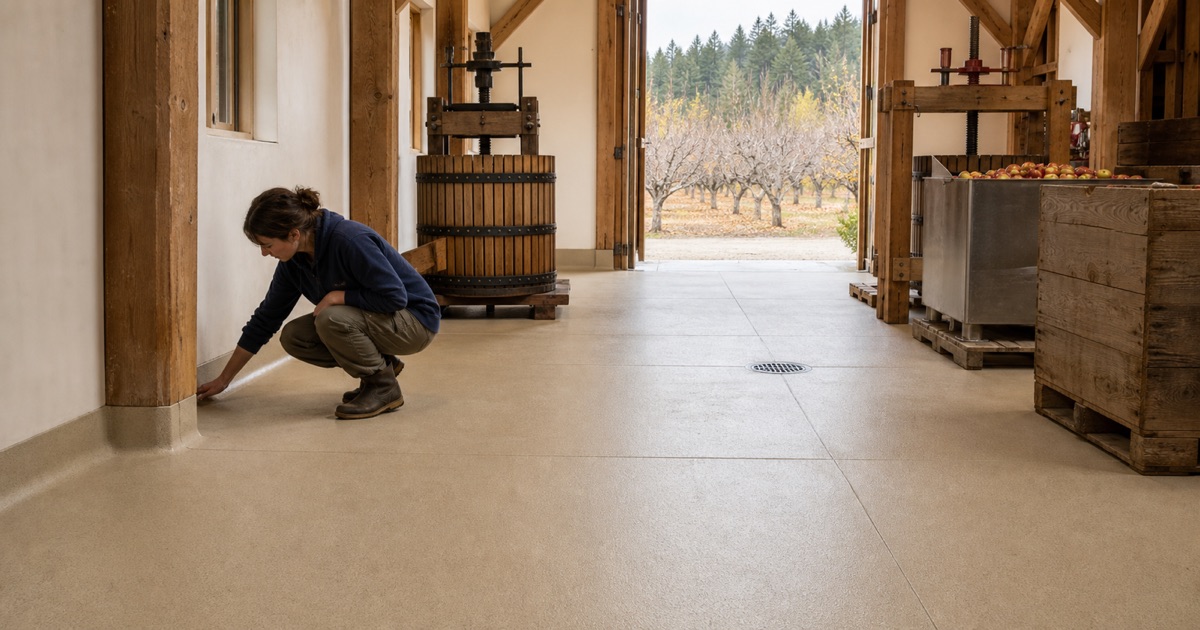
Los Rios Rancho, established in 1906, is a 300-acre working farm on Oak Glen Road running a bakery, a BBQ cafe, a country store, a U-Press cider mill and wedding and event facilities. That is five different floor specifications on a single address, and pretending one system covers all of them is how a job goes wrong here. A cider mill, a bakery and a country store on the same deed are three separate scopes of work with three separate prep sequences.
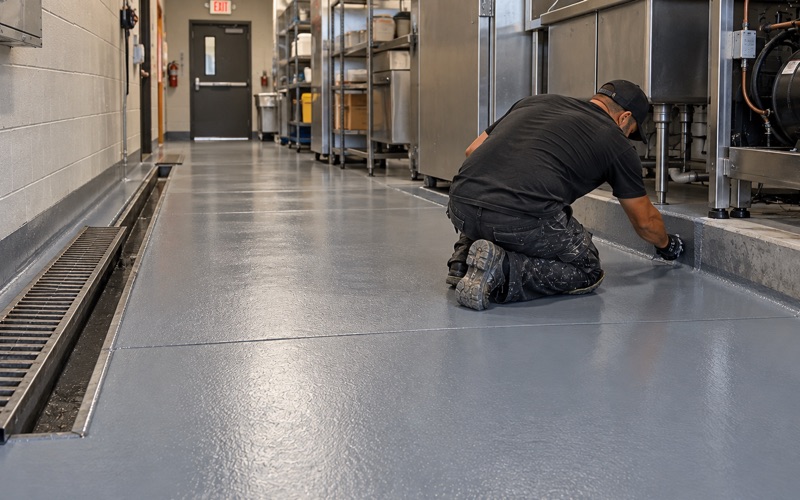
A pressing floor sees standing water, organic acid out of the juice, pomace, and bins rolled across it all day. What it needs is measured slip resistance while wet, an integral coved base so the wall junction can be hosed rather than scrubbed, and joint detail that does not become a place for solids to lodge. Competitors sell these rooms on a federal approval that does not exist; 9 CFR 416.2(b)(2) is performance-based and there is no product approval list, so cleanability and chemical resistance are what the specification can honestly rest on.
Bakery, Donut and Preserve Kitchens
Snow-Line Orchards and Winery produces apple cider mini-donuts fresh through the day out of the original 1898 Apple Shed, and Mom’s Country Orchards runs jams, jellies and fruit butters year round on Oak Glen Road. Hot oil, sugar syrup and hot water wash-down are the daily load on those floors.
Sugar is the underrated one. It works into any porosity left in a surface and then caramelizes, and a floor cleaned with hot water and caustic several times a week is being thermally cycled as well as chemically loaded. Thermal shock resistance and genuine cleanability decide the specification, not appearance.
Tasting Rooms, Farm Stores and Event Space
Riley’s Farm runs dinner theater and group banquet facilities, Stone Soup Farm and Heritage Orchard hosts curated dining events, and Oak Glen Cider Company, Stone Pantry Orchard and Willowbrook Apple Farm all put the public on their floors. These rooms are the ones customers photograph.
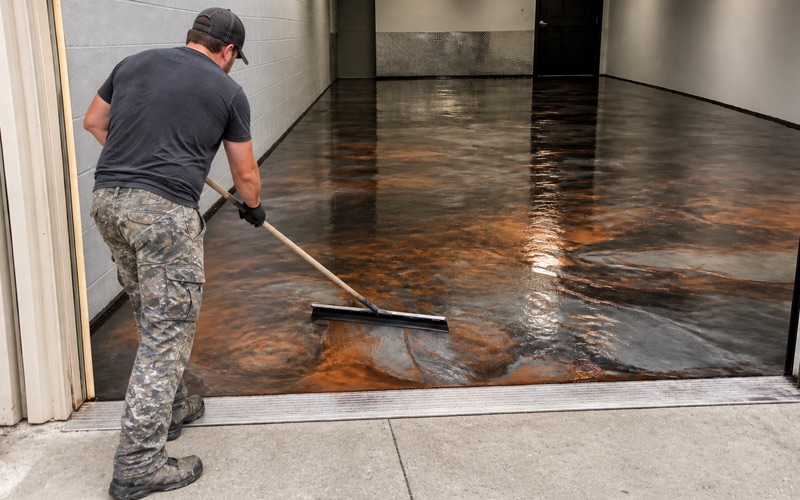
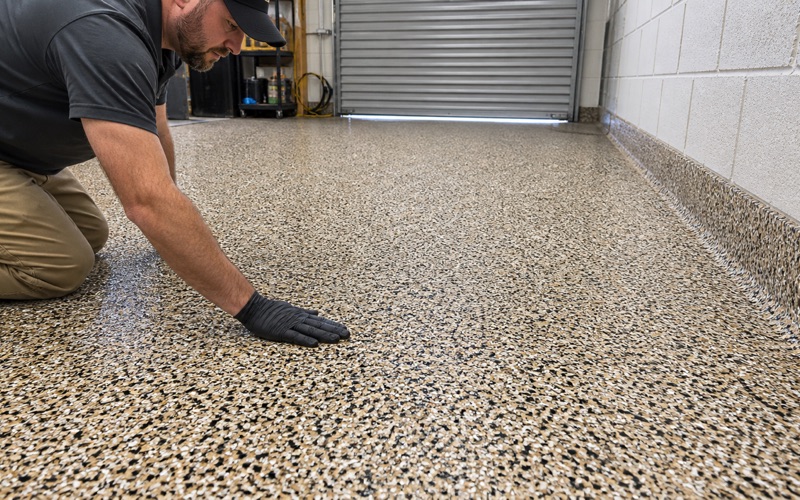
Appearance genuinely matters in a tasting room, so vinyl flake, quartz aggregate and metallic pigment all have a place. Slip resistance still outranks all of it, because orchard grit and wet boots arrive together, and a floor that looks expensive and reads slick is a liability rather than an upgrade.
Looking for warehouse floor coating closer to Rialto? See Rialto Warehouse Floor Coating.
Substrate Comes Before Product
Freeze-Thaw Scaling and Snow-Melt Chloride
Freeze-thaw cycling is live here in a way it simply is not on the valley floor, and chloride carried in from snow melt concentrates right where it does the most harm: door lines, aprons and the first few feet inside an unheated building. What it produces is surface scaling and spalled joint edges.
That has to be dealt with in prep before any product is chosen, and sometimes the honest answer is that a slab which has been scaling for years needs repair rather than a coating. We would rather lose that sale than bond a system to concrete that is still giving up its own surface.
What the Grinder Tells Us
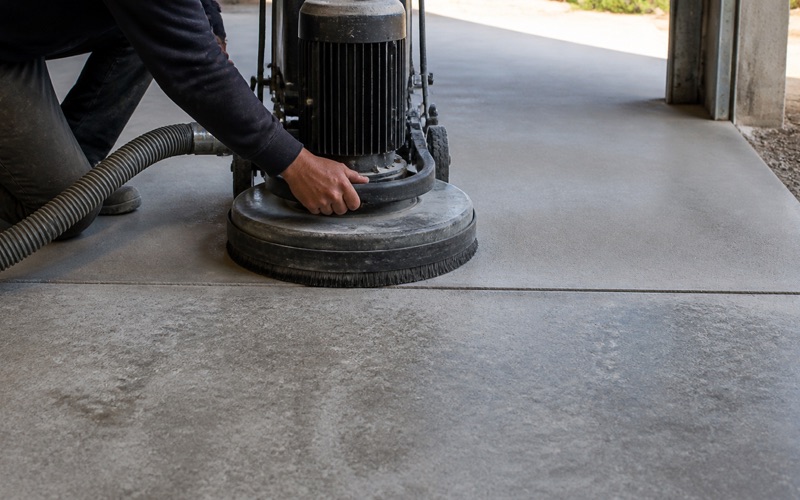
Every floor gets its mechanical profile opened by diamond grinding to a named ICRI concrete surface profile. Acid etching is not part of our process, and on a converted agricultural building it would be especially useless, because those slabs vary in hardness from one end of a room to the other.
Diamond segment bond gets chosen against the concrete in front of us on the rule that hard concrete takes a soft bond, and the grinder is also the diagnostic. Efflorescence, a previous sealer, old patches and soft top layers all show up in the first test pass, long before material is ordered.
Moisture on an Old Agricultural Slab
Slabs poured for a packing shed or a barn were rarely built with a vapor retarder under them, and many of these buildings have grade and drainage running toward rather than away from the wall. Moisture is measured, not assumed, and the reading is written into the proposal before any material is ordered.
ASTM F2170 in-situ relative humidity probes read a state inside the slab at 40 percent of its depth and ASTM F1869 calcium chloride reads a moisture vapor emission rate at the surface, with the pass and fail thresholds living in ASTM F710 rather than in either method. An ASTM D4263 plastic sheet is indicative only, since a positive fails a slab and a negative proves nothing at all.
Working an Operating Property in the Off Season
The Commercial Season Runs Labor Day to Thanksgiving
The buying season and the working season are not the same season, and that is the central scheduling problem here. From roughly Labor Day through Thanksgiving the pressing rooms, kitchens and farm stores are running at capacity, and nobody is taking a production floor offline for a grinder.
Which pushes the work into the off season by default. We would rather plan a job around that honestly, months ahead, than promise a turnaround that quietly assumes a room can be emptied during harvest. Sequencing one room at a time keeps an operating property in business while the work goes in, which is usually worth more to an owner than finishing a day sooner.
Cure Runs Cold Here, Not Hot
At 4,734 feet this community inverts the region’s usual cure problem completely. Across the lowland cities the risk is a hot slab collapsing pot life; here the risk is a slab in an unheated shed that never comes up to the temperature the chemistry needs.
Slab temperature lags air temperature by hours, so a mild afternoon does not mean a warm floor, and a coating that never reaches its cure temperature does not simply cure slowly, it can fail to develop the properties it is sold on. Solving that means portable heat, containment, monitored surface temperature, a dew point margin, and chemistry chosen for low-temperature cure.
Getting the Rig Up the Road and Onto the Property
Oak Glen Road is the through route, the community is spread across about 15 square miles at roughly 40 people per square mile, and the parcels are large with long farm drives that are frequently unpaved. Winter access can be affected by snow on top of that.
So getting a planetary grinder, a dust-extraction rig and material up a mountain road and then onto a working orchard is a logistics question before it is a pricing question. We confirm the last few hundred feet, the turnaround and the power at the building before a date is committed to.
What the Numbers Here Actually Support
A Visitor Economy Rather Than a Residential One
The inversion between visitors and residents is the whole reason a coating contractor writes about this place at all. Every named farm and food operation on the community’s own directory sits on or just off Oak Glen Road, and between them they run more square feet of hard-use commercial floor than the housing stock could ever supply. The route that makes sense here is a commercial one, called on by name.
Against a resident population of about 600, the residential pool is on the order of two hundred owner-occupied detached houses, and every figure at this geography should be read as directional rather than precise, since the margin of error on the housing total runs to about a third of the estimate. We quote the shape of the market, not a head count.
Every Job Is on an Existing Slab
No housing units have been recorded as built here since 2010, and that single fact sets the shape of every quote. There is no clean builder pour to bid on and no new-construction sequence to slot into.
Which means removal of whatever is already down, repair of whatever has failed, and a moisture reading are permanent line items rather than occasional ones. A quote written as though the slab is a blank surface will be wrong on the first morning. It also means warranty terms get stated with their exclusions in writing, including what happens if moisture drives a failure, rather than as a headline number with the conditions left unsaid.
County Permits and a Residential Category That Surprises People
There is no city government to call. This is unincorporated territory, and the permit authority is San Bernardino County Land Use Services, Building and Safety Division, at the County Government Center on N. Arrowhead Avenue, roughly 15 miles west and about 3,000 feet below the orchards.
South Coast AQMD Rule 1113 applies here as it does anywhere else in the district, capping floor coatings at 50 g/L VOC and industrial maintenance coatings at 100 g/L, with subsection (c)(6) prohibiting the application or solicitation of an industrial maintenance coating for residential use. A barn, packing shed or workshop on a residentially zoned parcel is a residential property under that rule however industrial its wear, and we say so rather than working around it.
- 20+ Years Experience
- Licensed & Insured
- Free Written Estimates