
Highland Epoxy Flooring installs polyaspartic floor coating systems across Highland, CA, and twenty-plus years of working inland slabs is most of what qualifies anyone to run this particular chemistry, serving surrounding cities including Redlands, Mentone, Loma Linda, Running Springs and San Bernardino. Polyaspartics are the fastest material we put down and the least forgiving of a bad plan. What is liquid at the start of a mix may be unusable a quarter of an hour later.
That speed is the reason clients ask for it. A garage emptied on a Friday morning can be parked in over the weekend, and a business can close on a Saturday night and open on a Monday, which on a working floor is often worth more than the coating itself. The trade-off is that nearly every decision has to be made before the first pail is cracked, because there is no pausing halfway to reconsider.
So we treat a polyaspartic job as a scheduling problem with a chemistry attached. Slab temperature, dew point, crew size, tool layout, batch size and the order of the coats all get settled at the quote, and the readings we take on the morning of the install decide the start time. Booked the other way around, the same product produces a floor that sets up in the pail and a crew standing over it.
What a Polyaspartic Coating Actually Is
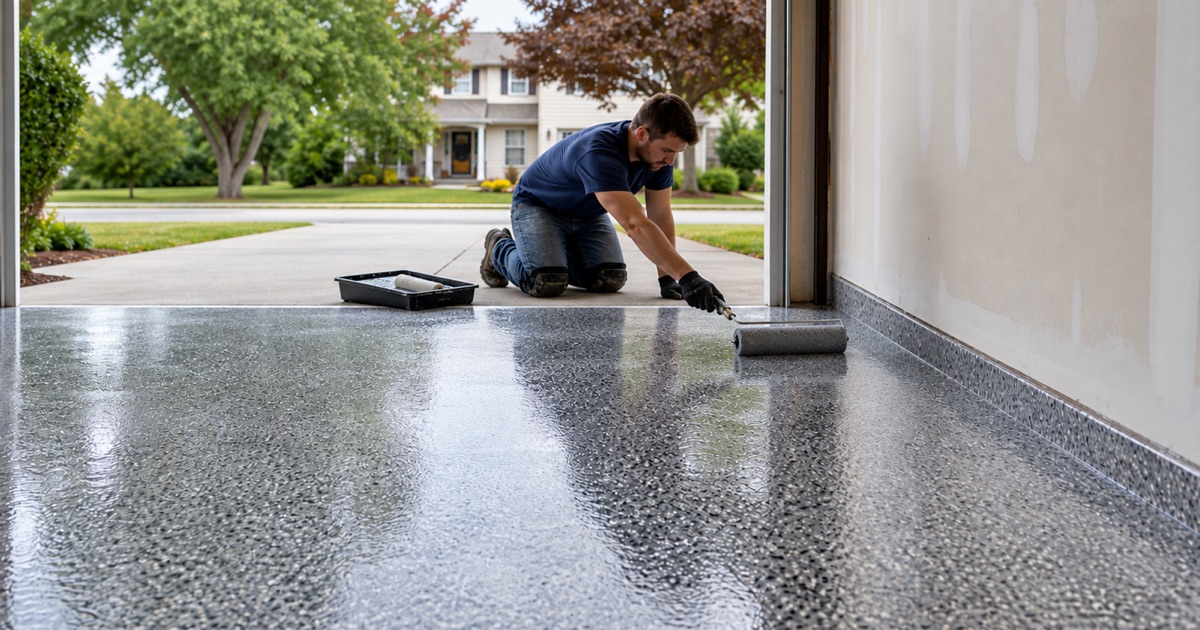
The name describes a specific chemistry rather than a performance grade. Knowing which properties come from that chemistry is what keeps a specification honest.
An Aliphatic Chemistry, and What That Buys
Polyaspartics are a branch of the polyurea family, built from an aspartic ester reacted with an aliphatic isocyanate. Aliphatic is the load-bearing word: it is why the resin holds its color under ultraviolet light instead of ambering the way a clear aromatic epoxy will in a sunlit bay. On a white, pale gray or lightly pigmented floor that difference is visible within a couple of summers.
Gel Time Is Formulated, Not Fixed
One polyaspartic is not the same as the next. The reaction speed is adjustable at the formulation stage, so the same product family covers a coat that stays workable for a reasonable window and a coat that is hard within the hour. Choosing the wrong end of that range for the conditions on the day is the single most common way these floors go wrong, and it is a specification error rather than an application error.
Thin Films and More Coats
Most polyaspartics are applied at lower film thicknesses per coat than a 100% solids epoxy, so a given build is reached across more coats rather than fewer. That changes the labor profile and it changes the tools: a notched squeegee laying an even wet film, an air-release roller behind it, spiked shoes on the crew, and a wet film thickness gauge to confirm the build rather than assume it.
The One-Day Floor, and What Pays For It
A same-day return to service is the reason most people arrive at this page, and it is achievable. It is achievable because the recoat windows are short, which is also its main constraint.
The Recoat Window Is the Whole Schedule
Between two coats there is a minimum time before the next can go on and a maximum before the chemical bond is lost. Hit that window and the coats fuse into one system. Miss the far end of it and the next coat is bonding mechanically to a cured surface, which means abrading a floor that was supposed to be finished by then. Every other decision on the day serves keeping that window.
Crew Size Is Part of the Specification
A short working time means the wet edge has to keep moving, and a wet edge that stalls in the middle of a bay leaves a line that no amount of topcoat hides. So the crew is sized to the square footage rather than to the budget, with someone mixing, someone laying, someone back-rolling and someone broadcasting on a flake floor. Sending two people to a floor that needs four is how a fast product turns into a slow repair.
What Actually Returns to Service, and When
Foot traffic comes back first, then furniture and light equipment, then vehicles. Full chemical resistance takes longer than any of those, which matters in a shop where solvents and brake cleaner are in daily use. We give those as separate times against the actual conditions of the install rather than as a single number, because they respond differently to slab temperature.
Where an Inland Slab Pushes Back
Everything above assumes the material behaves the way the data sheet says. The data sheet assumes conditions that a Highland slab does not automatically provide.
Pot Life Against Slab Temperature
On one published product, pot life runs 60 minutes at 55 degrees F, 40 minutes at 72 degrees F and 20 minutes at 95 degrees F. That is the same product with the same mix ratio, differing only in how warm the substrate is. A polyaspartic sitting at the fast end of its formulated range on a hot slab leaves a working time measured in a few minutes, so batch sizes shrink and the crew commits to a smaller area at a time.
Dew Point and the Ceiling on the Same Day
Surface temperature has to stay at least 5 degrees F above the dew point or moisture condenses into the curing film and shows up as a haze or a soft spot. At the other end, an uninsulated inland slab can approach the 160 degrees F maximum surface temperature a data sheet allows on a summer afternoon. Both limits can be live on the same day in the same building, which is why we read the slab rather than the forecast.
Why These Jobs Are Not Booked by the Calendar
The recoat minimum on the same published example collapses from 24 hours to as little as 6 as the temperature climbs, so the schedule is a moving target that the weather sets. We book polyaspartic work against slab conditions, we start early in the warm months, and we would rather move a start time than mix a batch that will gel on the floor.
Full Polyaspartic, or Polyaspartic Over Epoxy
The more useful question is usually not epoxy against polyaspartic but where each belongs inside one system. Most floors we install answer it as a hybrid.
The Hybrid System Most Floors Get
An epoxy base coat is thicker per pass, cheaper per gallon and excellent at wetting into a profiled slab, which makes it a good body for a system. A polyaspartic topcoat brings the color stability, the abrasion resistance and the fast return to service. That combination puts each material where its properties are worth paying for, and it is what we specify on the majority of residential garages.
Where a Full Polyaspartic Build Earns Its Cost
A full polyaspartic system is worth the money where the shutdown window is genuinely tight, where the floor is exposed to direct sun for hours a day, or where cold conditions would stall an epoxy’s cure. On a tenant floor that cannot close for three days, the material premium is smaller than the cost of the days it saves.
The Slab Still Decides First
Neither system rescues a slab that was not prepared or tested. The concrete is opened by diamond grinding to a named profile, typically CSP 3 or CSP 4 for a thin-film build, and the moisture reading comes back before any material is ordered, since moisture failure is the one thing most coating warranties exclude in writing. A fast chemistry over an untested slab simply fails faster.
Compliance and the Fine Print
50 g/L, and Which Category a Product Sits In
SCAQMD Rule 1113 governs Highland, capping floor coatings at 50 g/L of VOC and industrial maintenance coatings at 100 g/L, with the two categories mutually exclusive by definition (24). High-solids polyaspartics generally sit comfortably inside the floor coating limit, which is convenient rather than automatic, and we confirm the category from the data sheet. Subsection (c)(6) separately prohibits applying, or soliciting the application of, an industrial maintenance coating for residential use.
What the Warranty Says About Moisture
A fast-cure floor gets sold on speed and warranties get sold on years, and the exclusions are where the two meet. We put the terms in writing with what they do not cover named alongside what they do, including what happens if vapor coming up through the slab drives a failure. That is a harder conversation at the quote and a much easier one three years later.
- 20+ Years Experience
- Licensed & Insured
- Free Written Estimates