Highland Epoxy Flooring writes warehouse floor coating scopes in Rialto for landlords, leasing brokers and tenant-improvement general contractors, which is a different customer from the one most coating companies in this county are built to answer. We have spent twenty years in resin flooring, and the industrial half of that work has always been sold through people holding a building rather than people living in one.
The reason it matters in this city is arithmetic. Local reporting on a recent project hearing counted more than eighty warehouses here with at least eight of them standing empty, and an empty high-cube building is not a dormant asset. It is a slab that gets inspected, repaired, joint-filled and coated or sealed before a tenant ever signs.
That is the narrow window when the floor is genuinely reachable. Once racking is up, dock doors are running and inventory is on the ground, the same scope becomes a phased night job at three times the disruption. Our job on a vacant building is to get the floor finished while the building is still quiet.
Eight Empty Buildings and the Floor Work That Comes Before a Lease
What a Vacant High-Cube Slab Actually Needs
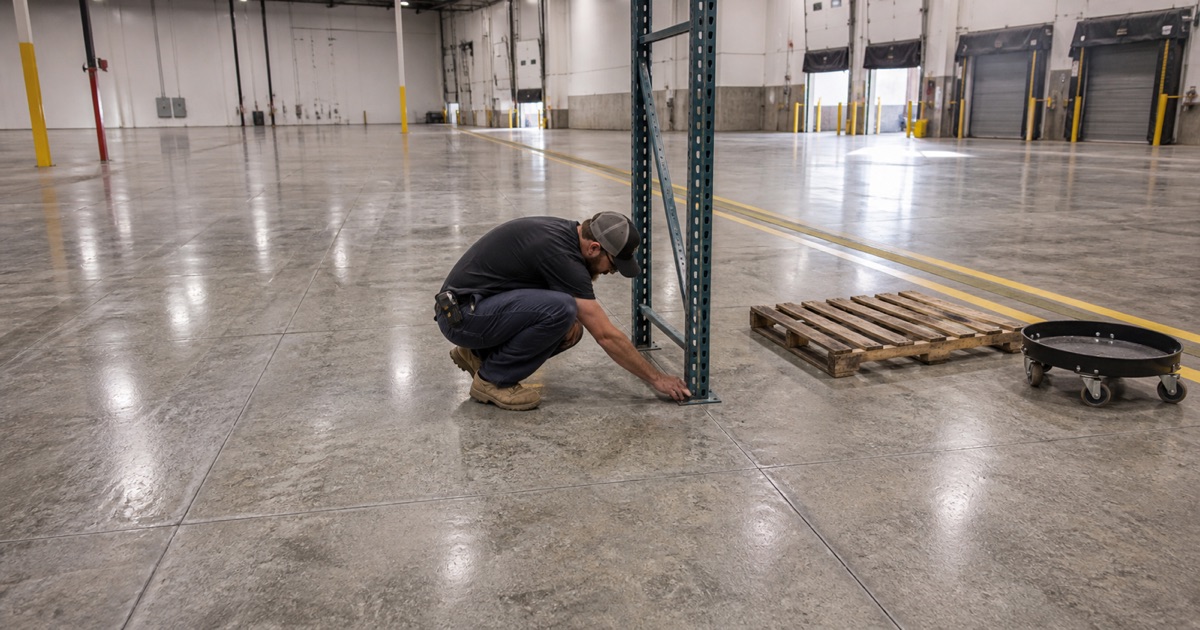
The scope on an empty distribution floor is rarely a full-coverage resin system, and pretending otherwise loses bids. It is usually crack repair, joint filling, spall and corner rebuild at the dock doors, a hardener or sealer across the open field, and traffic markings laid out to whatever the incoming operation will run. Each of those is a separate quantity and should be priced as one.
Joints are where the money is. A saw-cut joint left unfilled in a building running powered pallet trucks loses its edges within months, and a semi-rigid epoxy joint filler placed full-depth and shaved flush supports those edges instead of leaving them to chip. Doing it on a bare slab costs a fraction of doing it around live racking.
Why the Work Has to Close Before the Lease Does
A landlord holding an empty building is paying for it every month, so floor work sits on a clock that has nothing to do with our schedule. The practical consequence is that we quote with a firm mobilization date and a stated cure-to-traffic figure, because the number the leasing team actually needs is when a forklift can be on it.
Cure times are not negotiable but they are predictable, and that lets them be planned around. We state return-to-service by traffic type rather than as a single number, since foot traffic, pallet jacks and loaded lift trucks come back on the floor at genuinely different points, and a schedule built on the wrong one of those is a schedule that gets broken.
Bare Slab Is the Only Time Full Access Exists
Rialto’s warehouse belt has a physical origin worth knowing. The municipal airport closed on September 18, 2014 after the city agreed to closure in 2009 for redevelopment, and the western end of the runway has since been converted into distribution buildings under the 1,445.3-acre Renaissance Specific Plan adopted in 2010.
What that history produced is a stock of large-format buildings that change hands and change tenants, which is exactly the cycle that generates floor work. Recent industrial product in that plan area includes a 664,859-square-foot building on 39.89 acres and a two-building project of roughly 53,640 and 373,075 square feet on about 20.76 acres.
Looking for concrete resurfacing closer to Moreno Valley? See Concrete Resurfacing in Moreno Valley.
Who Actually Signs: Brokers, Landlords and TI General Contractors
The Bid Path Does Not Run Through a Homeowner Search
Nobody types a search query on behalf of a 400,000-square-foot slab. The scope gets written into a tenant improvement package by a leasing team or a project manager, priced by a general contractor, and awarded on a bid sheet, which is why a coating company that only markets to homeowners never sees this work at all in a city that is full of it.
We bid it the way the rest of that package is bid: a line-item schedule of quantities, unit rates where the quantity is uncertain, and a stated allowance for square footage of crack repair rather than a lump sum that hides it. That is what lets a TI allowance be traded against other trades without reopening our number.
What the Building Owner Is Actually Buying
A landlord is not buying a finish. They are buying a building that shows well on a tour and a floor that survives the first tenant without a claim coming back. Those two goals point at different products, and the honest conversation is about which one the budget is really serving before anything gets specified.
The city’s own major employer list tells you who the eventual tenant tends to be: Niagara Bottling, Medline Industries, Angelus Block, Biscomerica, Amazon, Fed-Ex and Target Distribution, with Staples, Under Armour and Monster Energy operating regional distribution in the Las Colinas area at the north end. Six of those seven are distribution or manufacturing.
The Counter That Makes This City Easy to Work
Rialto’s Building & Safety Division sits inside the Development Services Department at 150 South Palm Avenue, and the building counter accepts plan check and permit fees Monday through Friday from 7:00 AM to 5:30 PM, with an Online Permit Center running alongside it. That is a wider daily window than most cities in this county offer.
For a crew running a route across several jurisdictions, that matters more than it sounds like it should. A late-afternoon errand that would be dead anywhere else is still live here, and a 7:00 AM opening lets a permit stop happen before the first mobilization of the day rather than instead of it.
Four Genuinely Different Specifications In One City’s Industrial Base
Dry High-Cube Distribution
A dry distribution slab is an abrasion and point-load problem rather than a chemical one. Loaded lift trucks concentrate weight through small hard wheels, so the specification runs toward joint support, a hardener or a thin-film system with real compressive backing, and a topcoat chosen for wheeled traffic instead of for gloss retention.
Layout is part of the same scope. Aisle and staging markings on these floors come from the incoming tenant’s own operating standard, and we ask for that standard rather than inventing one, because the federal general-industry rule that gets quoted at contractors on this point specifies neither a stripe width nor a color and never has.
Wet Process, Food and Beverage
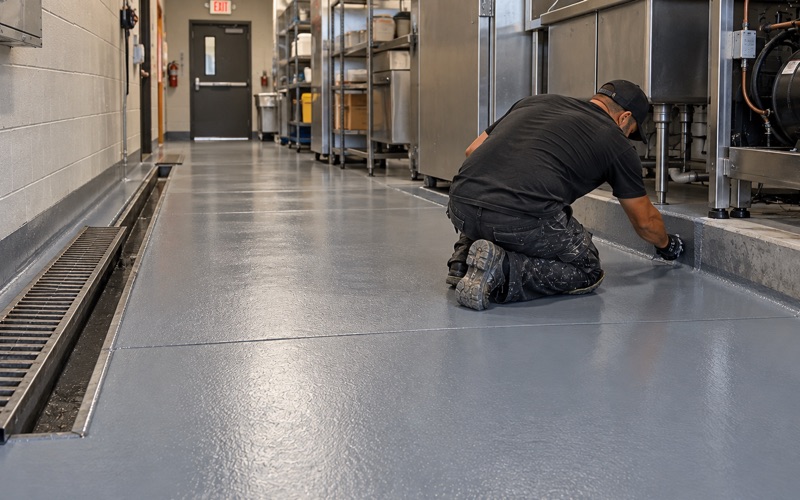
Bottling and bakery operations are a different specification entirely. Those floors want cleanability, resistance to thermal shock where hot water and steam hit them, an integral coved base so the wall junction can be washed rather than caulked, and slip resistance stated as a DCOF value that the plant’s own safety group can hold us to.
There is one claim we will not make on this work, and it is worth naming because the industry makes it constantly. No federal approval list for flooring products exists; the sanitation requirement is performance-based, which means what a specification can credibly demand is the properties above, not a stamp that nobody actually issues.
Abrasion Plants and Wet Chemical Process
A concrete products plant is a third case. Constant cementitious dust, dropped block and steel-wheeled equipment produce mechanical abrasion at a level most resin systems are simply not rated for, and the right answer is often a urethane cement or a heavily filled system rather than a conventional coating.
The bioenergy plant in the city is a fourth. That facility processes up to 1,000 tons per day of food waste, liquid waste and municipal biosolids into renewable natural gas, and floors in that kind of environment face chemical and biological exposure continuously rather than in spills. Four buildings, four different scopes, one city.
Preparation, Rule 1113 and the Line Between a Warehouse and a Garage
The Profile Is Named Before the Grinder Starts
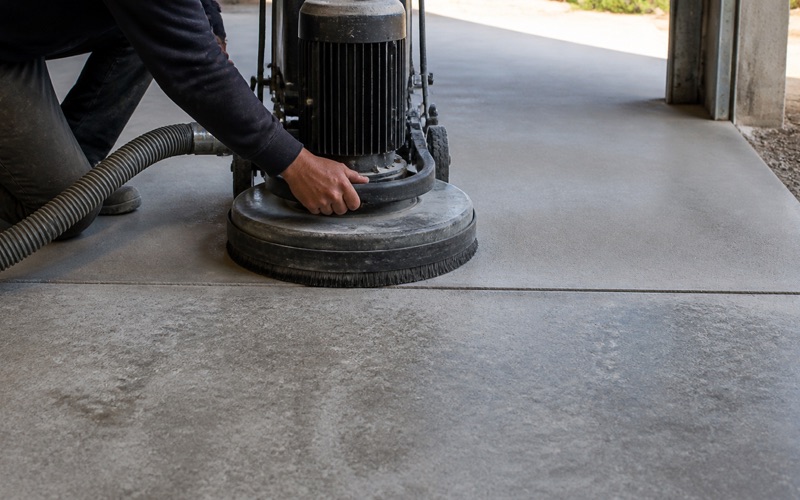
We open a mechanical profile with diamond grinding to a named ICRI concrete surface profile, never by acid etching, and we state which profile on the proposal so it can be checked. The ICRI scale runs from CSP 1 through CSP 10, and a thin-film sealer and a high-build system do not want the same number.
Diamond segment bond is chosen against the hardness of the slab in front of us rather than by running one grit sequence across every job. The rule reads backwards to most people and is nonetheless correct: hard concrete takes a soft bond, because the matrix has to wear away fast enough to keep exposing fresh diamond.
A Coating Legal In the Warehouse Can Be Illegal In the Garage
South Coast AQMD Rule 1113 caps floor coatings at 50 g/L VOC and industrial maintenance coatings at 100 g/L, and definition 24 in that rule makes the two categories mutually exclusive rather than overlapping. Subsection (c)(6) then prohibits any person from applying, or soliciting the application of, industrial maintenance coatings for residential use.
In a city with a commercial book this industrial, that is a live decision on every job rather than a compliance footnote. The same crew can legally place a 100 g/L system in a distribution building in the morning and be prohibited from placing it in a home garage that afternoon, which is why we quote residential and commercial from separate product lines.
The Awkward Case, and the Heat
The case that recurs here is the shop building or workshop sitting on a residentially zoned parcel, which the rule treats as residential property however industrial the wear on its floor happens to be. We check the zoning rather than the contents of the building, and the higher-VOC category comes off the table when the answer is residential.
Heat then decides the sequencing. Slab temperature drives pot life from roughly sixty minutes at 55 degrees F to about twenty at 95 degrees F on one published product, with a 5 degrees F floor above dew point and a 160 degrees F surface maximum an uninsulated slab can approach. Across 200,000 square feet that is a crew-size decision.
- 20+ Years Experience
- Licensed & Insured
- Free Written Estimates