Highland Epoxy Flooring books epoxy flooring in Running Springs off a slab temperature reading rather than a calendar date, and after twenty years in this trade that is the one discipline separating a coating that holds from one that never properly cured. At 6,109 feet the concrete decides when the work can happen, and the concrete is usually colder than the air standing over it.
That is a genuine inversion of how this work is priced down the hill. In the valley the enemy is a pot life that collapses in the heat; up here the enemy is a base coat sitting below the minimum temperature its own data sheet publishes, curing slowly or not fully, and looking perfectly fine on the day the crew drives away.
The second thing worth saying plainly is what this market is not. There is no apartment block, no parking deck and no property-management portfolio to quote in this community, and the housing table is unusually blunt about it. Every job here is a house, and almost every house is a detached one.
A Housing Table With No Apartments and No Mobile Homes In It
Zeros All the Way Down the Structure Column
The American Community Survey five-year table on units in structure records 3,533 of this community’s 3,677 housing units as single-family detached, 96.1 percent of everything standing. Another 144 are single-family attached. Every remaining category reads zero: no two-unit buildings, no three-or-four-unit, no five-to-nine, no ten-to-nineteen, no twenty-to-forty-nine and none at fifty or more.
There are no mobile homes recorded either, and no boat, RV or van units. It is rare to see a place where a whole column of a census table is empty, and it changes what an honest local page can promise. We are not going to tell you we maintain common-area floors here, because there are none to maintain.
What That Removes From the Quote Sheet
A coating company working the valley floor spends a real share of its week on stairwell landings, laundry rooms, trash rooms, maintenance shops and podium parking decks, all sold through a property manager on an annual budget. None of that inventory exists in this community, so none of it is in our scope when we come up the hill.
What replaces it is a single building type repeated at different vintages: an unheated, uninsulated garage or shop attached to or standing beside a mountain house. That is a narrower book of work, and it means the specification questions we ask are the same each time, which is exactly why we can answer them precisely rather than generically.
The Addressable Pool, Read Off the Table Rather Than the Population
The tenure-by-structure table puts owner-occupied single-family detached houses at 1,411, with renter-occupied detached at 461. A further 1,333 units sit in the seasonal, recreational or occasional use category, which is a large share of everything standing and is counted separately from occupied housing rather than folded into it.
So the addressable pool is somewhere between roughly 1,400 and 2,700 detached houses depending on how you count, not the 5,268 residents recorded at the 2020 census. We would rather state that honestly than describe a market five times its real size. It is a route-sized book of work and we treat it as one.
Looking for garage floor coating closer to San Bernardino? See Garage Floor Coating Services in San Bernardino.
The Slab Is the Binding Number, Not the Thermometer on the Wall
A Published Minimum, Not a Feeling About the Season
Sherwin-Williams ArmorSeal 1000 HS lists its application conditions as 50 degrees F minimum and 120 degrees F maximum for air, surface and material alike, at least 5 degrees F above the dew point, with relative humidity no higher than 85 percent. Those are printed numbers on a data sheet, not a rule of thumb somebody in the trade invented.
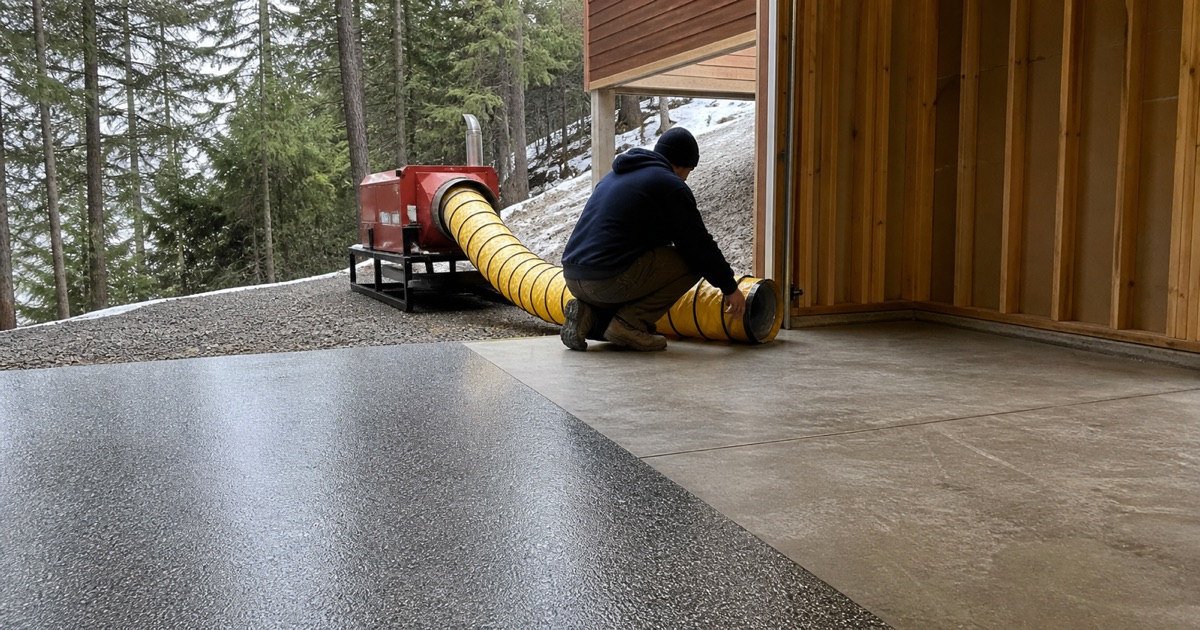
The word doing the work in that sentence is surface. An unheated garage slab at this elevation is a large cold thermal mass inside an uninsulated building, and it lags the air by hours. A wall thermometer reading 54 degrees F over a slab reading 46 degrees F is a failed job that has not happened yet, which is why we read the slab.
What Fifty Degrees Does to the Rest of the Schedule
Meeting the minimum is not the same as working comfortably above it. At exactly 50 degrees F the same product’s published drying schedule stretches badly: recoat minimum goes to 24 hours against 8 at 77 degrees F, foot traffic to 48 hours against 24, heavy traffic to four or five days against 48 to 72 hours, and full cure to 10 days against seven.
Pot life moves the opposite direction, running six hours at 50 degrees F against four at 77. Cold buys working time at the mixing station and charges for it at the far end in return-to-service. An owner who needs a vehicle back inside by the weekend needs to hear that arithmetic before a date is agreed, not after.
Why We Do Not Publish a Temperature Figure For This Community
There are no published climate normals for this place, and that is a checked finding rather than a shrug. The federal normals archive returns nothing for any candidate station identifier across all four normal periods, while control stations nearby return records normally, so any monthly table circulating for the town has been blended from somewhere else.
What we will say is directional and defensible. A ridge station roughly a thousand feet lower records about 97 freeze days a year and six months with a daily mean below 50 degrees F, and this ground is higher than that station. We plan for a short application window and we verify it with an instrument on the day.
Two Coats, Two Different Minimum Application Temperatures
The Base Coat Is the Seasonal Constraint
Within one manufacturer’s own floor system the two coats do not share a temperature floor. ArmorSeal 1000 HS stops at 50 degrees F, while ArmorSeal Rexthane I, the high-solids single-component aliphatic moisture-cure urethane that the same manufacturer tests as the topcoat over it, lists 20 degrees F minimum for air and surface and 40 degrees F for material.
Rexthane I also runs a relative humidity range of 30 to 99 percent and carries one instruction that is not remotely hypothetical up here: do not apply over surface ice. So on a two-coat system only the epoxy base is the seasonal limit, and knowing that is often the difference between a job that happens in April and one that waits for June.
Polyaspartics Are Not All Cold-Weather Products
The category gets sold as though temperature stopped mattering, and two published data sheets say otherwise. LATICRETE SPARTACOTE FLEX PURE lists low temperature cure at 25 degrees F as a product feature, with light foot traffic at three to four hours and vehicular traffic at 24 hours. Deco-Crete Polyaspartic 90 publishes a minimum application surface temperature of 40 degrees F.
That is a fifteen-degree gap between two products in the same chemical family, and Deco-Crete’s own limitations section adds that the product is best suited between 60 and 90 degrees F with humidity under 85 percent. At this elevation the difference between a 25-degree product and a 40-degree product is most of the working year, so we name the product, not the category.
What Low-Temperature Capability Actually Costs
Both of those polyaspartics publish 15 to 20 minutes of pot life, against the epoxy’s six hours at 50 degrees F. Twenty minutes is not much time to gauge-rake a two-car bay, back-roll it with an air-release roller and get a broadcast out at an even rate, and it is even less time when material has been hand-carried in from a truck parked out on the highway.
So batch size and crew size become part of the specification rather than a field decision. Deco-Crete also instructs that dew point sit at least 5 degrees F below the surface temperature and that mixing not happen below dew point at all, because condensation shortens pot life further. We plan the mixing station indoors and stage material warm.
Freeze-Thaw, Tracked Deicer and Whether the Slab Can Be Coated At All
Scaling Is a Documented Failure Mechanism, Not Folklore
NRMCA’s CIP 2 bulletin defines scaling as local flaking or peeling of a finished concrete surface caused by cycles of freezing and thawing, with moderate scaling exposing aggregate and involving a loss of up to an eighth to three-eighths of an inch of surface mortar. Deicing chemicals make it worse by raising surface saturation and multiplying the freeze-thaw cycles.
The bulletin also names the exact transport mechanism: magnesium-based salts used for pre-snow road deicing get tracked by cars and accumulate on concrete surfaces. Every vehicle that comes home off a treated highway carries that residue onto the garage slab, so this is not a road-surface problem that stays out on the road.
Why That Decides Whether We Coat It
ArmorSeal 1000 HS publishes adhesion over concrete at 350 psi with 100 percent concrete failure by ASTM D4541, meaning the bond is stronger than the substrate it is bonded to. If the top eighth to three-eighths of an inch of surface mortar has already been weakened by scaling, the coating does not fail on its own. It leaves, carrying that weakened layer with it.
CIP 2 puts it directly, that a repaired surface will only be as strong as the base surface it is bonded to, and recommends 6 percent total air content and 4,000 psi for slabs exposed to freezing and deicing chemicals, which is not what anything poured here in the 1950s was placed to. Assessing soundness is the first scope item, never an upsell.
Moisture Testing, Rule 1113 and Who Holds the Permit
Roughly 999 units in this community predate 1960 and 381 predate 1950, so a good share of the slabs went in before under-slab vapor retarders were routine. Deco-Crete’s own sheet requires moisture testing by ASTM F1869 calcium chloride or ASTM F2170 in-situ relative humidity before application, and the threshold values for both live in ASTM F710.
South Coast AQMD Rule 1113 applies here exactly as it does on the valley floor: 50 g/L VOC for floor coatings, 100 g/L for industrial maintenance coatings, and subsection (c)(6) prohibiting applying or soliciting industrial maintenance coatings for residential use. Cold tolerance and compliance are separate questions, and we check both before a pail is ordered.
Because this is unincorporated territory, the building authority is San Bernardino County Land Use Services, Building & Safety, whose main counter sits at the County Government Center at 385 N. Arrowhead Avenue in San Bernardino, with a Building & Safety presence maintained in Twin Peaks serving the Rim of the World communities. We name that authority and we let it answer its own questions.
One genuinely local commercial note is worth the space. Snow Valley Mountain Resort’s 2024-25 season ran 128 days from November 29 to April 6, so the base lodge, rental shop and food outlet floors can realistically only be scheduled outside that window, which happens to be the same stretch when the application minimums are comfortably met.
- 20+ Years Experience
- Licensed & Insured
- Free Written Estimates