Highland Epoxy Flooring treats garage floor coating in San Bernardino as two trades that happen to share one truck. One is a homeowner’s attached two-car garage on a tract slab. The other sits inside the fence at San Bernardino International Airport, and no other city in our service area asks us for both in the same week.
The airport’s own tenant directory names Amazon Air, FedEx and UPS as cargo operators, Luxivair SBD as the fixed-base operator, and AeroPro and Executive Jet Maintenance among its maintenance, repair and overhaul companies, with AFS Aircraft Maintenance alongside them. Aero Pro is described as an aircraft painting and custom interiors operation.
Those floors and a garage floor have almost nothing in common except the way we approach them: a slab moisture reading written into the proposal before material is ordered, a profile opened mechanically to a named ICRI concrete surface profile, and a coating category selected so the product is legal for the building it goes into.
Coating a Hangar Deck and an MRO Shop Floor
Point Loading From Jacks, Tugs and Rolling Gear
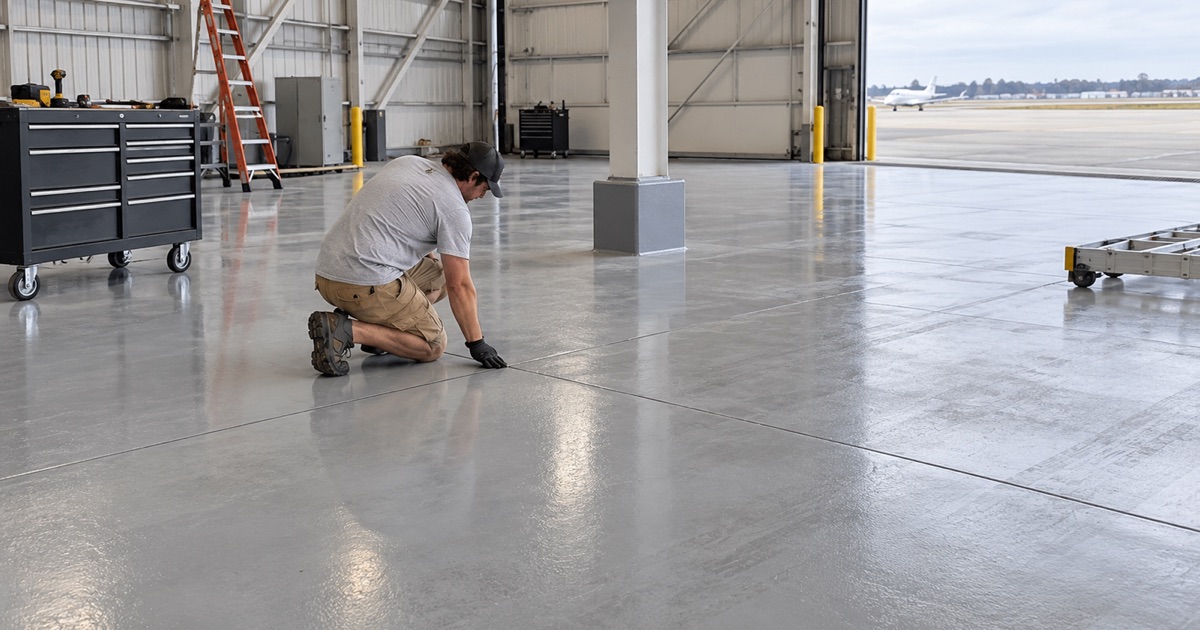
A hangar deck is not a warehouse floor with a taller door. It carries concentrated point loads from jack pads and tail stands, tow tug traffic that turns tightly in the same spots every day, and toolboxes and stands that are dragged rather than lifted. The coating question is bond strength and film integrity under concentrated load rather than square-foot durability.
That pushes the specification toward a high-solids system at a measured mil build over a properly opened profile, with the slab itself sounded first. Where a jack pad sits on unsound concrete, no coating chemistry rescues it, so repair of the substrate is priced as its own work rather than buried in a square-foot rate.
Hydraulic Fluid, Solvent and Fuel Exposure
Maintenance shops publish their own exposure list without meaning to: hydraulic fluid, phosphate ester fluids, degreasers, fuel, and whatever the parts washer is running. Those are aggressive on the topcoat rather than on the body coat, so the resistance conversation belongs at the top of the system.
We specify from the fluids actually in the building, ask for the safety data sheets, and match a urethane or polyaspartic topcoat to them. It is also honest to say which fluids will stain a floor even when they will not degrade it, because a maintenance manager who was not told that reads the first stain as a failure.
Containment and Cleanability in an Aircraft Paint Bay
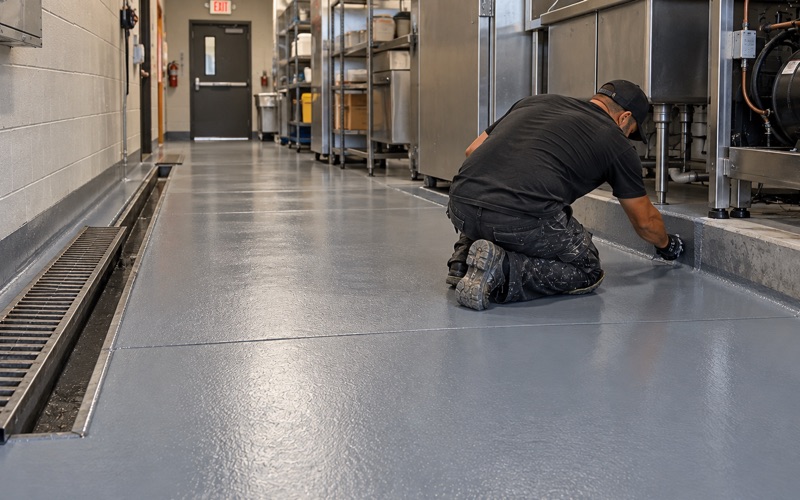
A paint bay is a containment problem before it is a coating problem. Overspray settles everywhere, wash-down is routine, and the floor has to release material rather than hold it, which argues for a tight, non-porous topcoat and an integral coved base that eliminates the floor-to-wall joint entirely.
Drainage falls, curbs and the transition into any sump have to be part of the same scope, because a coating that stops short of a detail simply relocates the failure to the edge. On this kind of work we would rather quote the details than quote a lower square-foot number and argue about them later.
Looking for epoxy flooring closer to Yucaipa? See Yucaipa Epoxy Flooring.
Contracting Work Inside the Airport Fence
Leasehold Channels Rather Than the Ordinary Commercial Market
The airport property is owned and leased by the San Bernardino International Airport Authority, a joint-powers authority holding the former Norton Air Force Base land. Tenant improvement work there is contracted through leaseholds and tenant agreements rather than through the same channels as an ordinary commercial building in the city.
Practically, that means the party who signs is often not the party who occupies, and lease language can decide who owns the floor at the end of a term. We ask early which entity is authorizing the work, because it changes the warranty conversation more than it changes the product.
Marking and Striping to the Tenant’s Own Standard
Aircraft parking limits, walkways, equipment staging and hazard zones all get marked, and the dimensions come from the operator’s own standard rather than from a federal one. It is worth saying plainly that the widely repeated claim about a required two-inch aisle stripe has no basis in the general industry standard people cite for it, which specifies neither a width nor a color.
So we ask for the tenant’s marking standard, lay it out to that, and use a striping product compatible with the base system rather than whatever traffic paint is nearby. Incompatible stripe material lifting off a cured epoxy floor is a common and entirely avoidable callback.
Static Control Only Where It Is Genuinely Specified
Static-dissipative flooring is a real category with a real test regime, and it is also one of the easiest things for a contractor to sell into a building that never asked for it. Avionics benches and specific process areas may require it. A general hangar deck usually does not.
We would rather scope it where an engineer or an insurer has specified it and leave it out everywhere else, because a dissipative system carries installation, grounding and verification requirements that a standard floor does not. Selling it as a blanket upgrade is a way to be expensive without being useful.
The Widest Slab-Era Spread in One City
A 1920s Garage Slab and a 2020s Slab in the Same Week
Of the city’s 67,108 housing units, 22,838 were built before 1960 and 5,935 before 1940, while just 334 have gone up since 2020. That spread inside one municipal boundary is the widest we work, and the two ends of it share almost no assumptions about what is under the surface.
A slab from the 1920s may be thin, unreinforced, patched with something nobody recorded, and set behind the house on a narrow drive. A recent one is flat, hard, power-troweled and often too dense for a casual prep. Neither is harder than the other; they are just different jobs that get quoted differently.
Moisture Testing Is Scope on a Third of the Residential Work
Under-slab vapor retarders were not routine before roughly the 1960s, which puts about a third of this city’s housing on slabs where moisture is a scope item rather than an optional extra. We test with ASTM F2170 in-situ relative humidity probes or ASTM F1869 calcium chloride and write the reading into the proposal before material is ordered.
We test newer garages too, because the California Residential Code exempts garages from the under-slab vapor retarder requirement and a recent pour therefore proves nothing on its own. ASTM D4263 plastic sheet is indicative only and asymmetric, since a positive result fails a slab while a negative one settles nothing, and the acceptance thresholds live in ASTM F710 rather than in the test methods.
Choosing Diamond Segment Bond Against the Slab in Front of Us
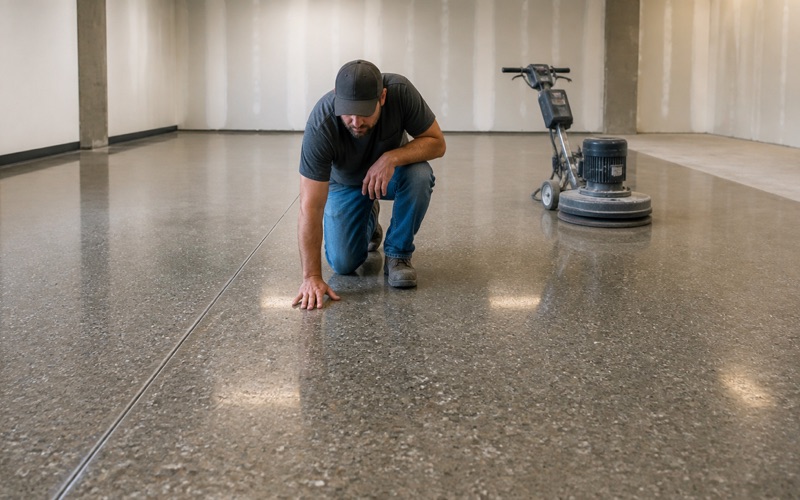
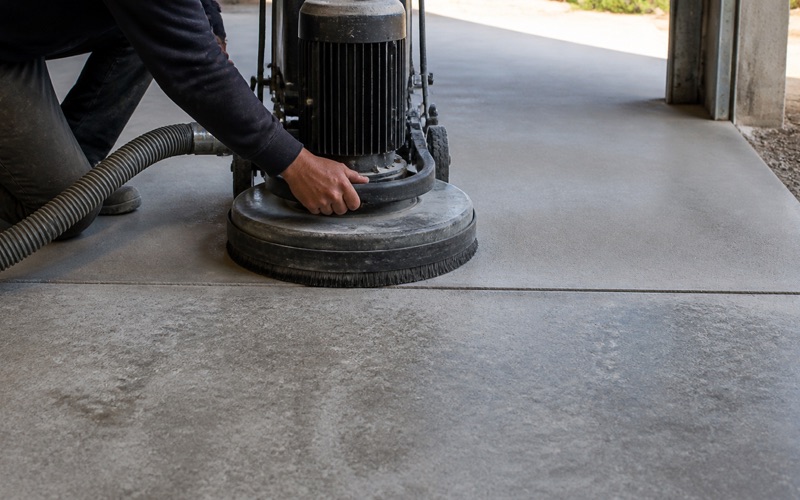
Profile gets opened by diamond grinding, never by acid etching, and the tooling is chosen against the concrete we are standing on rather than against a standard sequence. The rule is counterintuitive to most homeowners: hard concrete takes a soft bond, and a soft slab takes a hard one.
That matters a great deal in a city where a crew can meet 1940s concrete and 2010s concrete on consecutive days. Running one grit sequence everywhere either polishes a hard slab without opening it or tears an old one apart, and both outcomes cost more to fix than surveying the slab in the first place.
Who the Residential Customer Actually Is
An Exact Dead Heat on Tenure
Ownership here splits almost precisely in half: 32,092 owner-occupied units against 32,107 renter-occupied. Applied to the 40,615 single-family detached houses in the city, that leaves something on the order of twenty thousand owner-occupied detached houses as the realistic residential market.
That is a useful number precisely because it is so much smaller than the population figure a marketing page would reach for. A garage floor decision has to be made by whoever owns the property, so we plan against the owner-occupied count rather than against 222,101 residents.
Removing a Failed Coating Before Anything New Goes Down
Only about a fifth of this housing stock was built in 1990 or later, so the residential work is overwhelmingly on existing slabs, and a large share of those slabs already carry a one-part paint or a store-bought kit. That prior coating has to come off mechanically before anything new can bond.
We quote removal as its own line of work rather than folding it into a square-foot price, because the amount of it is the single biggest variable in a residential estimate. An owner who is told that up front can make a real decision; one who is not meets it as a change order.
Heat, Pot Life and a Counter That Closes Early on Friday
Inland summer heat governs cure more than anything else on the calendar. Pot life on one published product runs about 60 minutes at 55 degrees F and roughly 20 minutes at 95 degrees F, the recoat minimum collapses from 24 hours to 6, and an uninsulated slab here can approach a 160 degrees F surface maximum in July, so we read the slab rather than the air.
On the administrative side, the City of San Bernardino Building and Safety Division within Community Development and Housing is the permit authority, with its service counter on North E Street. The counter opens late on Wednesday and stops taking permit issuance sign-ins at 2:30 PM on Friday, which is worth knowing before a Friday afternoon is planned around it.
- 20+ Years Experience
- Licensed & Insured
- Free Written Estimates