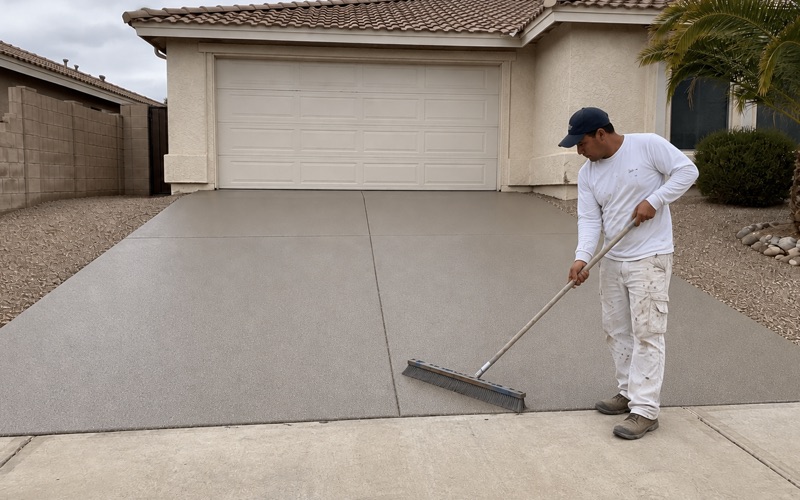
Highland Epoxy Flooring rarely quotes a single slab when we price epoxy flooring in Woodcrest. Most addresses out here have three or four worth talking about, and a contractor who measures the attached garage, writes a number and drives off has just left the larger part of the job sitting behind the house untouched.
Riverside County says as much in its own planning documents. The Lake Mathews/Woodcrest Area Plan, revised September 28, 2021, describes this community as generally characterized by lots one acre and larger, with a substantial estate residential enclave near Mockingbird Canyon Road, and every Rural Community residential designation applied here states that limited agriculture and intensive equestrian and animal keeping uses are expected.
Lot size is therefore not local color on this page. It is the reason the buildings on a parcel outnumber the buildings on a tract lot, and the reason those buildings carry duties a two-car garage never sees. We walk the whole property before we write anything down, because that is the only way the number means anything.
One Address, Several Slabs
What Is Actually Standing On an Acre
Behind the house on a parcel this size there is commonly a detached shop, a building for an RV or a boat, a barn, a tack or feed room, a covered wash rack and a pool equipment room. Not every property has all of them and we do not pretend otherwise, but the attached garage is very rarely the only coatable floor.
Each of those has a different duty cycle, a different level of exposure and often a different slab quality, poured at a different time by different hands. Treating them as one quantity at one rate produces a number that is wrong in both directions at once, over-priced on the easy rooms and badly under-priced on the hard ones.
Why We Walk the Parcel Before We Price It
The walk is where the surprises live. A shop slab may have been placed on grade without the finish a house slab got; a wash rack may have a drainage fall nobody has looked at in twenty years; a barn aisle may have been patched three times with three different materials. None of that is visible from the driveway.
We record what each slab is, what it does, what has already been put on it and what condition it is in, and the proposal comes back as separate scopes rather than one blended rate. That lets an owner take two buildings now and two later without renegotiating anything, which is how most of these jobs actually happen.
Two Eras of Substrate On the Same Street
The housing here splits cleanly. About 3,034 of 4,954 units, 61.2 percent, were built before 1980, with the 1970s and 1980s each contributing more than a thousand units. Those slabs are forty-five to fifty-five years old and carry settlement cracking, joint spalling and deeply soaked oil.
Against that, 1,475 units, 29.8 percent, were built in 2000 or later, and only 274 units predate 1960. On the newer stock the slab is usually sound and the sale is finish rather than repair. On any pre-1970 house, and on any barn or shop slab poured to agricultural rather than residential practice, moisture testing goes into scope.
Looking for epoxy flooring closer to Beaumont? See Beaumont Epoxy Flooring.
A Workshop Floor Is Not a Garage Floor
Point Loads and Dropped Steel
A working shop puts weight through jack stands, engine hoist casters and equipment feet, which concentrates load into contact patches a passenger tire never produces. A film specified for tires and foot traffic will indent, and once the surface has been pressed the coating has lost its bond in exactly the place it is being worked hardest.
Dropped tools are the other half of it. Impact resistance is a function of build and of the resin’s toughness rather than of gloss, and a shop floor that gets a garage specification chips at every point where a wrench has landed. We size the system to the duty rather than to the room’s square footage.
Welding Spatter, Solvent and Hydraulic Fluid
Hot spatter is a thermal insult that most thin films simply cannot take, and it arrives in the same few square feet again and again because that is where the bench is. Where welding happens we either specify a system that tolerates it or we leave that zone out and say so, which is more honest than coating it and waiting.
Chemical exposure is continuous rather than accidental in a shop. Solvent, brake cleaner, hydraulic fluid and gear oil sit on a floor overnight instead of being wiped in a minute, and resistance to those is a published property of a product rather than something a contractor can promise generically. We match the product to what is actually being spilled.
Build, Profile and Topcoat Chosen For the Duty
All of that translates into three decisions. The mil build goes up, the mechanical profile goes more aggressive because a thicker system needs more key, and the topcoat is chosen for abrasion and chemical resistance rather than for how it photographs under a phone light.
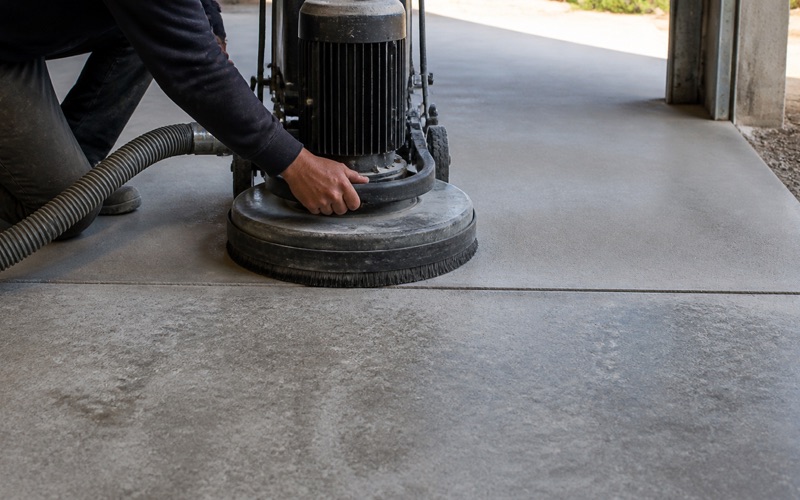
Profile gets named rather than described. We open it with diamond grinding to a specific ICRI concrete surface profile, on a scale that runs CSP 1 through CSP 10, and the number appears on the proposal so it can be checked against what the manufacturer requires. Acid etching does not produce that key and we do not use it.
Barn Aisles, Wash Racks and Standing Water
What a Barn Floor Actually Takes
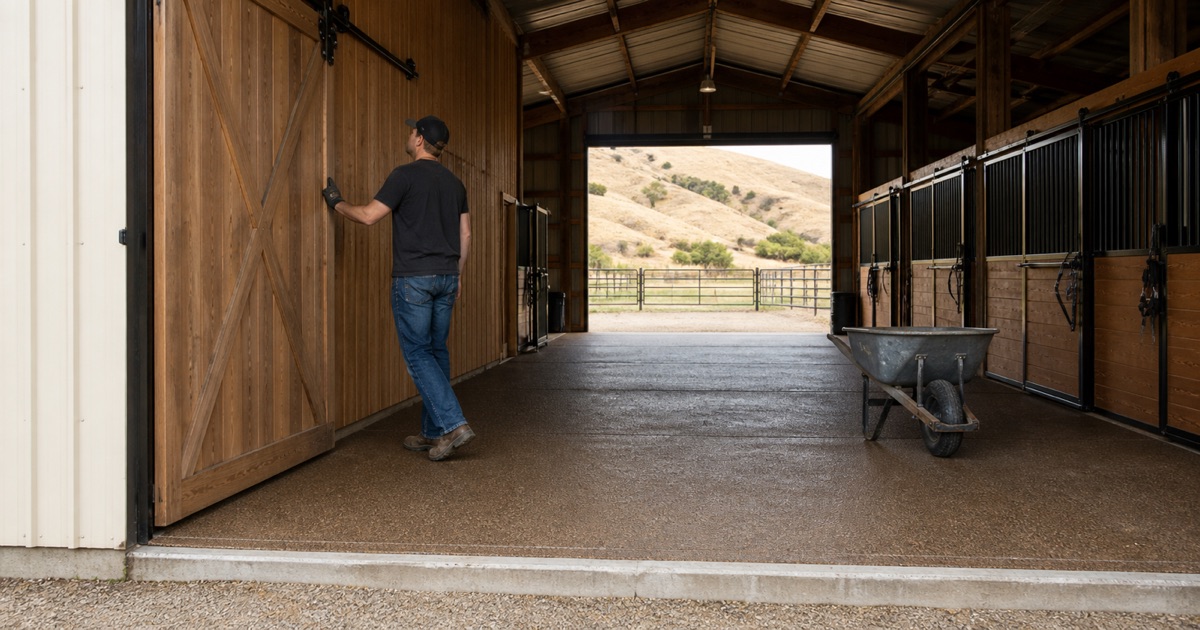
Hoof traffic is a point load with a steel shoe on it, and it arrives thousands of times a day in the same aisle. Add urine and manure, which are chemically aggressive and sit in place, and daily wash-down that keeps the surface wet for hours, and the duty on a barn slab has almost nothing in common with a garage.
Wash racks are worse again, because they combine standing water with detergent and constant abrasion from grooming. The question there is not only what the coating survives but where the water goes, so drainage falls and how the coating terminates at a drain are part of the specification rather than an afterthought.
Slip Resistance, Coving and Termination Details
Slip resistance on those floors gets specified as a DCOF value achieved through a deliberate aggregate broadcast, not assumed from the texture a squeegee happens to leave. Wet concrete under a shod hoof is a genuine hazard, and the aggregate that fixes it is also the aggregate that makes the floor harder to clean, so the balance gets discussed rather than defaulted.
An integral coved base at the wall junction is usually worth the money in a building washed daily, because it removes the joint where water gets in behind the coating and lifts it. The same logic applies at posts, door thresholds and drain edges, and those details are where a barn floor is won or lost.
Moisture Under an Agricultural Pour
A barn or shop slab poured to agricultural practice is a different animal from a house slab, and the vapor retarder underneath it is an open question rather than an assumption. We test to ASTM F2170 with in-situ relative humidity probes at forty percent of slab depth, or ASTM F1869 where a surface emission rate is what the specification wants.
Neither method carries its own pass mark; those thresholds are published in ASTM F710. The taped plastic sheet of ASTM D4263 is a field indicator only, meaningful when it condenses and worth nothing at all when it comes up dry. The reading is written into the proposal before material is ordered, because moisture failure is what most coating warranties exclude.
The Barn Is Legally Residential, and Getting the Rig To It
Rule 1113 (c)(6) On a Residentially Zoned Parcel
Rule 1113 at South Coast AQMD allows a floor coating 50 g/L of VOC content and an industrial maintenance coating 100 g/L, and by that rule’s own definitions the two categories exclude one another rather than sitting on a spectrum. That district covers the non-desert portion of Riverside County, so those are the limits that apply on every parcel out here.
Subsection (c)(6) then prohibits applying, or soliciting the application of, industrial maintenance coatings for residential use. A barn or a workshop on a residentially zoned parcel is residential property no matter how industrial the wear on its floor is, so the 50 g/L category governs and the 100 g/L category is not available to us there. That is a legal boundary, not a preference.
What We Do Instead of Reaching For the Wrong Category
Working inside the residential category is not a limitation on quality, and treating it as one is how contractors talk themselves into a violation. The levers that actually matter on a hard-wear floor are build thickness, profile, aggregate loading and topcoat selection, and all four are available without leaving the compliant category.
We quote residential and commercial work from separate product lines specifically so this never becomes a field decision made under time pressure. If a scope genuinely sits on the commercial side we say so and price it that way, and if it does not, the conversation stops there rather than continuing into an offer we are not permitted to make.
Mobilization Is a Priced Line, Not an Afterthought
Getting a planetary grinder, a dust extractor and a generator to a building sited well behind the house is a materially different operation from backing a trailer up a tract driveway. Long drives, gates set back from the road, surfaces that are not always paved and outbuildings hundreds of feet from the curb all cost real time before any work starts.
Three-phase power is unlikely on a rural residential parcel, so larger equipment usually runs on a generator or on single-phase machines, and that is a planning assumption we confirm rather than a certainty. Permits and inspections run through Riverside County Building & Safety at 4080 Lemon Street in Riverside, with applications filed through the county’s online portal.
- 20+ Years Experience
- Licensed & Insured
- Free Written Estimates