Highland Epoxy Flooring quotes epoxy flooring in Yucaipa off the decade the slab was poured rather than off a square-foot price sheet, and after more than 20 years in this trade that habit is what separates a bid that holds from one that unravels on the second morning. The garage in front of us decides the scope, not an average.
That matters more here than in most places because no single build era dominates. The housing stock is spread almost evenly across the 1960s, the 1970s and the 2000s, and a substantial block of it is still standing from before 1950. Three genuinely different jobs coexist inside one boundary, and they do not share a prep sequence or a price.
So the first visit is a measurement visit. We look at what coating is already down and how it is bonded, we test the slab for moisture whatever its age, and we grind a small test area to see how the concrete gives up material. Only after that does a product get named on paper.
Three Garage Eras Under One City Boundary
A 1960s or 1970s Two-Car Attached Bay
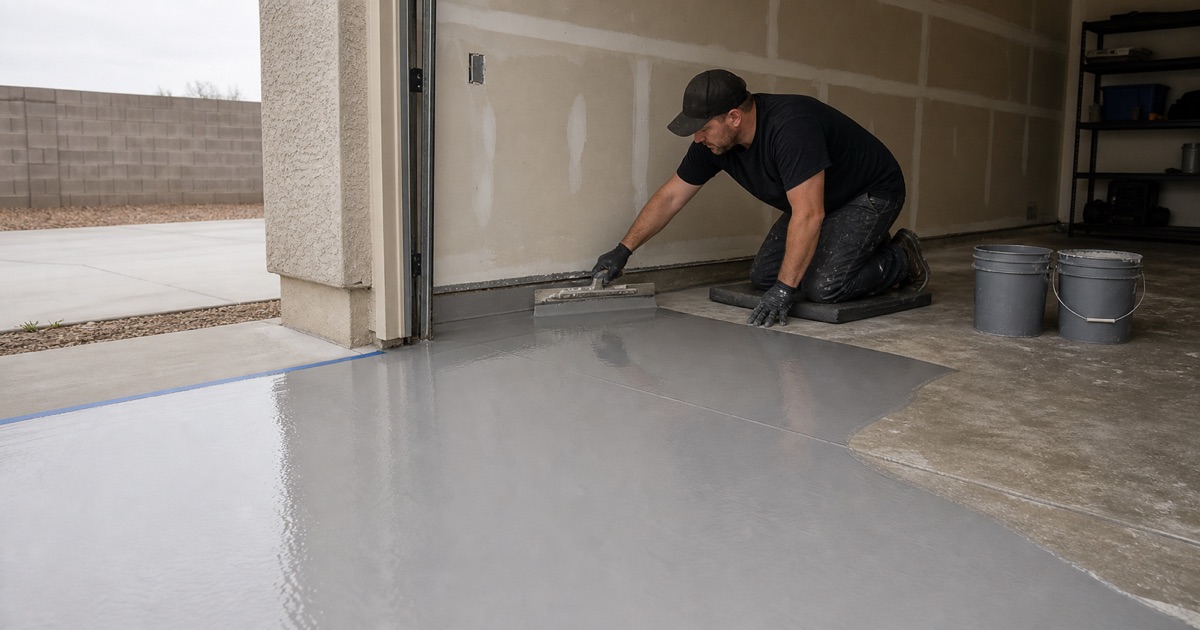
About 6,646 units date to those two decades, which makes this the most common single conversation we have in the city. The slab is 50 to 65 years old, usually attached to the house, usually with a control joint or two that have opened up, and very often carrying a coat of something already.
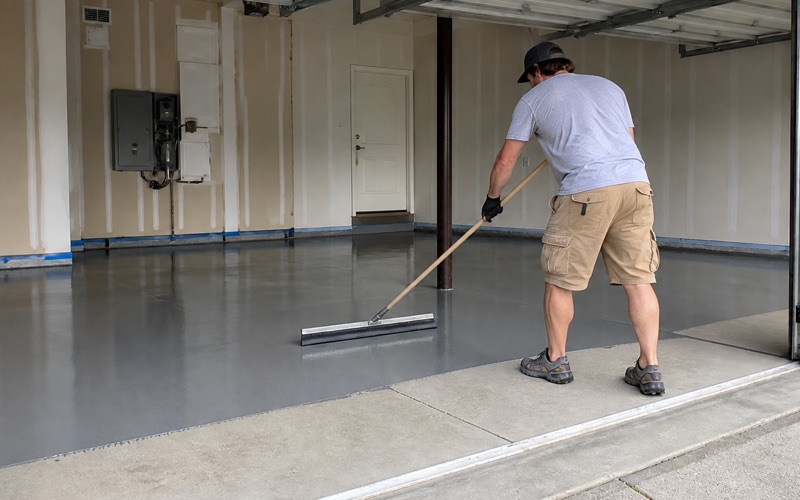
What is already down is the variable that moves the price. A one-part paint or a store-bought kit has to come off mechanically before a new system bonds to anything, so removal is quoted as its own line of work rather than buried inside a square-foot rate and hoped for. Two bays on the same street can differ by a full day of grinding on that basis alone.
A 2000s Three-Car Tract Garage
The 2000-2009 decade accounts for 3,692 units, the largest single block in the city, and a good share of those bays have never been coated at all. A clean 15 to 25 year old slab is the most straightforward job on this list, but straightforward is not the same as automatic. What it buys the owner is a longer working life out of the system, not a cheaper afternoon.
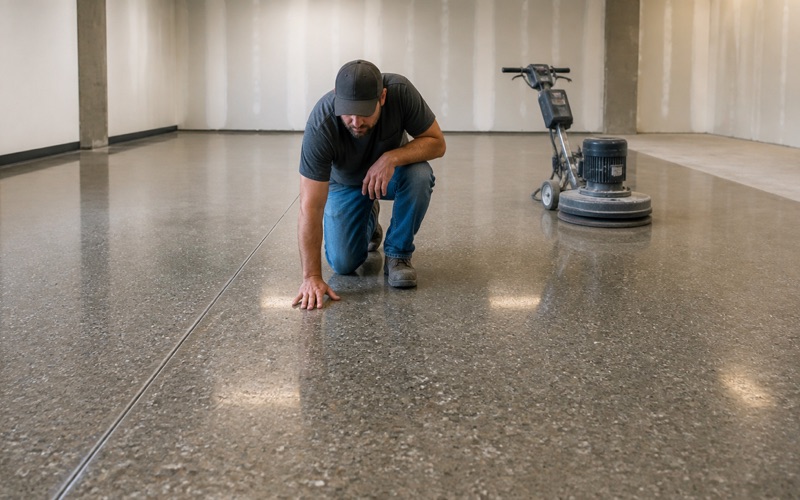
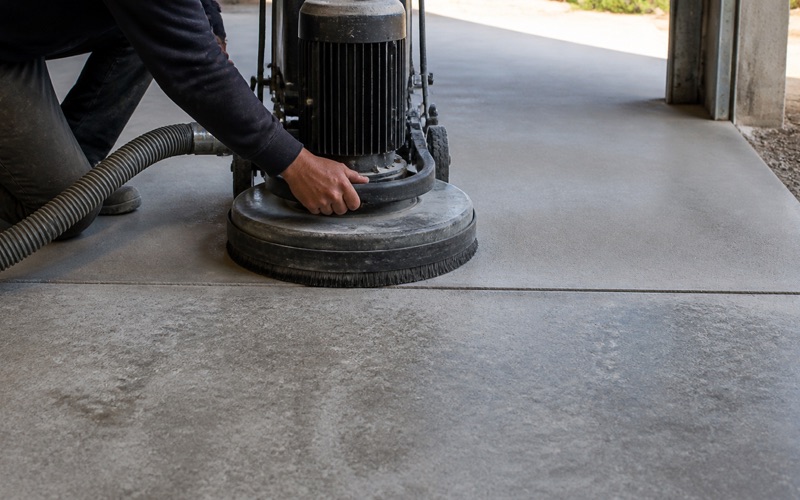
Those slabs were power-troweled hard and tight, so the grind has to open a real mechanical profile rather than simply dust the surface. We name the ICRI concrete surface profile we are cutting to, typically CSP 3 or CSP 4 depending on the system going down, and we cut to it with diamond tooling rather than acid.
A Pre-1950 Detached Garage on an Original Valley Lot
The 1,751 units predating 1950 usually come with a detached garage, often narrow, sometimes built without any of the drainage detailing a modern bay takes for granted. Whether there is usable power at the building is a real question to settle before a grinder comes off the trailer. Rig staging is planned in advance on the sloping foothill lots and split-level driveways common in the older and eastern tracts.
These are the slabs where we slow down. Edges crumble, old patches let go, and the concrete under a soft surface skim is frequently harder than it looks, which changes the diamond segment bond we run. Hard concrete takes a soft bond, and that call gets made on the floor rather than in the office.
Looking for epoxy flooring closer to Lake Arrowhead? See Epoxy Flooring in Lake Arrowhead.
Prep Is Where the Three Jobs Diverge
Taking Off a Failed Kit Before Anything Else
Garages built through the 1980s, 1990s and 2000s very often already carry a one-part paint or a big-box kit, and those coatings fail at the bond line rather than from wear. Grinding one off is slow, dusty and entirely predictable work, which is exactly why it belongs on the estimate as its own item.
We would rather hand a homeowner two numbers, removal and then the new system, than one number that quietly assumes the old floor lifts easily. When it does not lift easily, that assumption turns into a change order halfway through the day, and nobody enjoys that conversation.
Opening the Profile With Diamond Tooling
Every slab gets its mechanical profile opened by diamond grinding to a named ICRI concrete surface profile. Acid etching does not produce a consistent profile, it leaves residue down in the pores, and it is not something we will put under a floor we are warranting.
The grit sequence is chosen against the slab in front of us rather than run from habit. A soft 1940s pour and a hard 2005 tract pour will not answer to the same segment, so we cut a test area first, read how the tooling loads, and set the sequence from what the concrete actually does. Running one grit sequence on every job is faster to schedule and worse to live with.
Measuring Moisture on Every Slab, Whatever Its Age
The California Residential Code exempts garages from the under-slab vapor retarder requirement, which means a newer slab proves nothing on its own. Every garage we quote gets a moisture test, and the reading goes into the written proposal before any material is ordered, because moisture failure is the one thing most coating warranties exclude.
ASTM F2170 in-situ relative humidity probes read a state inside the slab at 40 percent of its depth, while ASTM F1869 calcium chloride reads a moisture vapor emission rate at the surface. The pass and fail numbers live in ASTM F710 rather than in either test method, and an ASTM D4263 plastic sheet is indicative only: a positive fails a slab and a negative proves nothing.
Slab Temperature Sets the Calendar at 2,600 Feet
Summer Pot Life, Winter Cold Slabs
Yucaipa sits at roughly 2,600 feet, with published July and August highs around 96 to 97 degrees F against January and February lows near 40 to 41 degrees F. Both ends of that range are operationally real. A hot slab drives pot life toward the short end of the published curve and changes batch size, crew size and start time.
In winter the problem runs the other way. An unheated garage can sit below the temperature a chemistry needs to develop its stated properties, and a coating that never reaches cure temperature does not simply cure slowly. Here the season decides the product, not only the day.
Placing on a Rising Slab, Never a Falling One
The diurnal swing at this elevation is the underrated part of the work. A slab that is comfortably warm at two in the afternoon can already be cooling by six, and cooling concrete pushes outgassed air up into a wet film that has not yet set. The film is still open, so the air has somewhere to go.
That is what produces pinholes and bubbles in a foothill garage and rarely in a coastal one. We place onto a rising or steady slab temperature, read surface temperature and dew point on the day, and move the date when the numbers say to rather than when the calendar says to.
Rule 1113 Draws a Legal Line Through the Product List
South Coast Air Quality Management District Rule 1113 sets the two numbers that decide the product: 50 g/L VOC for a floor coating and 100 g/L for an industrial maintenance coating, with the definitions written so that nothing qualifies as both. Subsection (c)(6) then bars an industrial maintenance coating from residential use, and bars soliciting one as well.
So the two halves of our work are estimated off two different catalogs. A workshop or a barn on a residentially zoned parcel is a residential property under that rule however industrial the wear on its floor, and we would rather say so plainly than write around it. The category is decided per job, in writing, before an order goes in.
Sizing This Market Honestly
10,684 Owner-Occupied Detached Houses
The addressable residential pool here is 10,684 owner-occupied single-family detached units, published directly rather than inferred from anything. That is genuine volume, and it is the reason a crew can hold a standing route in this city instead of treating it as an occasional drive out.
It changes what we can offer as well as how often we come. Enough work in one place means tighter scheduling windows, a shorter wait when a floor needs a return visit, and the ability to hold a date rather than batching a trip until enough jobs stack up. It also means a warranty visit is a short drive rather than an expedition, which is part of why we state warranty exclusions in writing instead of leading with a headline number.
The 3,816 Units That Do Not Have a Garage
Roughly one in five housing units here, 3,816 out of a citywide 19,248, is a manufactured home, and those carry a carport rather than a garage slab. That is not a rounding error, and it is the reason we never size this market off population or off a raw housing-unit count.
Working from the total unit count overstates the coatable garage stock by about a fifth. We would rather quote against the number that describes real floor area than against a number that flatters the territory on a map. The same discipline applies when a customer asks how quickly we can get out here.
Commercial Floor Carrying a Yucaipa Address
The city holds genuine high-cube industrial inside its own boundary rather than beside somebody else’s. Pacific Oaks Commerce Center runs roughly 2,054,801 square feet on about 312.91 gross acres at 32335 Live Oak Canyon Road, with Brookfield Commerce Center at roughly 363,000 square feet and the 59,200 square foot Sorenson manufacturing facility alongside it.
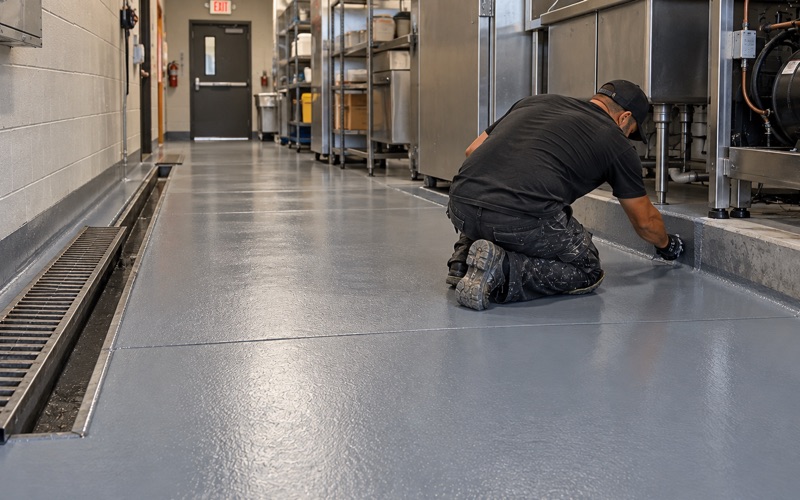
Those are approved and under development rather than occupied floor, and we describe them that way. The commercial work buying coatings today is smaller and steadier, running to quick-service kitchens, a car wash tunnel, self-storage and medical suites, all of it specified on cleanability, integral coved base and DCOF slip resistance rather than on any federal product approval, because no such list exists.
- 20+ Years Experience
- Licensed & Insured
- Free Written Estimates